
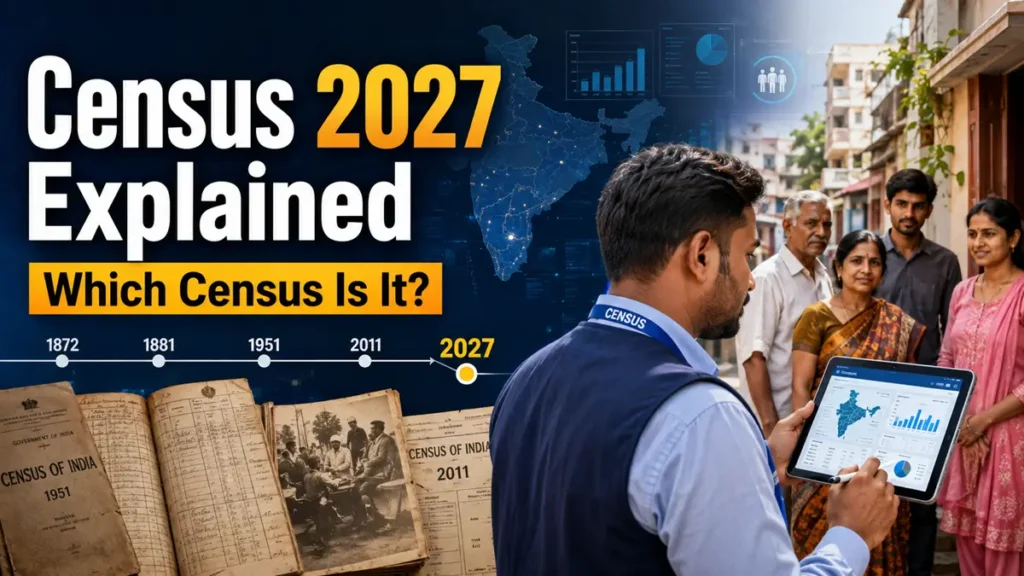
Census 2027 explained with important facts, Census years, phases, caste enumeration, reference dates and historical background for UPSC, PCS, SSC, banking, railway and other government exams.
Introduction to Census 2027
Census 2027 is an important national exercise that will provide updated demographic, social and economic information about India. The upcoming census is particularly significant because India’s last population census was conducted in 2011, while the census scheduled for 2021 was postponed. The Government of India has now planned the exercise in two phases, making it an important topic for UPSC, State PCS, SSC, banking, railway, defence and other government examinations.
Which Census Is Census 2027?
Census 2027 will be the 16th Census of India and the 8th census after Independence. India has maintained a regular decennial census tradition since 1881, although earlier population-counting exercises were conducted during British rule. The 2011 Census was the 15th census of India and the seventh after Independence.
Census 2027 Will Be Conducted in Two Phases
The Census 2027 exercise is being conducted in two major phases. The first phase covers House Listing and Housing Census, while the second phase involves Population Enumeration. The first phase began in April 2026 and is scheduled across States and Union Territories. Population Enumeration will take place in February 2027 for most of the country.
Population Enumeration and Reference Date
The reference date for Population Census 2027 is 00:00 hours on 1 March 2027 for most of India. However, Ladakh and the non-synchronous snow-bound areas of Jammu and Kashmir, Himachal Pradesh and Uttarakhand will follow an earlier reference date of 1 October 2026 because of difficult climatic and geographical conditions.
Caste Enumeration in Census 2027
One of the most significant features of Census 2027 is the inclusion of caste-related information during the population enumeration phase. The comprehensive collection of caste data is particularly important because such information has not been included in the decennial population census for all communities since 1931, although Scheduled Castes and Scheduled Tribes have continued to be enumerated.
Digital and Self-Enumeration Features
Census 2027 is also notable for its increased use of digital technology. The census infrastructure provides for self-enumeration, allowing eligible residents to submit information digitally before the official enumeration process. This marks an important technological development in India’s census history and is relevant for examination questions on e-governance and digital public administration.
What Information Will Be Collected?
The population enumeration schedule contains questions covering demographic and socio-economic characteristics. The notified questionnaire includes information relating to caste, religion, education, employment, migration and other household and individual details. Reports on the notified schedule also indicate questions concerning identity documents, bank accounts and COVID-19 vaccination-related information.
Census 2011 and the Delay in Census 2021
The 2011 Census remains the latest completed decennial population census of India. The next census was scheduled for 2021 but was postponed during the COVID-19 pandemic. Consequently, Census 2027 assumes greater importance because it will provide the country with a comprehensive, updated demographic database after a longer-than-usual interval.
Why Census Data Matters for Governance
Census data is essential for evidence-based public administration. Governments use population and socio-economic information to support planning for education, healthcare, housing, infrastructure, employment, welfare programmes and other public services. Census tables are also used for demographic analysis and comparison across different census years.
Important Census Years for Government Exams
Students should remember the major milestones in India’s census history. The first modern population census exercise is associated with 1872, while the first synchronous all-India census was conducted in 1881. Subsequent censuses were held every ten years, including 1891, 1901, 1911, 1921, 1931 and 1941. After Independence, censuses were conducted in 1951, 1961, 1971, 1981, 1991, 2001 and 2011.
Census 2027: Important Exam Perspective
For competitive examinations, aspirants should remember the distinction between the first census exercise in 1872 and the first regular synchronous census in 1881. They should also remember that 2011 was the latest completed census before Census 2027 and that Census 2027 is the 16th Census of India. The addition of comprehensive caste enumeration and the use of digital and self-enumeration mechanisms make this census particularly important for current affairs preparation.
Why This News Is Important: Census 2027
Importance for Government Examinations
Census 2027 is a high-value current affairs topic because it connects population statistics with governance, public policy, social justice and administrative planning. Questions related to the Census of India frequently appear in UPSC, State PCS, SSC, banking, railway, defence and teaching examinations. Aspirants should therefore understand both the current developments and the historical background of India’s census system.
Importance for Public Policy
A census provides a comprehensive demographic picture of the country. Updated information on population characteristics, education, employment, migration, housing and other socio-economic indicators can help governments design and evaluate welfare programmes and public services. Census data therefore plays an important role in evidence-based policymaking.
Importance of Caste Enumeration
The decision to include comprehensive caste information makes Census 2027 particularly significant. Caste data can provide policymakers with updated information about India’s social composition and may contribute to discussions concerning social welfare, representation and affirmative-action policies. It is also historically important because comprehensive caste enumeration has not been part of the decennial census for all communities since 1931.
Importance of Digital Census
The use of self-enumeration and digital systems represents an important modernization of the census process. It can improve data collection and administrative efficiency while reducing dependence on entirely paper-based procedures. For students, this development is relevant to questions concerning digital governance and the modernization of public administration.
Importance of Updated Demographic Data
The gap since the 2011 Census makes updated population information especially important. Census 2027 will provide a new nationwide demographic dataset that can support planning for the coming years. For exam aspirants, remembering the census number, reference date, phases, caste enumeration and historical census milestones is particularly important.
Historical Context of the Census of India
Early Census Exercises
Population-counting exercises were conducted in different parts of India before the establishment of a regular all-India census. The first modern population census exercise is generally associated with the period between 1865 and 1872. The 1872 exercise is therefore an important milestone in the history of Indian census-taking.
Beginning of the Synchronous Census
The 1881 Census marked the beginning of the regular synchronous decennial census tradition in India. From this point, population censuses were generally conducted every ten years, creating a continuous historical series useful for demographic comparisons.
Census During British India
Regular censuses were conducted in 1891, 1901, 1911, 1921, 1931 and 1941. The 1931 Census is particularly important in discussions about caste because it was the last decennial census before Independence to comprehensively enumerate caste across the population.
Census After Independence
After Independence, India continued the decennial census system. The post-Independence censuses were conducted in 1951, 1961, 1971, 1981, 1991, 2001 and 2011. The 1951 Census was the first census conducted in independent India.
Census 2011
The 2011 Census was India’s 15th Census and the seventh after Independence. It remains the latest completed population census because the exercise scheduled for 2021 was postponed.
Census 2027
Census 2027 represents the next major milestone in this historical sequence. It will be India’s 16th Census and the eighth after Independence. The exercise introduces important contemporary features, including digital processes, self-enumeration and comprehensive caste enumeration during the population enumeration phase.
Key Historical Sequence
For examination preparation, the most important sequence to remember is: 1872 – first modern census exercise; 1881 – first regular synchronous census; 1931 – last comprehensive caste census before Independence; 1951 – first census of independent India; 2011 – latest completed census before the upcoming exercise; 2027 – 16th Census of India.
FAQs: Census 2027
1. What is Census 2027?
Census 2027 is India’s upcoming decennial population census. It will be the 16th Census of India and the 8th Census after Independence.
2. When was the last Census conducted in India?
The last completed Census of India was conducted in 2011. The census scheduled for 2021 was postponed.
3. Which was the first synchronous Census of India?
The 1881 Census was the first regular synchronous all-India census.
4. What was the first Census exercise in India?
The first modern census exercise is generally associated with 1872, although it was not conducted synchronously across the entire country.
5. How many censuses have been conducted in India after Independence?
Censuses were conducted after Independence in 1951, 1961, 1971, 1981, 1991, 2001 and 2011—seven completed post-Independence censuses. Census 2027 will be the eighth.
6. Why is Census 2027 particularly significant?
It will provide updated demographic and socio-economic information after the long gap since 2011. It is also significant because comprehensive caste enumeration is being included.
7. When will Population Enumeration take place in Census 2027?
For most of India, Population Enumeration is scheduled for February 2027, with 00:00 hours on 1 March 2027 as the reference date.
8. Are all areas following the same Census reference date?
No. Ladakh and certain snow-bound areas of Jammu & Kashmir, Himachal Pradesh and Uttarakhand will follow an earlier reference date of 1 October 2026 because of climatic conditions.
9. What are the two major phases of Census 2027?
The two major phases are House Listing and Housing Census and Population Enumeration.
10. What is a major technological feature of Census 2027?
Census 2027 incorporates digital processes and self-enumeration, representing an important shift toward technology-enabled census operations.
Some Important Current Affairs Links

