

Bima Sakhi Yojana 2025: LIC and the Rural Development Ministry sign MoU to empower SHG women as rural LIC agents under a stipend-based model to enhance financial inclusion in India.
LIC, Rural Development Ministry Join Forces to Launch Bima Sakhi Yojana in Rural India
Introduction: Empowering Rural Women Through Insurance Access
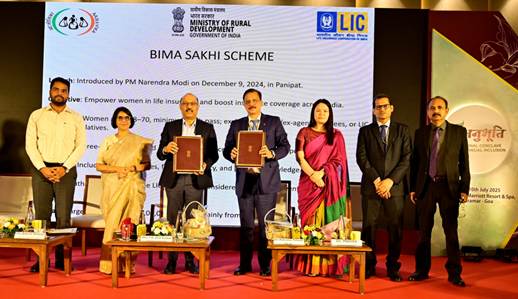
The Government of India is taking a major stride toward financial inclusion by formalizing a partnership between the Ministry of Rural Development and Life Insurance Corporation of India (LIC). A Memorandum of Understanding (MoU) was signed at the Anubhuti National Conclave on Financial Inclusion, held in Goa from July 8–10, 2025 This collaboration aims to roll out the Bima Sakhi Yojana nationwide, where trained rural women, especially Self‑Help Group (SHG) members, will be recruited as grassroots LIC agents—called Bima Sakhis—to expand insurance outreach and foster community trust
How the Bima Sakhi Initiative Works
Under the scheme, selected women will serve as performance‑oriented, stipendiary LIC agents, receiving the full range of LIC agent benefits. Additionally, they will be eligible for fixed monthly stipends—₹7,000 in the first year, ₹6,000 in the second, and ₹5,000 in the third year—subject to specified conditions Drawing parallels with the DAY‑NRLM mission objectives, the scheme aligns seamlessly with the National Rural Livelihood Mission in promoting rural income enhancement and women empowerment
Strategic Objectives and Nationwide Impact
The initiative intends not only to deeply integrate insurance coverage across rural India but also to foster economic self-reliance among SHG women. Bima Sakhis will play a dual role: guiding villagers on financial protection and insurance choices, while also earning a sustainable income. The government and LIC plan to scale this model through collaboration with state governments, skill development agencies, and local panchayats, turning the scheme into a significant rural empowerment movement
Benefits to Stakeholders
- Rural households gain access to localized and affordable insurance awareness and services.
- Women benefit financially through stipulated agency careers and empowerment.
- LIC expands reach, strengthening insurance penetration in underserved areas.
- Economic inclusion deepens, in line with the Atmanirbhar Bharat vision and “Insurance for All by 2047” initiative
In summary, this MoU represents a strategic merging of social policy and corporate capability, aiming to uplift rural livelihoods through women-led financial inclusion.
B) Why This News Is Important
Alignment with Exam-Relevant Themes
For exam aspirants across PSCs, banking, railways, defence, and civil services, this news is crucial because it touches on women empowerment, rural development, financial inclusion, and flagship government initiatives—all important GA/topic areas.
Policy and Institutional Insight
The MoU shows how two major institutions—the Ministry of Rural Development and LIC—can collaborate to implement large-scale public welfare schemes. Understanding the policy mechanisms behind such partnerships and schemes helps candidates in questions on governance, public administration, and economic schemes.
Implications for Rural Economy
With structured stipends and roles for women in SHGs, the initiative promotes income augmentation and entrepreneurship at the grassroots. Such steps are central to the upgradation of rural livelihoods—an essential discussion point in aspirants’ preparation across sectors.
C) Historical Context
Evolution of Financial Inclusion in India
Over the past two decades, India has significantly promoted financial inclusion through initiatives like PMJDY, MUDRA loans, and RBI-led banking reforms. Despite progress, insurance penetration in rural areas has remained low, especially among women.
Precedents in Women-Led Schemes
Schemes like Self‑Help Groups under DAY‑NRLM, Mahila Kisan Sashaktikaran Pariyojana, and Women SHGs involvement in microfinance have aimed at economic upliftment of women. Aligning Bima Sakhi Yojana with these missions creates policy coherence.
Atmanirbhar Bharat & Insurance for All 2047
Prime Minister Modi’s vision of Insurance for All by 2047 and Atmanirbhar Bharat underline the strategic importance of enabling women to work as LIC agents, expanding outreach while fostering self-reliance at a community level.
D) Key Takeaways from LIC‑Rural Development MoU on Bima Sakhi Yojana
| S. No. | Key Takeaway |
|---|---|
| 1 | The MoU was signed on July 21, 2025 at the Anubhuti Conclave in Goa (July 8–10, 2025) between LIC and the Ministry of Rural Development |
| 2 | Bima Sakhi Yojana appoints rural women from SHGs as stipendiary LIC agents, offering full benefits and support |
| 3 | Agents receive ₹7,000/month in year 1, ₹6,000 in year 2, and ₹5,000 in year 3, subject to conditions |
| 4 | Scheme aligns with Deendayal Antyodaya Yojana – NRLM, supporting rural livelihoods and women’s empowerment |
| 5 | Aims to strengthen insurance penetration in rural areas, provide additional household income, and support national goals like Insurance for All by 2047 and Atmanirbhar Bharat |
Frequently Asked Questions (FAQs)
1. What is the objective of the Bima Sakhi Yojana?
The main objective is to promote financial inclusion by appointing trained SHG women as LIC agents in rural areas to spread insurance awareness and services.
2. Who are eligible to become Bima Sakhis under this scheme?
Only SHG (Self-Help Group) women under the DAY-NRLM (Deendayal Antyodaya Yojana – National Rural Livelihoods Mission) are eligible to be trained and engaged as Bima Sakhis.
3. What are the stipend benefits under the Bima Sakhi scheme?
Bima Sakhis will get a monthly stipend of ₹7,000 in the first year, ₹6,000 in the second year, and ₹5,000 in the third year, subject to performance-based conditions.
4. Which ministries or institutions are involved in this MoU?
The Ministry of Rural Development (MoRD) and the Life Insurance Corporation of India (LIC) have signed the Memorandum of Understanding (MoU) for this initiative.
5. When and where was this MoU signed?
The MoU was signed during the Anubhuti National Conclave on Financial Inclusion, held in Goa from July 8 to July 10, 2025.
6. How does this scheme support government exam topics?
It links directly with key topics such as women empowerment, financial inclusion, rural development, and government schemes like DAY-NRLM—frequently covered in exams like UPSC, PSCs, banking, SSC, and teaching.
7. What is the vision behind “Insurance for All by 2047”?
It is a government initiative aimed at ensuring every Indian has access to basic insurance coverage by the centenary of India’s independence.
Some Important Current Affairs Links

