
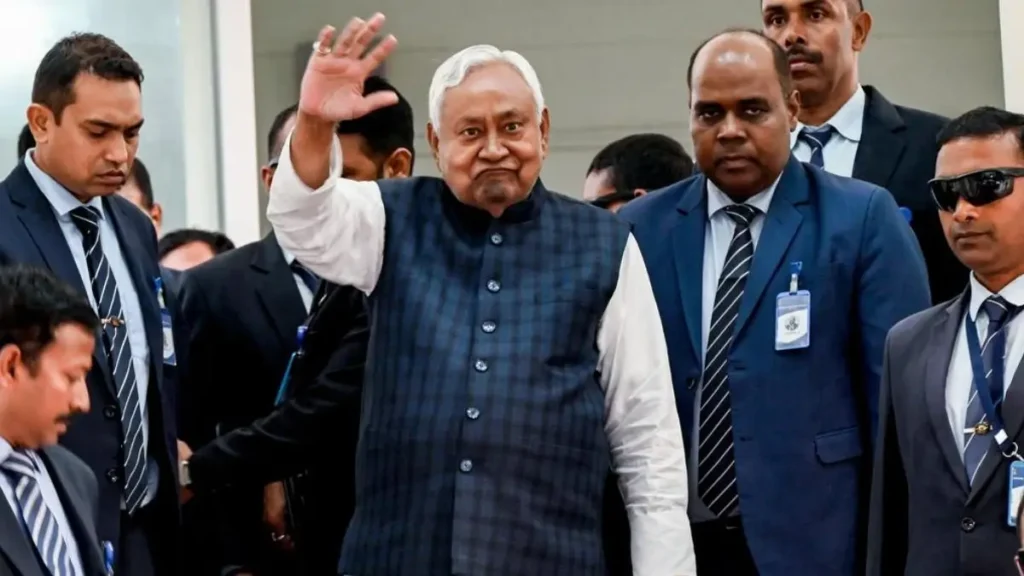
Nitish Kumar sworn in as Bihar CM for the tenth term in 2025. Learn about NDA’s historic win, government priorities, and key developments in Bihar politics for competitive exams.
Nitish Kumar Sworn‑In As Bihar CM For Historic Tenth Term
Record Milestone As Bihar’s Leadership Enters A New Phase
On 20 November 2025, Nitish Kumar took oath as the Chief Minister of Bihar for an unprecedented tenth term following the sweeping victory of the National Democratic Alliance (NDA) in the state assembly elections.
The election delivered a strong mandate with the NDA securing 202 out of 243 seats, while the rival Mahagathbandhan could muster only 35 seats.
The swearing‑in ceremony, held at the historic Gandhi Maidan in Patna, saw the attendance of several top national leaders, signalling the union of state and central stage political priorities.
Ceremony At Gandhi Maidan Signals Momentum
The event commenced at approximately 11:30 AM at Gandhi Maidan and was marked by high security and pomp owing to the presence of a distinguished guest list.
Among the dignitaries were Narendra Modi (Prime Minister of India), Amit Shah (Union Home Minister), J.P. Nadda (BJP President), and several chief ministers from other states including Devendra Fadnavis, N. Chandrababu Naidu and Bhupendra Patel.
This large gathering underlines the significance of the event both within Bihar and at the national level.
Composition Of The New Government – A Democratic Alliance
Following the election results, the new government has been structured to reflect the alliance dynamics. Two deputy chief ministers were appointed, strengthening the role of the Bharatiya Janata Party (BJP) in the state administration:
- Vinay Kumar Sinha (reappointed)
- Samrat Choudhary (new)
Additionally, leading figures from the Janata Dal (United) [JD(U)] such as Leshi Singh, Madan Sahni and Ram Kripal Yadav were sworn in as state ministers, indicating the coalition’s attempt to balance experience, regional representation and political heft.
Strategic Priorities For The Term Ahead
With this tenth term, Nitish Kumar’s government has laid out clear priority areas:
- Accelerated development projects across the state — infrastructure, connectivity, and rural development.
- Enhanced social welfare, particularly in rural and under‑served areas, tying in with broader central‑state initiatives.
- Strengthening law and order and governance systems to ensure stability and investor confidence.
- Boosting job creation and economic growth by leveraging the strong mandate and coalition stability.
Outlook & Implications For Bihar And Beyond
This leadership continuity in Bihar offers both opportunities and challenges. On one hand, continuity may ensure predictable governance and expedite projects stalled by political instability. On the other, the government will need to demonstrate fresh momentum to meet rising expectations from the electorate. For students of competitive exams — especially those focusing on state governance, public administration, polity and current affairs — this event underscores how state elections, coalition dynamics, and leadership changes impact policy and administration in large states like Bihar.

Why This News Is Important
Significance For State Governance And Policy Stability
The appointment of Nitish Kumar to a tenth term as Chief Minister is significant because it provides a unique instance of political continuity in India’s vibrant state democratic system. Stability in leadership can translate into consistent policy implementation, especially in critical sectors such as infrastructure, social welfare, law & order — all of which appear as priorities in this government’s agenda.
Implications For Federal And Regional Dynamics
In the Indian federal structure, major states like Bihar play a crucial role not only in regional politics but also in national policymaking. The large mandate captured by the NDA in the state suggests alignment between the centre and state, which can accelerate implementation of central‑state partnered schemes. For students preparing for exams, this underlines the connection between electoral outcomes, governance, and developmental impact across states.
Relevance For Competitive Exams And Current Affairs
For aspirants of examinations such as the Union Public Service Commission (UPSC) civil service exams, state service commissions, banking, railways, police and teaching positions, understanding this news equips them with:
- Insight into recent state political developments
- Clarity on how governance transitions affect administrative and developmental priorities
- Context to answer questions on state elections, coalition governments, and policy continuity
Thus, it is an important piece of current affairs to note, for its immediate significance and for broader understanding of Indian polity and governance.
Historical Context: Leadership And Political Evolution In Bihar
The political journey of Bihar has been characterized by coalition governments, shifting alliances and periodic instability. Nitish Kumar first became Chief Minister in 2000 (briefly), then more permanently from 2005 onwards, leading various alliances and sometimes switching partners. Through this, he gained a reputation for focusing on governance reforms, infrastructure and law & order improvement. The 2025 victory signals not just his personal political staying power, but also the electorate’s tilt towards continuity and stability. The strong showing of the NDA reflects changing political patterns in Bihar, where regional combination with national parties is becoming more structural. For students, this context is important: the state’s political history shapes current administrative structures, policy priorities and reform trajectories.
Key Takeaways from “Nitish Kumar’s Historic Tenth Term as Bihar CM”
| S.No | Key Takeaway |
|---|---|
| 1 | Nitish Kumar sworn in as Bihar CM for a record tenth term on 20‑November‑2025. |
| 2 | The NDA won 202 out of 243 seats in the 2025 Bihar Assembly elections, defeating the Mahagathbandhan which managed only 35 seats. |
| 3 | The oath ceremony at Gandhi Maidan, Patna had attendance of major national leaders including PM Narendra Modi and Home Minister Amit Shah. |
| 4 | Two BJP leaders appointed as Deputy Chief Ministers (Vinay Kumar Sinha & Samrat Choudhary) signalling BJP’s strong role in the coalition government. |
| 5 | The new government’s priority areas include accelerated development, rural welfare, infrastructure & connectivity, strengthening law & order, economic growth and job creation. |
FAQs Related to Nitish Kumar’s Tenth Term as Bihar CM
1. Who has been sworn in as the Chief Minister of Bihar for the tenth term?
Answer: Nitish Kumar has taken oath as the Chief Minister of Bihar for a historic tenth term.
2. When was Nitish Kumar sworn in as the Bihar CM for the tenth term?
Answer: He was sworn in on 20 November 2025 at Gandhi Maidan, Patna.
3. How many seats did NDA win in the 2025 Bihar Assembly elections?
Answer: NDA secured 202 out of 243 seats in the Bihar Assembly elections 2025.
4. Who were appointed as Deputy Chief Ministers in the new Bihar government?
Answer: Vinay Kumar Sinha and Samrat Choudhary were appointed as Deputy Chief Ministers.
5. What are the key priorities of Nitish Kumar’s tenth term government?
Answer: Key priorities include accelerated development, rural welfare, infrastructure & connectivity, law & order, economic growth, and job creation.
6. Why is Nitish Kumar’s tenth term historically significant?
Answer: He has become the first leader in Bihar to serve ten terms as Chief Minister, demonstrating political continuity and stability.
7. Which major national leaders attended the swearing-in ceremony?
Answer: Prime Minister Narendra Modi, Union Home Minister Amit Shah, BJP President J.P. Nadda, and several other Chief Ministers attended.
Some Important Current Affairs Links

