
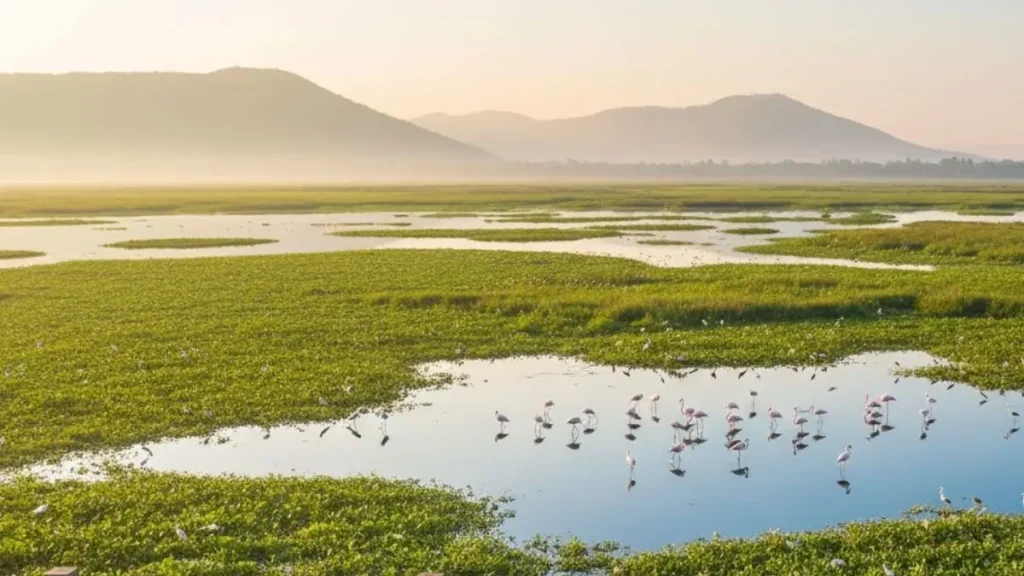
Gogabeel Lake Ramsar Site in Bihar has been declared a wetland of international importance. Learn its location, ecological significance, migratory birds, community involvement, and key points for UPSC, SSC, and State PCS exams.
Location and Geographic Significance
Situated in the Katihar district of Bihar, Gogabeel Lake is a naturally-formed ox-bow lake in the trans-Gangetic plains, flanked by the Mahananda River to its north-east and the Ganga River to its south. This positioning not only defines its formation but also its ecological role as a hydrological and biodiversity buffer in an otherwise heavily cultivated and flood-prone region.
Declaration as Ramsar Site
In 2025, Gogabeel Lake was officially recognised as a wetland of international importance under the Ramsar Convention. This latest addition strengthens India’s commitment to wetland conservation, adding to the country’s list of over 80 Ramsar sites. Prior to its Ramsar status, Gogabeel was already declared a Community Reserve in Bihar—a recognition of local community involvement in its preservation.
Ecological Richness: Flora & Fauna
The landscape around Gogabeel is dominated by tropical dry deciduous forests, which support a variety of plants and maintain soil health in the region.In terms of fauna, the lake holds significant value:
- It acts as a wintering ground for migratory birds along flyways, making it internationally relevant.
- Species of conservation concern inhabit or breed here — for instance, the smooth-coated otter (Lutrogale perspicillata), listed as Vulnerable, and the helicopter catfish (Wallago attu), a threatened freshwater fish species.
This mix of resident and migratory species, combined with the wetland’s hydrological dynamics, makes Gogabeel a biodiversity hotspot of regional and international significance.
Cultural & Social Significance
Gogabeel is not only an ecological asset but also a living cultural space. Local communities celebrate festivals such as Sirva, Adra and Chhath along its shores—rituals that underline the spiritual connection between people and wetlands. These cultural practices reinforce the concept of “wise use” promoted under the Ramsar paradigm: balancing human activity with conservation, not excluding people but integrating them. The designation as a Community Reserve prior to Ramsar status also signals the importance of community-centric conservation models in India.
Implications for Conservation & Policy
With Gogabeel’s Ramsar recognition, policy and conservation efforts receive a boost: the wetland is now eligible for higher levels of monitoring, international support, and inclusion in national wetland action policies. This status may trigger stricter regulation of land use, agricultural runoff, tourism development and community grazing around the lake. By becoming a Ramsar site, Gogabeel aligns with Sustainable Development Goals (SDGs) related to life-on-land (SDG 15), clean water (SDG 6) and climate resilience. For students preparing for exams such as Staff Selection Commission (SSC), Union Public Service Commission (UPSC) and other state service examinations, understanding such designations helps in topics like environment, biodiversity, ecosystem services and national/international treaties.

Why This News Is Important
Relevance to Biodiversity & Wetland Conservation
The declaration of Gogabeel Lake as a Ramsar site underscores India’s continuing effort to protect its complex wetland ecosystems. Wetlands perform multiple ecosystem services—water filtration, flood mitigation, carbon sequestration, biodiversity habitat—and their protection is critical in the face of climate change and land-use pressures. For exam aspirants in fields like the civil services, banking (especially where environmental risk may intersect with financing), railways (aligning with route planning), and teaching (environment syllabus), this news provides a current example of environmental governance in India.
Importance from Policy & Governance Perspective
This recognition also signals policy direction: the government’s use of international treaties (like the Ramsar Convention) to further domestic environmental goals. For candidates preparing for teacher, police, banking, railways, defence or civil service posts, such matters often surface under governance, environment, and sustainable development segments. The news reflects how local ecosystems (in Katihar district, Bihar) connect to global frameworks, bridging grassroots community action (“Community Reserve”) with international recognition (Ramsar status). Understanding how this chain works can help one answer questions around India’s commitments to international environmental treaties and how they translate into ground-level conservation.
Historical Context
Wetland Protection in India
India became a party to the Ramsar Convention in 1982 and since then has designated numerous wetlands as Ramsar sites. These designations reflect both ecological importance and national commitments to sustainable use of wetlands. Over time, India’s wetland policy has evolved: from merely listing wetlands to integrating them into the National Wetland Action Programme and aligning them with state-level conservation plans.
Gogabeel’s Journey: From Community Reserve to Ramsar Site
Gogabeel Lake’s path to recognition began with its designation as Bihar’s first Community Reserve, recognising the role of local communities in conserving the wetland. This step dovetailed with India’s broader push toward community-led conservation models, such as the Biodiversity Act (2002) and various state-level community reserve frameworks. Subsequently, the lake’s rich ecology and cultural significance led to its nomination and eventual inclusion as a Ramsar site in 2025.
The Ramsar Convention and India’s Commitments
The Ramsar Convention, adopted in 1971 in Iran, is a treaty focused on “the conservation and wise use of all wetlands through local, regional and national actions and international cooperation”. India’s active participation in the convention and frequent additions of Ramsar sites (now numbering over 80) reflect its acknowledgement of wetlands as key ecosystems in the face of climate change, biodiversity loss and increasing human pressure on water resources.
Key Takeaways from Gogabeel Lake Ramsar Site Declaration
| S.No | Key Takeaway |
|---|---|
| 1 | Gogabeel Lake (Katihar district, Bihar) has been declared a Ramsar site in 2025. |
| 2 | The lake is a naturally-formed ox-bow wetland, flanked by the Mahananda River and the Ganga River. |
| 3 | It acts as a wintering ground for migratory birds and is home to species of global conservation concern (e.g., smooth-coated otter, helicopter catfish). |
| 4 | Local communities perform cultural rituals near the lake (Sirva, Adra, Chhath), highlighting the human-wetland link required by “wise use”. |
| 5 | The Ramsar status strengthens India’s wetland conservation efforts and aligns with international environmental treaties and SDG commitments. |
Frequently Asked Questions (FAQs)
Q1. Where is Gogabeel Lake located?
Ans: Gogabeel Lake is located in the Katihar district of Bihar in the eastern part of India.
Q2. What type of lake is Gogabeel?
Ans: Gogabeel is an ox-bow lake, formed due to the meandering and shifting of river channels over time.
Q3. Why was Gogabeel Lake declared a Ramsar Site?
Ans: It was declared a Ramsar Site due to its ecological importance, rich biodiversity, presence of migratory birds, and involvement of local communities in conservation.
Q4. Which international treaty is associated with Ramsar Sites?
Ans: The Ramsar Convention (1971), an international treaty for the conservation and wise use of wetlands.
Q5. Which two major rivers influence the Gogabeel wetland system?
Ans: The Ganga River to the south and the Mahananda River to the north-east.
Q6. What is meant by a Community Reserve?
Ans: A Community Reserve is a protected area recognized for community participation in wildlife and ecosystem conservation.
Q7. Name one vulnerable animal species found in Gogabeel Lake.
Ans: The Smooth-coated Otter (Lutrogale perspicillata), which is listed as Vulnerable.
Q8. Which festival celebrated at Gogabeel Lake highlights cultural-ecological linkage?
Ans: Festivals like Chhath Puja, Sirva and Adra are celebrated, showing cultural dependence on wetlands.
Q9. How does Ramsar recognition help conservation?
Ans: It ensures legal protection, funding opportunities, scientific monitoring, and better conservation planning.
Q10. Why is this topic important for competitive exams?
Ans: Because environmental conservation, Ramsar Sites, and wetland ecosystems are frequent topics in UPSC, State PCS, SSC, Defence, Teaching, Railway, and Banking exams.
Some Important Current Affairs Links

