
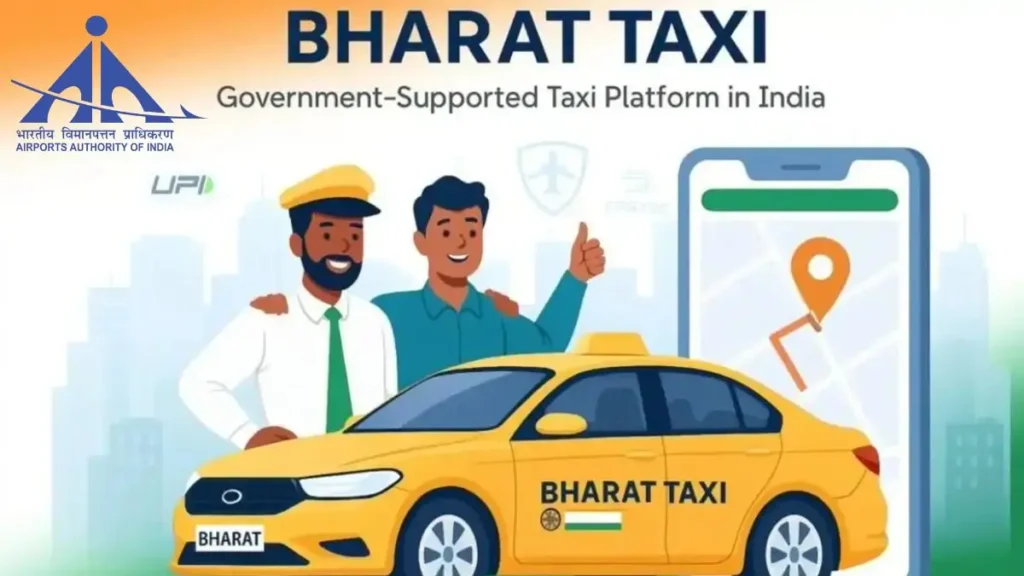
Bharat Taxi surge-free airport services launched through AAI partnership improve last-mile connectivity, transparent fares, and cooperative ride-hailing model in 10 Indian airports.
Bharat Taxi Partners with AAI to Launch Surge‑Free Airport Services: A Major Boost to India’s Last‑Mile Connectivity
The Airports Authority of India (AAI) has signed an important Memorandum of Understanding (MoU) with Bharat Taxi to introduce transparent, regulated, and surge‑free taxi services at select Indian airports. This collaboration aims at improving last‑mile connectivity for air passengers, ensuring reliable transportation and fair pricing across regional and tier‑2 airports in India.
Under this MoU, the AAI will integrate Bharat Taxi services at multiple airports, beginning with cities like Rajkot, Vadodara, Surat, Bhuj, Pune, Aurangabad, Varanasi, Kanpur, Agra, and Prayagraj. These cities represent key regional aviation hubs where reliable taxi services were previously inconsistent or prone to unpredictable pricing and surge charges.
Bharat Taxi is India’s first driver‑owned cooperative ride‑hailing platform, promoted by the National Cooperative Development Corporation (NCDC) and supported by leading cooperative institutions. Unlike traditional app‑based aggregators that often impose surge pricing during periods of high demand, Bharat Taxi operates on a cooperative model that ensures transparent fare structures with no surge charges. This means passengers will pay fair, predictable prices every time they travel, while drivers share in ownership and benefit from better income stability.
The partnership will also help institutionalize regulated cab services on airport premises, reducing confusion and disputes over fares and improving the overall travel experience. Clearly demarcated pickup and drop zones, trained drivers, and standardized tariffs are expected to boost passenger confidence, especially among first‑time flyers, students, and senior citizens.
Furthermore, this initiative aligns with major national objectives such as Atmanirbhar Bharat, Sahakar se Samriddhi, and the long‑term strategic vision of Viksit Bharat 2047—which promote self‑reliance, cooperative movements, and inclusive economic growth. Many view this agreement as a milestone in integrating cooperative enterprises with modern tech‑driven services.

Why This News is Important for Exam Aspirants
Boost to Regional Airport Connectivity
This development is significant for candidates preparing for UPSC, State PSC, SSC, Banking, Railways, and Defence exams because it highlights government action on urban mobility and public service improvements. Many competitive exams include questions on public infrastructure reforms and transport sector initiatives.
Focus on Cooperative Economy
This policy supports cooperative models—an important topic within the Indian economy syllabus. Bharat Taxi’s cooperative structure brings driver empowerment and shared ownership into mainstream transport services, contrasting with privately owned aggregators. Questions can be asked about cooperative movements and their role in economic inclusion.
Transparent Pricing without Surge Charges
This move addresses critical issues in transport pricing and passenger rights—a relevant theme in general awareness and current affairs sections of exams. The elimination of surge pricing reflects consumer protection measures adopted by the government.
Alignment with National Vision Statements
The initiative contributes to major government priorities like Atmanirbhar Bharat and Viksit Bharat 2047. Exam questions often relate to these policies, and understanding how specific actions align with them is a key part of strategic preparation.
Relevance Across Multiple Sectors
For aspirants in aviation, transport, civil services, and public administration, this is a case study in public‑private cooperation, regulatory reforms, and citizen‑centric service design.
Historical Context: Airports Connectivity and Cooperative Movement in India
Improving airport connectivity has long been a priority in India’s transportation sector. Over the past decade, the Airports Authority of India has focused on modernizing infrastructure, expanding regional airports, and improving last‑mile connectivity services. However, taxi services at airports have traditionally been unregulated, leading to surge pricing and passenger dissatisfaction.
The cooperative movement in India dates back to the early 20th century, aiming to empower local communities through collective ownership. Historically, cooperatives have played a role in agriculture, credit, and small industries. Bharat Taxi’s model leverages this cooperative ethos to reshape urban transport, combining tech‑driven platforms with community ownership.
The launch of Bharat Taxi was inaugurated by Union Home and Cooperation Minister Amit Shah in February 2026, marking a milestone in integrating government vision with cooperative frameworks. This reflects a broader shift toward sustainable and inclusive economic models that prioritize stakeholder benefits over profit‑centric approaches.
Key Takeaways from “Bharat Taxi Partners with AAI to Launch Surge‑Free Airport Services”
| S. No. | Key Takeaway |
|---|---|
| 1 | The Airports Authority of India signed an MoU with Bharat Taxi to improve airport taxi services. |
| 2 | Bharat Taxi offers transparent pricing and no surge charges. |
| 3 | Services are proposed at key regional airports including Rajkot, Vadodara, Surat, and others. |
| 4 | Bharat Taxi is India’s first driver‑owned cooperative ride‑hailing platform. |
| 5 | Initiative aligns with national priorities like Atmanirbhar Bharat and Viksit Bharat 2047. |
FAQs: Frequently Asked Questions
1. What is Bharat Taxi?
Bharat Taxi is India’s first driver-owned cooperative ride-hailing platform, promoted by the National Cooperative Development Corporation (NCDC). It allows drivers to collectively own the platform, ensuring fair income distribution and eliminating surge pricing.
2. What is the partnership between Bharat Taxi and AAI about?
The Airports Authority of India (AAI) signed an MoU with Bharat Taxi to introduce surge-free taxi services at select airports. The partnership aims to improve last-mile connectivity, regulate fares, and provide reliable transport services for passengers.
3. Which airports will Bharat Taxi services cover initially?
The initial launch covers 10 airports in cities like Rajkot, Vadodara, Surat, Bhuj, Pune, Aurangabad, Varanasi, Kanpur, Agra, and Prayagraj.
4. What is unique about Bharat Taxi’s pricing model?
Unlike conventional app-based taxi aggregators, Bharat Taxi operates on a cooperative model with transparent pricing and no surge charges, ensuring predictable fares for passengers.
5. How does this initiative support government policies?
This initiative aligns with Atmanirbhar Bharat, Sahakar se Samriddhi, and Viksit Bharat 2047, promoting cooperative enterprises, inclusive economic growth, and sustainable employment.
6. Why is this news important for competitive exams?
It is relevant for UPSC, State PSC, SSC, Banking, Railways, and Defence exams as it highlights government initiatives on public transport reforms, cooperative movement, regional airport connectivity, and citizen-centric services.
7. Who benefits from Bharat Taxi services?
Passengers get fair and predictable pricing, while drivers gain ownership and a better income share. Airports benefit from regulated and efficient taxi services.
Some Important Current Affairs Links

