
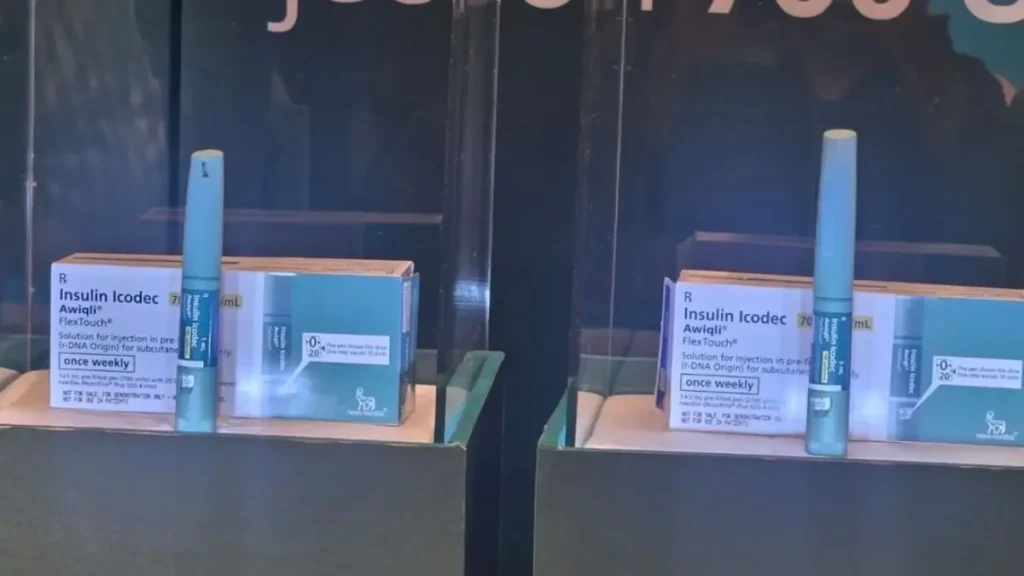
Awiqli once weekly basal insulin in India marks a major breakthrough in diabetes care. Learn about Novo Nordisk’s insulin icodec, its benefits, key facts, historical background, FAQs, and exam-oriented points for UPSC, SSC, Banking, Railways, Defence, and State PSC exams.
A Major Milestone in India’s Diabetes Care
Global pharmaceutical company Novo Nordisk has launched Awiqli (insulin icodec) in India, marking a significant advancement in diabetes treatment. Awiqli is the world’s first once-weekly basal insulin approved for adults with Type 1 Diabetes and Type 2 Diabetes. The launch is expected to transform diabetes management by reducing the frequency of insulin injections from 365 injections a year to just 52.
India is often referred to as the “Diabetes Capital of the World” due to its rapidly increasing number of diabetes patients. The introduction of Awiqli is expected to improve treatment adherence and enhance the quality of life for millions of people requiring long-term insulin therapy.
What is Awiqli?
Awiqli is the brand name for insulin icodec, a long-acting basal insulin developed by Novo Nordisk. Basal insulin helps maintain stable blood sugar levels throughout the day and night by providing a continuous supply of insulin. Unlike conventional basal insulin, which requires daily administration, Awiqli is injected only once every week.
This innovative treatment has been designed to offer the same blood glucose control as daily basal insulin while significantly reducing the number of injections required.
How Does Once-Weekly Basal Insulin Work?
Awiqli contains insulin icodec, which has been engineered to remain active in the body for approximately seven days. Patients administer one injection on the same day every week, ensuring consistent blood sugar control throughout the week.
Clinical studies have shown that once-weekly insulin provides effective glycaemic control with a safety profile comparable to daily basal insulin. The simplified treatment schedule is expected to improve patient compliance, especially among individuals who struggle with daily injections.
Why the Launch is Significant for India
India has one of the world’s largest populations of people living with diabetes. According to international health estimates, more than 100 million Indians are affected by diabetes, making effective disease management a major public health priority.
Many patients discontinue or delay insulin therapy because of the inconvenience and psychological burden of daily injections. A once-weekly insulin option can help improve treatment adherence, reduce missed doses, and support better long-term blood sugar management.
Healthcare experts believe that easier treatment schedules may also encourage earlier adoption of insulin therapy among eligible patients, reducing the risk of diabetes-related complications such as kidney disease, vision loss, nerve damage, and cardiovascular disorders.
Clinical Evidence Supporting Awiqli
Before its launch, Awiqli underwent extensive international clinical trials involving thousands of patients. These studies demonstrated that once-weekly insulin icodec achieved blood sugar control comparable to widely used daily basal insulin therapies.
The treatment also maintained an acceptable safety profile, giving healthcare professionals greater confidence in prescribing it to eligible adult patients with diabetes.
Implications for Healthcare and Competitive Exams
The launch of Awiqli is important not only from a medical perspective but also for competitive examinations. Questions related to diabetes, non-communicable diseases, pharmaceutical innovations, biotechnology, and healthcare reforms frequently appear in UPSC, State PSC, SSC, Banking, Railways, Defence, Nursing, and other government recruitment examinations.
Candidates should remember that Awiqli (insulin icodec) is the world’s first once-weekly basal insulin, developed by Novo Nordisk, and has now been introduced in India to improve diabetes management. This development reflects India’s growing adoption of advanced healthcare technologies and innovative pharmaceutical treatments.
Conclusion
The introduction of Awiqli in India represents a landmark achievement in diabetes care. By reducing insulin injections from daily to once a week, Novo Nordisk aims to make treatment more convenient, improve patient adherence, and enhance overall health outcomes. As diabetes continues to pose a major public health challenge in India, innovations like Awiqli have the potential to significantly strengthen long-term disease management and improve the quality of life for millions of patients.
Why This News is Important: Awiqli Once-Weekly Basal Insulin Launched in India
Significance for Public Health in India
The launch of Awiqli (insulin icodec) in India is a major milestone in the country’s healthcare sector. India has one of the largest diabetic populations in the world, with over 100 million people living with diabetes. Managing diabetes requires regular monitoring of blood glucose levels and, for many patients, daily insulin injections. The availability of a once-weekly basal insulin offers a more convenient treatment option, which can improve patient adherence and overall disease management.
Importance for Government Exam Aspirants
This development is highly relevant for candidates preparing for UPSC, State PSC, SSC, Banking, Railways, Defence, Nursing, Pharmacy, and other government examinations. Competitive exams frequently include questions on recent developments in healthcare, biotechnology, pharmaceuticals, public health initiatives, and non-communicable diseases. Aspirants should remember that Awiqli is the world’s first once-weekly basal insulin, developed by Novo Nordisk, and has now been launched in India.
Advancement in Medical Innovation
The introduction of insulin icodec reflects the rapid advancement of pharmaceutical research and innovation. By reducing the number of insulin injections from 365 to just 52 per year, the treatment addresses one of the biggest challenges faced by diabetic patients—treatment fatigue. Improved convenience can encourage more patients to continue insulin therapy as prescribed, thereby reducing the risk of long-term complications such as heart disease, kidney failure, nerve damage, and vision impairment.
Contribution to India’s Healthcare System
The launch supports India’s broader goal of improving access to advanced medical treatments for chronic diseases. As the burden of non-communicable diseases continues to rise, innovative therapies like Awiqli can strengthen diabetes care, improve health outcomes, and reduce healthcare costs associated with diabetes-related complications. It also demonstrates the growing importance of India as a key market for introducing cutting-edge global healthcare innovations.
Exam-Oriented Facts to Remember
For competitive examinations, candidates should remember the following key facts:
- Company: Novo Nordisk
- Medicine: Awiqli (Insulin Icodec)
- Category: Once-weekly basal insulin
- First in the World: World’s first once-weekly basal insulin for adults
- Country of Launch: India
- Target Patients: Adults with Type 1 Diabetes and Type 2 Diabetes
- Major Benefit: Reduces insulin injections from 365 to 52 annually while maintaining effective blood sugar control.
This news is important because it combines current affairs with topics from science and technology, health, biotechnology, pharmaceuticals, and public policy, making it highly relevant for both preliminary and mains examinations.
Historical Context: Evolution of Insulin Therapy and Diabetes Management
Discovery of Insulin: A Medical Breakthrough
The history of insulin therapy began in 1921, when Canadian researchers Frederick Banting and Charles Best successfully discovered insulin. Their groundbreaking work revolutionized the treatment of diabetes, a disease that was often fatal before insulin became available. In 1922, insulin was administered to a human patient for the first time, marking the beginning of modern diabetes care. Frederick Banting was later awarded the Nobel Prize in Physiology or Medicine (1923) for this historic discovery.
Evolution from Daily to Long-Acting Insulin
Over the decades, insulin formulations have undergone significant improvements. Initially, patients relied on short-acting insulin, requiring multiple injections each day. Advances in biotechnology led to the development of long-acting (basal) insulin analogues, such as insulin glargine, insulin detemir, and insulin degludec, which provided more stable blood glucose control with fewer daily injections. These innovations greatly improved the quality of life for people living with diabetes.
Rising Diabetes Burden in India
India has witnessed a sharp rise in diabetes cases due to rapid urbanization, changing lifestyles, unhealthy dietary habits, obesity, and reduced physical activity. The country is home to one of the world’s largest populations of people living with diabetes, making the disease a major public health concern. The Government of India has strengthened diabetes prevention and treatment through the National Programme for Prevention and Control of Non-Communicable Diseases (NP-NCD), which focuses on early detection, awareness, and affordable treatment of chronic diseases, including diabetes.
Development of Once-Weekly Insulin
Recognizing the challenges of daily insulin injections, researchers worked to develop a longer-acting insulin that could maintain stable blood sugar levels for an entire week. This led to the development of insulin icodec, a novel basal insulin molecule designed by Novo Nordisk. Extensive international clinical trials demonstrated that insulin icodec provides blood glucose control comparable to daily basal insulin while significantly reducing the number of injections required.
Launch of Awiqli in India
The introduction of Awiqli (insulin icodec) in 2026 marks an important milestone in India’s healthcare sector. As the world’s first once-weekly basal insulin for adults with Type 1 and Type 2 diabetes, Awiqli represents a new era in diabetes management. Its launch reflects the growing adoption of advanced pharmaceutical innovations in India and highlights ongoing efforts to improve treatment adherence, patient convenience, and long-term health outcomes.
Relevance for Competitive Examinations
Understanding the historical evolution of insulin therapy is important for candidates preparing for UPSC, State PSC, SSC, Banking, Railways, Defence, Nursing, and other government examinations. Questions may be asked about the discovery of insulin, the development of long-acting insulin analogues, India’s growing diabetes burden, government initiatives for non-communicable diseases, and recent pharmaceutical innovations such as Awiqli (insulin icodec).
Key Takeaways from Awiqli Once-Weekly Basal Insulin Launch
| S. No. | Key Takeaway |
|---|---|
| 1 | Novo Nordisk has launched Awiqli (insulin icodec) in India, the world’s first once-weekly basal insulin for adults with Type 1 and Type 2 diabetes. |
| 2 | Awiqli reduces the number of insulin injections from 365 injections per year to just 52, making diabetes management more convenient for patients. |
| 3 | The once-weekly insulin provides effective blood glucose control with a safety profile comparable to daily basal insulin, based on international clinical trials. |
| 4 | The launch is significant for India, which has one of the world’s largest diabetic populations, and is expected to improve treatment adherence and reduce diabetes-related complications. |
| 5 | This development is important for competitive examinations as it covers topics related to healthcare, biotechnology, pharmaceutical innovation, non-communicable diseases (NCDs), and current affairs frequently asked in UPSC, State PSC, SSC, Banking, Railways, Defence, and other government exams. |
FAQs: Awiqli Once-Weekly Basal Insulin Launched in India
1. What is Awiqli?
Awiqli is the brand name of insulin icodec, the world’s first once-weekly basal insulin developed by Novo Nordisk for adults with Type 1 and Type 2 diabetes.
2. Which company launched Awiqli in India?
Awiqli has been launched in India by Novo Nordisk, a global healthcare company specializing in diabetes care.
3. What is basal insulin?
Basal insulin is a long-acting insulin that helps maintain stable blood glucose levels throughout the day and night by providing a continuous supply of insulin.
4. How often is Awiqli administered?
Awiqli is administered once every week, unlike conventional basal insulin, which is generally taken once daily.
5. What is the active ingredient in Awiqli?
The active ingredient in Awiqli is insulin icodec, an ultra-long-acting insulin analogue.
6. Who can use Awiqli?
Awiqli is approved for adult patients with Type 1 Diabetes and Type 2 Diabetes, as prescribed by a healthcare professional.
7. Why is the launch of Awiqli significant?
It reduces the number of insulin injections from 365 to 52 per year, improving treatment adherence and patient convenience.
8. Why is India an important market for diabetes treatment?
India has one of the largest populations of people living with diabetes, making innovative treatment options highly significant for public health.
9. Which government programme addresses diabetes and other non-communicable diseases in India?
The National Programme for Prevention and Control of Non-Communicable Diseases (NP-NCD) aims to prevent, detect, and manage diseases such as diabetes, hypertension, cardiovascular diseases, and cancer.
10. Why is this topic important for competitive examinations?
It is relevant for UPSC, State PSC, SSC, Banking, Railways, Defence, Nursing, Pharmacy, and other government exams because it covers current affairs, healthcare, biotechnology, pharmaceuticals, and public health.
Some Important Current Affairs Links

