
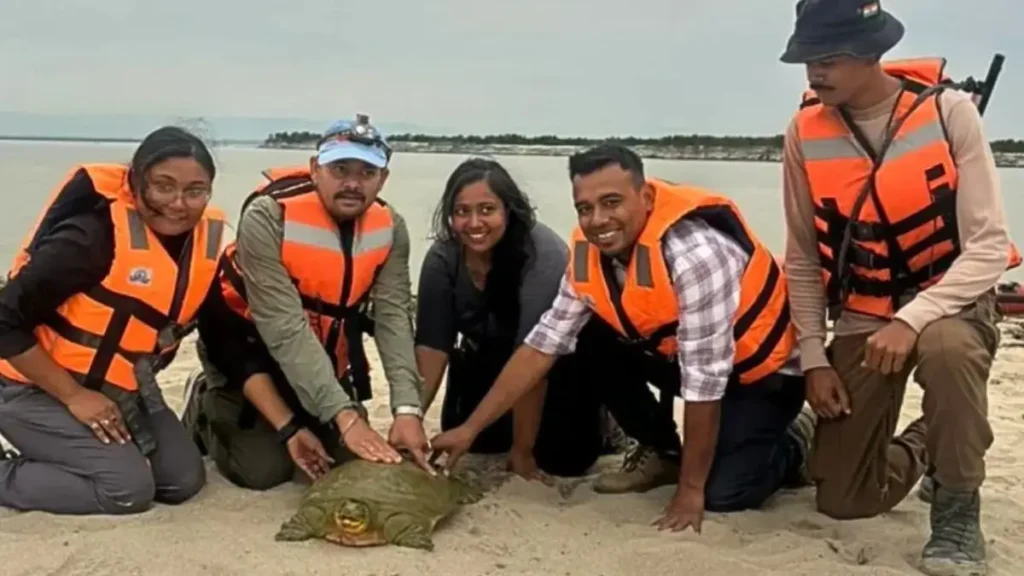
India first satellite tagged turtle initiative launched in Kaziranga National Park with the release of the endangered Ganges softshell turtle. Learn important facts, conservation significance, MCQs and exam-relevant current affairs details.
India’s First Satellite-Tagged Ganges Softshell Turtle Released in Kaziranga
A Landmark Step in Wildlife Conservation
India achieved a major milestone in wildlife conservation with the release of the country’s first satellite-tagged Ganges softshell turtle in the famous Kaziranga National Park and Tiger Reserve. The initiative was launched on the occasion of Endangered Species Day and is being seen as an important advancement in scientific conservation efforts.
The endangered turtle species, scientifically known as Nilssonia gangetica, was fitted with a lightweight satellite transmitter before being released into its natural habitat. The device will help researchers track the turtle’s movement patterns, breeding behaviour, migration routes and habitat preferences in real time.
Role of Satellite Technology in Conservation
Satellite tagging is an advanced scientific method widely used in wildlife monitoring. In this case, the technology will allow conservationists to gather crucial information about the freshwater turtle’s seasonal movement and ecological requirements without disturbing the animal in the wild.
Scientists believe that the data collected through satellite tracking will improve conservation planning in the Brahmaputra river basin. It will also help identify nesting and breeding sites that require stronger protection measures.
Importance of Kaziranga for Turtle Conservation
Kaziranga National Park and Tiger Reserve is globally famous for the one-horned rhinoceros, but it is also one of Asia’s richest freshwater turtle habitats. Officials stated that Assam is home to nearly 21 species of turtles, making it one of the world’s top-priority regions for turtle conservation.
Out of the eight softshell turtle species found in India, five are reported from Kaziranga alone. This highlights the ecological significance of the Brahmaputra floodplains and wetlands. Conservationists believe that preserving these ecosystems is essential for maintaining biodiversity in northeastern India.
Statements by Government and Experts
Assam Chief Minister Himanta Biswa Sarma described the development as a “proud moment” for Assam and India’s wildlife conservation efforts. He emphasized the government’s commitment to protecting all species inhabiting the state’s forests and wetlands.
Experts from the Wildlife Institute of India explained that understanding the turtle’s home range and movement behaviour will support active conservation management. The project was reportedly carried out in collaboration with the Assam Forest Department and received support from conservation organisations.
About the Ganges Softshell Turtle
The Ganges softshell turtle is a freshwater reptile mainly found in the Ganga, Indus and Mahanadi river systems of the Indian subcontinent. It is recognised by the arrow-shaped marking present on the top of its head.
The species is listed as endangered on the IUCN Red List and is protected under Schedule I of the Wildlife (Protection) Act, 1972. Possession, trade or hunting of the species is punishable under Indian law.
Significance for Competitive Examinations
This development is highly important for aspirants preparing for UPSC, State PSCs, SSC, Railways, Banking, Defence and teaching examinations because questions related to biodiversity conservation, national parks, endangered species and satellite technology are frequently asked in current affairs and environment sections.
Students should remember important facts such as:
- Kaziranga National Park is located in Assam.
- The species involved is the Ganges softshell turtle (Nilssonia gangetica).
- The initiative marked India’s first satellite-tagging of this turtle species.
- The turtle is protected under Schedule I of the Wildlife Protection Act.
- The event coincided with Endangered Species Day.

Why This News is Important
Importance for Biodiversity Conservation
The satellite-tagging of the Ganges softshell turtle is significant because it demonstrates India’s growing focus on scientific wildlife conservation. Freshwater turtles are among the most threatened reptile groups due to habitat destruction, river pollution, illegal trade and climate change. By using satellite technology, researchers can better understand the survival challenges faced by these species.
The initiative is expected to strengthen conservation strategies in the Brahmaputra basin and support habitat protection measures. It also highlights the importance of integrating modern science with wildlife management policies.
Importance for Government Exam Preparation
Environmental conservation has become a major topic in competitive examinations. Questions are frequently asked about endangered species, national parks, biosphere reserves and conservation technologies. This news connects multiple syllabus areas including environment, ecology, geography and science & technology.
The event is also important because it reflects India’s commitment toward biodiversity conservation under international environmental agreements. Aspirants should understand how satellite tracking supports wildlife research and helps authorities identify migration corridors, breeding grounds and ecological threats.
Historical Context
History of Turtle Conservation in India
India has a rich diversity of freshwater turtles and tortoises. However, many species have experienced population decline because of wetland destruction, sand mining, river pollution and illegal poaching. Conservation efforts increased significantly after the enactment of the Wildlife (Protection) Act, 1972.
Over the years, organisations such as the Wildlife Institute of India and state forest departments have launched several conservation programmes for endangered reptiles, including gharials, crocodiles and turtles. Satellite tagging has already been used successfully for tracking Olive Ridley sea turtles along India’s coastline.
Importance of Kaziranga in Conservation History
Kaziranga National Park and Tiger Reserve has long been recognised as one of India’s most important biodiversity hotspots. Apart from protecting the one-horned rhinoceros, the park conserves elephants, tigers, swamp deer, dolphins and numerous reptile species.
The Brahmaputra river ecosystem around Kaziranga supports rare freshwater turtles and aquatic species. Conservation surveys conducted in recent years have recorded hundreds of freshwater turtles in the region, underlining the ecological richness of Assam’s wetlands.
Key Takeaways from This News
| S.No. | Key Takeaway |
|---|---|
| 1 | India’s first satellite-tagged Ganges softshell turtle was released in Kaziranga National Park, Assam. |
| 2 | The species involved is the endangered Ganges softshell turtle (Nilssonia gangetica). |
| 3 | Satellite tagging will help scientists track migration, breeding and habitat use. |
| 4 | The species is protected under Schedule I of the Wildlife (Protection) Act, 1972. |
| 5 | The initiative was launched on Endangered Species Day to strengthen wildlife conservation efforts. |
FAQs: India’s First Satellite-Tagged Ganges Softshell Turtle
1. Which turtle became India’s first satellite-tagged freshwater turtle?
The Ganges softshell turtle (Nilssonia gangetica) became India’s first satellite-tagged freshwater turtle released in Kaziranga National Park, Assam.
2. Where was the satellite-tagged turtle released?
The turtle was released in Kaziranga National Park and Tiger Reserve in Assam.
3. What is the scientific name of the Ganges softshell turtle?
The scientific name of the Ganges softshell turtle is Nilssonia gangetica.
4. Why is satellite tagging important in wildlife conservation?
Satellite tagging helps scientists monitor animal movement, breeding behaviour, habitat use and migration routes in real time for better conservation planning.
5. Under which law is the Ganges softshell turtle protected?
The species is protected under Schedule I of the Wildlife (Protection) Act, 1972.
6. What is the conservation status of the Ganges softshell turtle?
The species is classified as Endangered on the IUCN Red List.
7. Which river ecosystem is important for this turtle species?
The Brahmaputra river ecosystem and floodplains are important habitats for the species.
8. On which occasion was the turtle released?
The turtle was released on the occasion of Endangered Species Day.
9. Which state is known for rich freshwater turtle diversity in India?
Assam is considered one of the richest regions for freshwater turtle diversity in India.
10. Why is Kaziranga National Park globally famous?
Kaziranga is globally famous for conserving the one-horned rhinoceros and its rich biodiversity.
Some Important Current Affairs Links

