
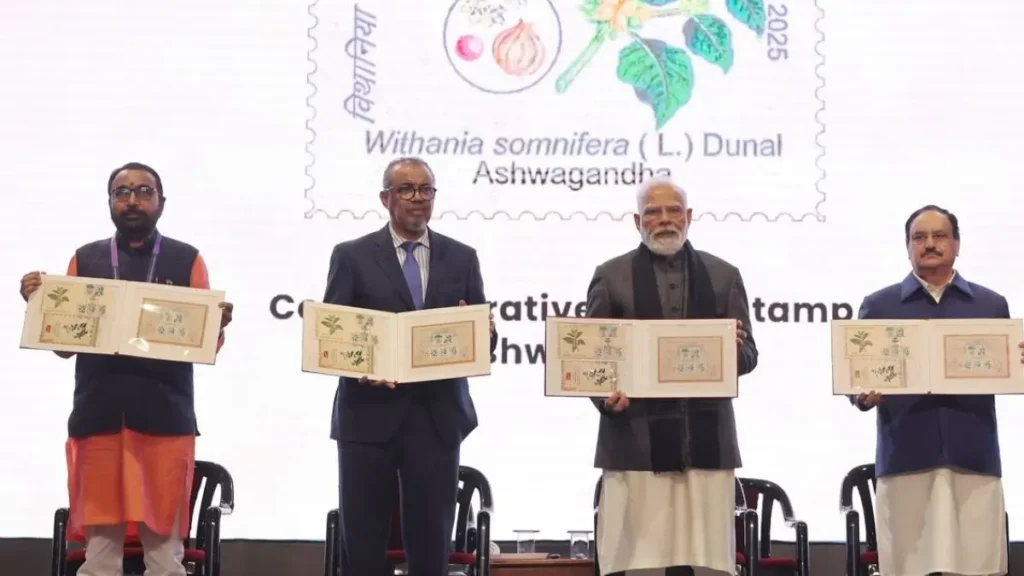
Ashwagandha commemorative postal stamp released by PM Modi at WHO Global Summit 2025 highlights India’s leadership in traditional medicine, Ayurveda initiatives, and global healthcare promotion.
📌 Prime Minister Releases Commemorative Postal Stamp on Ashwagandha at WHO Global Summit: A Current Affairs Article
Introduction: Landmark Event at WHO Global Summit on Traditional Medicine
Prime Minister Narendra Modi released a special commemorative postal stamp on Ashwagandha during the Second World Health Organization (WHO) Global Summit on Traditional Medicine held in New Delhi. This event, which concluded on 19th December 2025, brought together thousands of delegates, health experts, policymakers, and practitioners from around the world under the theme “Restoring balance: The science and practice of health and well-being.”
Ashwagandha: From Traditional Herb to Global Recognition
Ashwagandha, scientifically known as Withania somnifera, is a major medicinal herb in Ayurveda, valued for its adaptogenic properties — helping reduce stress, enhance immunity, and promote overall wellbeing. The launch of a commemorative stamp honors the herb’s centuries-old legacy and highlights its growing international importance in traditional and modern healthcare practices.
Significance of the Commemorative Postal Stamp
The postal stamp serves more than just a symbolic gesture — it is a cultural ambassador promoting India’s traditional medicinal heritage on a global stage. The move aligns with India’s broader strategy of mainstreaming traditional medicine and raising global awareness about effective ancient remedies that complement modern health systems.
WHO Summit: A Platform for Global Cooperation
The Second WHO Global Summit on Traditional Medicine fostered international dialogue on evidence-based traditional healthcare. Delegates from over 100 countries participated, discussing the role of herbs like Ashwagandha in preventive healthcare and holistic wellness. One key outcome was the emphasis placed on building scientific evidence, safety standards, and regulatory frameworks that can support traditional medicine’s integration into global health systems.
India’s Leadership in Traditional Medicine Initiatives
Alongside releasing the Ashwagandha stamp, the Prime Minister unveiled several initiatives aimed at enhancing the visibility and credibility of traditional Indian medicines:
- Ayush Mark — a global quality standard for traditional medicine products and services.
- My Ayush Integrated Services Portal (MAISP) — a digital platform for Ayush information and services.
- WHO technical report on Yoga training and new publications on Ayush transformation.
These initiatives reflect India’s commitment to integrating traditional knowledge systems with modern healthcare and setting global benchmarks in quality and safety.

📌 Why This News Matters (Exam-Oriented Explanation)
Relevance for Competitive Exams
This development is important for aspirants preparing for UPSC, SSC, Banking, Railways, Defence, Teacher and Police Exams because it intersects key themes of public health, international relations, cultural heritage, and holistic medicine. The release of a commemorative postal stamp on Ashwagandha is not just philatelic; it signals India’s strategic role in promoting traditional medicines globally.
Link to International Health Policy
The WHO Summit, co-hosted by India, emphasised evidence-based traditional medicine, bringing Ashwagandha into global health conversations — something aspirants should associate with world health strategies and international cooperation.
Cultural and Scientific Integration
Understanding this news helps students link India’s cultural legacy (Ayurveda and Ashwagandha) with scientific research and global recognition. This is relevant for General Studies papers in exams like UPSC Mains and CSAT, where interdisciplinary knowledge is essential.
Philately and National Symbols
The issuance of a commemorative stamp underscores how state symbols and cultural elements reflect national priorities — a topic often seen in Indian Polity and Governance sections of competitive exams.
📌 Historical Context: Ashwagandha and India’s Traditional Medicine Legacy
Ayurveda and Traditional Medicine in India
Ayurveda, one of the world’s oldest holistic healing systems, has been practised in India for over 3,000 years, emphasizing balance in mind, body and spirit. Herbs like Ashwagandha play a pivotal role in Ayurvedic formulations due to their therapeutic properties — especially as adaptogens.
India and WHO Collaboration
India’s partnership with the World Health Organization has strengthened since the establishment of the WHO Global Centre for Traditional Medicine in Jamnagar, Gujarat — a major milestone that reinforces traditional medicine’s global relevance.
Philately as a Tool for Cultural Promotion
Commemorative stamps have historically been used to celebrate national achievements, cultural icons, and heritage symbols. India Post frequently releases such stamps to highlight significant events or personalities that shape national and international understanding.
📌 Key Takeaways from “Prime Minister Releases Commemorative Postal Stamp on Ashwagandha”
📊 Key Takeaways Table
| S.No. | Key Takeaway |
|---|---|
| 1 | Prime Minister Narendra Modi released a commemorative Ashwagandha postal stamp at the 2nd WHO Global Summit on Traditional Medicine in New Delhi. |
| 2 | The Indian herb Ashwagandha was highlighted for its global health relevance and traditional medicinal value. |
| 3 | India emphasised evidence-based traditional medicine, integrating it with modern healthcare systems. |
| 4 | Key Ayush initiatives like the Ayush Mark and My Ayush Integrated Services Portal were also launched. |
| 5 | The event showcased India’s leadership role in promoting traditional medicine at the global level. |
FAQs: Frequently Asked Questions
1. What is Ashwagandha and why is it important?
Answer: Ashwagandha (Withania somnifera) is a medicinal herb widely used in Ayurveda for its adaptogenic properties. It helps reduce stress, boost immunity, and improve overall wellbeing. It has gained international recognition for its therapeutic potential.
2. When and where was the commemorative Ashwagandha postal stamp released?
Answer: Prime Minister Narendra Modi released the commemorative postal stamp on Ashwagandha on 19th December 2025 during the 2nd WHO Global Summit on Traditional Medicine in New Delhi.
3. What is the significance of releasing a postal stamp for Ashwagandha?
Answer: The stamp symbolizes India’s promotion of traditional medicine globally, highlighting the historical and cultural importance of Ashwagandha and showcasing India’s leadership in traditional healthcare practices.
4. What initiatives related to Ayush were launched during the WHO Summit?
Answer: Key initiatives include Ayush Mark, a global quality standard for traditional medicine, and the My Ayush Integrated Services Portal (MAISP), which provides digital access to Ayush information and services.
5. How does this news relate to competitive exams like UPSC or SSC?
Answer: This news links topics like Ayurveda, Indian heritage, international health policy, and WHO collaborations, which are relevant for General Studies papers, current affairs sections, and questions on government initiatives in exams like UPSC, SSC, banking, and railways.
6. What was the theme of the WHO Global Summit on Traditional Medicine?
Answer: The theme was “Restoring balance: The science and practice of health and well-being”, emphasizing the integration of evidence-based traditional medicine with modern healthcare.
7. What is the WHO Global Centre for Traditional Medicine?
Answer: Located in Jamnagar, Gujarat, it serves as a global hub for research, training, and promotion of traditional medicine, strengthening India’s leadership role in this sector.
Some Important Current Affairs Links

