
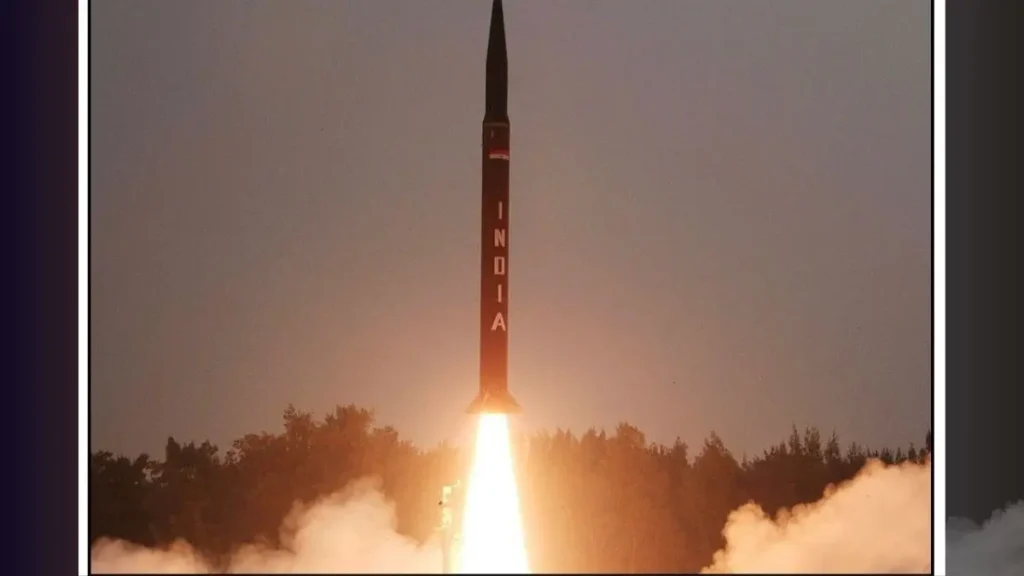
Agni-1 missile test India: The Strategic Forces Command successfully tested Agni-1 ballistic missile from Chandipur, Odisha, enhancing India’s nuclear deterrence and DRDO defence capability.
Agni-1 Missile Test Strengthens India’s Strategic Defence Capability
🛰️ Successful Test Launch of Agni-1 Missile from Odisha
India successfully conducted the test launch of the Agni-1 short-range ballistic missile from the Integrated Test Range at Chandipur, Odisha, under the supervision of the Strategic Forces Command (SFC). The test was carried out as part of routine operational validation and demonstrated the missile’s readiness for strategic deployment.
According to defence sources, the missile successfully met all operational and technical parameters, confirming its reliability and accuracy. The launch was coordinated with the support of the Defence Research and Development Organisation (DRDO), which has been instrumental in developing India’s indigenous missile systems.
The Agni-1 missile is a nuclear-capable surface-to-surface ballistic missile with an estimated range of around 700–900 km, making it a key component of India’s short-range strategic deterrence system.
🚀 Role of Strategic Forces Command in Missile Testing
The Strategic Forces Command, which manages India’s nuclear arsenal, conducted the user trial of Agni-1. The test ensures that the missile system remains fully operational under real-time military conditions.
Such trials are part of India’s continuous deterrence strategy, ensuring that its missile systems remain accurate, reliable, and ready for deployment whenever required.
🏭 Indigenous Defence Development by DRDO
The Agni-1 missile is developed under the Integrated Guided Missile Development Programme (IGMDP) led by DRDO. Over the years, DRDO has strengthened India’s self-reliance in defence technology by developing multiple variants of the Agni missile series.
The successful test reflects India’s growing capability in advanced missile technology, solid fuel propulsion systems, and mobile launcher systems, reinforcing the country’s strategic autonomy.
🌍 Strategic Importance in Regional Security
The Agni-1 missile plays a crucial role in maintaining credible minimum deterrence in South Asia. Its mobility and rapid deployment capability make it an important asset for national security.
The successful test reinforces India’s defence preparedness amid evolving regional security challenges and strengthens its position as a responsible nuclear power with advanced deterrence capability.

📌 Why This News is Important
🔹 National Security and Strategic Deterrence
The successful test of the Agni-1 missile is significant for India’s national security framework. It enhances the credibility of India’s nuclear deterrence strategy, ensuring readiness against any potential external threats.
🔹 Strengthening Indigenous Defence Capability
This test highlights India’s progress in indigenous defence manufacturing, reducing dependence on foreign technology. DRDO’s role reflects India’s commitment to Atmanirbhar Bharat in defence production.
🔹 Operational Readiness of Armed Forces
The involvement of the Strategic Forces Command confirms that India’s missile systems are continuously evaluated for real-time operational readiness, ensuring effective deployment in case of strategic necessity.
🔹 Technological Advancement
Agni-1’s successful test validates advancements in solid fuel technology, navigation accuracy, and mobile launch systems, which are critical for modern missile warfare systems.
🔹 Geopolitical Significance
In a region with evolving security dynamics, this test sends a strong message of strategic stability and deterrence capability, reinforcing India’s position in global defence architecture.
📚 Historical Context
The Agni missile series was developed under DRDO’s Integrated Guided Missile Development Programme (IGMDP), initiated in the 1980s to achieve self-reliance in strategic weapons technology.
- The first Agni technology demonstrator was tested in 1989.
- Agni-1 was formally developed as a short-range ballistic missile in the early 2000s.
- It evolved to serve as a key part of India’s nuclear triad capability.
- Over the years, Agni-1 has undergone multiple user trials by the Strategic Forces Command to ensure operational reliability.
Today, the Agni series includes multiple variants (Agni-1 to Agni-5 and beyond), forming the backbone of India’s land-based strategic deterrent system.
📊 Key Takeaways from Agni-1 Missile Test
| S. No. | Key Takeaway |
|---|---|
| 1 | India successfully tested Agni-1 missile from Chandipur, Odisha under Strategic Forces Command. |
| 2 | The missile validated all operational and technical performance parameters. |
| 3 | Agni-1 is a nuclear-capable short-range ballistic missile with ~700–900 km range. |
| 4 | The test reinforces India’s indigenous defence capability developed by DRDO. |
| 5 | The launch strengthens India’s strategic deterrence and national security readiness. |
FAQs: Agni-1 Missile Test (Exam-Oriented)
Q1. What is Agni-1 missile?
Agni-1 is a nuclear-capable short-range ballistic missile (SRBM) developed by DRDO, designed for strategic deterrence.
Q2. Where was the Agni-1 missile tested recently?
It was successfully tested from the Integrated Test Range, Chandipur in Odisha.
Q3. Which organization conducted the Agni-1 missile test?
The test was conducted by India’s Strategic Forces Command (SFC) with support from DRDO.
Q4. What is the range of Agni-1 missile?
The Agni-1 missile has an approximate range of 700–900 km.
Q5. Why is Agni-1 important for India’s defence system?
It strengthens India’s credible minimum nuclear deterrence and enhances operational readiness of strategic forces.
Q6. Under which programme was Agni missile developed?
The Agni series was developed under the Integrated Guided Missile Development Programme (IGMDP).
Q7. Who manages India’s nuclear arsenal operations?
The Strategic Forces Command (SFC) manages and operates India’s nuclear weapons systems.
Q8. What type of missile is Agni-1?
Agni-1 is a surface-to-surface ballistic missile capable of carrying nuclear warheads.
Some Important Current Affairs Links

