
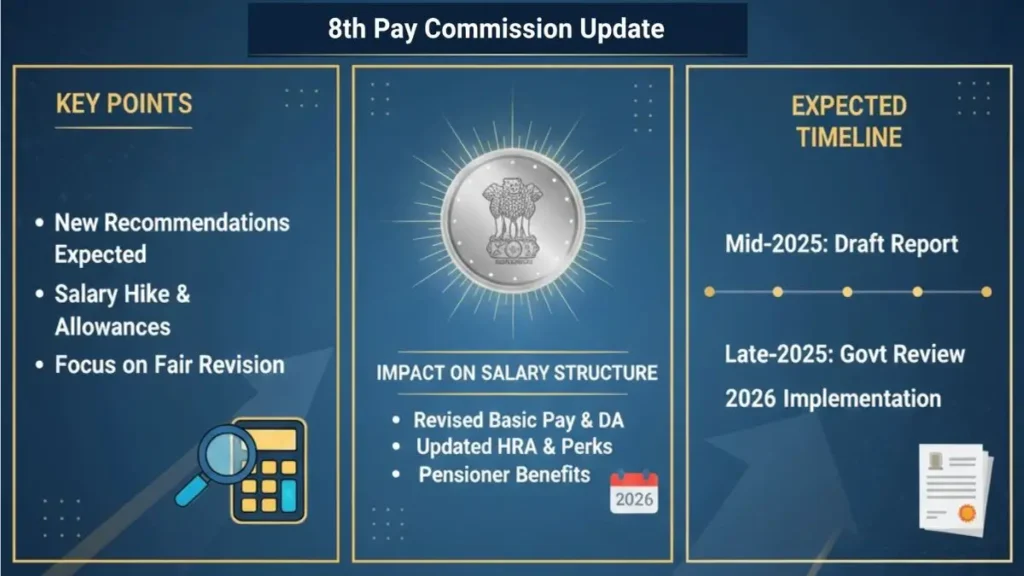
8th Pay Commission update 2025: Government rules out DA basic pay merger for central employees and pensioners. Know latest pay, allowances, and pension info for exams.
8th Pay Commission Update: Centre Rules Out DA–Basic Pay Merger For Now
On December 1, 2025, during the Winter Session of Parliament, the Ministry of Finance officially clarified that there is no proposal currently under consideration to merge the Dearness Allowance (DA) with the basic pay for central government employees and pensioners — despite growing demands from employee unions
This announcement comes in the context of the recent formation of the 8th Central Pay Commission (8th CPC), which was constituted via a Gazette notification dated November 3, 2025.
The 8th CPC will now review pay structures, allowances, pensions, gratuity, and other service conditions for nearly 50 lakh central government employees and pensioners. However, the current Terms of Reference (ToR) do not include any explicit mandate to merge DA with basic pay — a fact that has disappointed many unions and pensioner groups who had hoped for interim relief.
Why Expectations Were Raised for a DA–Basic Pay Merger
Over the years, the DA — a component meant to compensate for inflation — has often crossed the 50% threshold of basic pay. Historically, whenever DA had risen significantly, there were precedents where DA was merged with basic pay under earlier pay structures. Given the cost of living and inflationary pressures, many employees and pensioners viewed the constitution of the 8th CPC as an opportune moment for the government to formalize the merger.
Such a merger would not only raise the base pay but also increase other allowances (like HRA, transport allowance) and pension calculations — offering a more stable and inflation-resilient income structure.
Why the Government is Hesitant
According to the Ministry of Finance, merging DA with basic pay would significantly increase recurring liabilities. A higher base pay means higher pensions, higher allowances linked to basic pay, and long-term fiscal burden. By keeping DA separate and subject to periodic revision (every six months, based on inflation indices like AICPI-IW), the government retains flexibility in managing expenses.
Moreover, since the 8th CPC’s ToR do not currently include DA–basic pay merger, any such change would require a formal inclusion in the commission’s mandate — which, for now, seems unlikely.
Reaction from Employees, Pensioners and Unions
The government’s decision has led to disappointment among many central government employees and pensioner groups. Some of their concerns:
- Pensioners feel especially sidelined, as they fear that any enhancement in basic pay may not be matched by proportionate pension increase unless DA is merged.
- Lower-grade employees, for whom DA constitutes a significant portion of income, worry that periodic DA revisions may not keep pace with rising inflation, thus eroding real value over time.
- Many had hoped for immediate interim relief — but with the government’s formal refusal, all eyes now shift to the final report of the 8th CPC, and possible lobbying for revised ToR
What’s Next: The Road Ahead for 8th CPC
- The 8th CPC will continue its detailed review of salaries, allowances, pensions, gratuity, and other benefits for central government personnel. The Commission is expected to submit its recommendations within approximately 18 months.
- Until the Commission’s recommendations are implemented, the current pay structure remains unchanged: DA and Dearness Relief (DR) will continue to be adjusted periodically based on inflation indices (such as AICPI-IW), and there will be no structural change in basic pay.
- Employee and pensioner unions are likely to press for inclusion of DA–merger and pension revision in final recommendations, or demand amendment in ToR.

Why This News is Important
Significance for Government Job Aspirants and Employees
For students preparing for government exams — whether for teaching roles, banking, railways, police, defence or civil services (like PCS to IAS) — this update is critical. It directly impacts the remuneration structure for central government jobs. The refusal to merge DA with basic pay means that the existing pay scales and allowance structure remain the same, at least until the 8th CPC submits its recommendations. If you secure a central government post under the 8th CPC regime, your pay will follow the existing framework — possibly with a new basic pay, but without guaranteed DA merger.
Implications for Future Salaries and Job Planning
A merged DA with basic pay could significantly raise your future pay structure: basic pay, allowances (like HRA, transport), pension, gratuity — all would be calculated on a higher base. Since the government has ruled out such a merger for now, aspirants should temper expectations. It also means that financial planning and expectations regarding in-hand salary need to be realistic.
Relevance for Competitive Exam Preparation and Current Affairs
Given that pay commission announcements often appear in the general awareness/current affairs sections of competitive exams (especially for banking, railways, civil services, defence), knowing the government’s current stance helps you stay updated. Moreover, understanding the broader context — fiscal prudence, inflation, pension liabilities — provides deeper insight for descriptive or analytical questions on pay structure reforms, employee welfare, or government fiscal policy.
Historical Context
The issue of merging Dearness Allowance (DA) with basic pay has a long history in India’s pay-commission cycles. In earlier decades, when inflation and cost of living rose sharply, there were instances where DA — which is meant to compensate for inflation — was merged into basic pay to provide stable income and simplify the pay structure.
With the announcement of the 7th Central Pay Commission (7th CPC), the pay structure was revised, basic pay was reset (using a fitment factor), and DA continued as a separate allowance, adjusted periodically based on inflation indices. Over time, as DA accumulated and often crossed 50% (or more) of basic pay, employee unions renewed demands to merge it with basic pay — seeing it as a way to secure future allowances and pension benefits on a stronger base.
The constitution of the 8th CPC in late 2025 had raised hopes among many — especially when inflation and cost-of-living pressures have made DA a substantial portion of total salary. However, the current response from the Ministry of Finance shows that the government is opting for fiscal caution and has not included DA merger in the ToR. As a result, DA remains separate — for now — maintaining the status quo until the 8th CPC submits its recommendations and possibly reshapes the pay and pension structure.
This development continues a pattern of periodic review and revision through pay commissions — rather than ad-hoc structural changes — highlighting the delicate balance the government seeks between employee welfare and fiscal prudence.
Key Takeaways from This News
| # | Key Takeaway |
|---|---|
| 1 | The 8th Central Pay Commission (8th CPC) has been formally constituted as of November 3, 2025. |
| 2 | As of December 1, 2025, the Government has clarified that there is no proposal under consideration to merge Dearness Allowance (DA) / Dearness Relief (DR) with basic pay. |
| 3 | The existing system — where DA / DR is revised every six months based on inflation (like AICPI-IW) — will continue until any future change is made. |
| 4 | Employee unions’ demand for DA–basic pay merger stemmed from DA frequently surpassing 50% of basic pay, making such merger beneficial for allowances, pension, and long-term income stability. |
| 5 | Any structural change in pay — including possible DA merger — would depend on the final recommendations of the 8th CPC; nothing is guaranteed until the Commission completes its review (expected in ~18 months). |
FAQs: Frequently Asked Questions
1. What is the 8th Pay Commission (8th CPC)?
The 8th Central Pay Commission is a government-appointed body tasked with reviewing and recommending changes to the salary structure, allowances, pensions, and other service conditions of central government employees and pensioners. It was constituted on November 3, 2025.
2. Has the government merged DA with basic pay under the 8th Pay Commission?
No. As of December 1, 2025, the Ministry of Finance has clarified that there is no proposal currently under consideration to merge Dearness Allowance (DA) with basic pay.
3. How often is Dearness Allowance (DA) revised?
DA is revised every six months based on the All India Consumer Price Index for Industrial Workers (AICPI‑IW) to offset the impact of inflation on government employees and pensioners.
4. Who will benefit from the 8th Pay Commission recommendations?
The recommendations of the 8th CPC will benefit approximately 50 lakh central government employees and pensioners, including teachers, police personnel, defence personnel, civil servants, and other central government staff.
5. Why do employee unions demand DA–basic pay merger?
Employee unions demand DA–basic pay merger because DA often exceeds 50% of basic pay, and merging it would increase allowances, pensions, and other benefits calculated on basic pay, ensuring more stable and inflation-resilient income.
6. When is the 8th Pay Commission expected to submit its recommendations?
The 8th CPC is expected to submit its recommendations within 18 months from its constitution, i.e., likely by mid-2027.
7. Will DA–basic pay merger affect pensions?
Yes, merging DA with basic pay would increase pensions since pensions are calculated on the last drawn basic pay. However, currently, there is no merger, so pension calculations remain unaffected.
8. How does the government manage fiscal responsibility regarding pay structures?
By keeping DA separate and adjusting it periodically, the government avoids long-term fiscal liabilities that could arise from permanently increasing basic pay and linked allowances.
9. Does the 8th CPC include allowances and gratuity in its review?
Yes, the 8th CPC is reviewing all aspects of pay, allowances, pensions, gratuity, and other service conditions.
10. Why is this news important for government exam aspirants?
Knowledge about the 8th CPC, DA, pay structures, and allowances is crucial for the General Awareness and Current Affairs sections of government exams like banking, railways, teaching, police, defence, and civil services (PCS to IAS).
Some Important Current Affairs Links

