
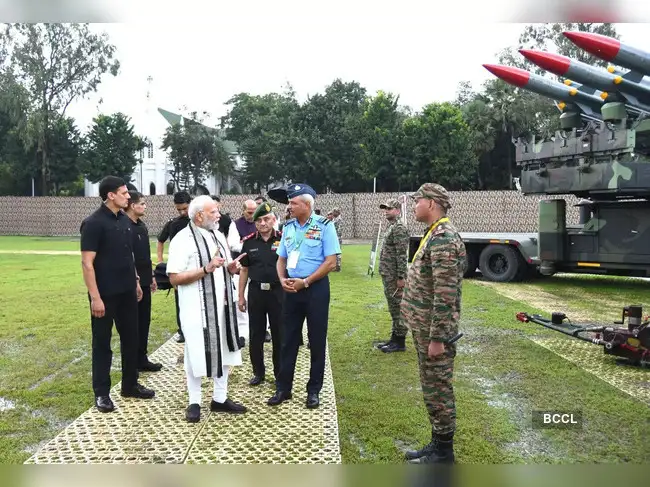
16th Armed Forces Conference 2025: PM Modi inaugurated the defence conference in Kolkata focusing on jointness, Atmanirbharta, innovation, and operational reforms in India’s armed forces.
PM Modi Opens 16th Combined Commanders’ Conference in Kolkata
Introduction: What is the CCC 2025
On 15 September 2025, Prime Minister Narendra Modi inaugurated the 16th Combined Commanders’ Conference (CCC) at the Eastern Command Headquarters (Vijay Durg), Kolkata. This three-day biennial defence conference brings together India’s top military and civilian leadership.
The Conference’s theme is “Year of Reforms – Transforming for the Future”, reflecting India’s push for modernisation, technological advancement, structural reforms, and enhanced operational preparedness.
Key Participants and Venue
- Important dignitaries present included Defence Minister Rajnath Singh, National Security Advisor Ajit Doval, Chief of Defence Staff General Anil Chauhan, Defence Secretary Rajesh Kumar Singh, and the chiefs of the Army, Navy, and Air Force.
- The location, Vijay Durg (erstwhile Fort William), is the headquarters of the Eastern Command of the Indian Army.
Main Focus Areas: Reforms, Jointness, Atmanirbharta & Innovation
During his address, PM Modi emphasised a few major priorities:
- Jointness among the Armed Forces: Enhanced integration between Army, Navy, and Air Force.
- Self-reliance (Atmanirbharta): Boosting indigenous capability in defence manufacturing, technologies, systems.
- Innovation: Adapting newer technologies, strategies, and readiness for evolving threats.
Operational Review & Context: Operation Sindoor
A central point during the conference was Operation Sindoor, carried out in May 2025:
- The Prime Minister praised the Armed Forces for its success.
- Operation Sindoor was a tri-services operation aimed at dismantling terror infrastructure across the Line of Control and deeper inside Pakistan, after the Pahalgam terror attack.
- It is treated as a “new normal” in assessing India’s operational readiness, influencing how threats are seen, including in multi-domain warfare.
Roadmap & Reforms Under Discussion
Over the course of the three days, several topics are to be discussed in depth:
- Review of reforms in the past two years, and planning for the next two years.
- Structural, administrative and operational changes based on feedback from various forces.
- Tackling global uncertainties, preparing for future warfare with emerging technology, cyberspace, unmanned systems, etc.
Why the Theme Matters: Modernisation & Preparedness
The conference with its theme is significant not just as a meeting, but as marker of India’s evolving defence posture:
- Emphasis is shifting from traditional defence structures to faster, technology-driven responses.
- Greater roles for private sector, academia, indigenous production are being encouraged.
- The move toward theatre commands, joint logistics, integrated command structures, etc., fall under this broader transformation.
Why This News Is Important
Enhancing National Security in a Changing Threat Landscape
India faces a rapidly changing strategic environment—terrorism, regional competition, border tensions, and emerging domains such as cyber, space, biological threats. The directives from this conference (jointness, innovation, self-reliance) signal that India intends to adapt to these threats proactively. For students, this reflects policy trends that exam questions may target: how India is preparing for future warfare, its defence strategy, etc.
Policy & Structural Reforms in Defence
The conference underlines that India is pursuing structural reforms: how the military is managed, how resources are allocated, how different services coordinate. Reforms like theatre commands, integration of logistics, streamlined procurement, etc. are central. These tie directly to exam topics under Governance, Security, Public Policy, etc.
Atmanirbharta & Technological Innovation as Key Pillars
Self-reliance (Atmanirbharta) is no longer just an economic slogan—it’s now intrinsic to defence planning. Innovation, especially in indigenous systems, R&D, AI, unmanned technologies, etc., are being prioritised. That’s relevant for UPSC/PSC/Bank PO current affairs sections where questions often ask how India is enhancing strategic autonomy.
Operational Readiness & Recent Operations
Operation Sindoor being referenced shows how recent operations are influencing broad defence policy. Understanding what happened in Operation Sindoor, what lessons were learnt, how they are shaping policies, is valuable for both prelims and mains. Exams often ask case studies, implications of recent operations.
Historical Context
The Tradition of the Combined Commanders’ Conference (CCC)
The CCC is a biennial apex‐level conference of India’s armed forces, bringing together senior military and civilian leaders. It serves as a platform for reviewing defence preparedness, discussing strategy, procurement, reforms, etc. Previous editions have addressed similar themes of integration and modernisation. The last CCC before 2025 was held in Bhopal in 2023.
Operation Sindoor and Its Impact
Operation Sindoor, launched in May 2025 after the Pahalgam terror attack, was a tri-services operation aimed at dismantling terror infrastructure across the Line of Control and within Pakistan. It demonstrated India’s growing ability to conduct calibrated, precise operations with jointness among services. Its success is being used as a benchmark in the 2025 CCC for reviewing operational readiness
Broader Trends in Indian Defence Reform
Over the last several years, there has been a continuous push in India for:
- Theatre Command restructuring to ensure better jointness among services.
- Procurement reforms to speed up acquisition, reduce dependence on imports.
- Strengthening indigenous defence production under “Make in India” and “Atmanirbhar Bharat.”
- Focusing on modern threats: cyber, space, unmanned systems, AI.
These trends have been building; the 2025 CCC represents a consolidation and acceleration of these efforts.
Key Takeaways from 16th CCC: “Year of Reforms – Transforming for the Future”
| S. No. | Key Takeaway |
|---|---|
| 1 | Theme emphasises reforms, transformation, change & operational preparedness. |
| 2 | Prime Minister instructs Defence Ministry to swiftly implement Jointness, Atmanirbharta (self-reliance), and Innovation. |
| 3 | Operation Sindoor’s success serves as benchmark: tri-services operations, precision, strategic messaging. |
| 4 | Focus on structural / administrative reforms: feedback across forces, longer-term planning for the next two years. |
| 5 | Top civil-military leadership involved; readiness for emerging warfare domains and enhancing domestic defence capabilities. |
FAQs: Frequently Asked Questions
1. What is the 16th Combined Commanders’ Conference (CCC) 2025?
The CCC is a biennial apex-level defence conference in India, bringing together top military and civilian leaders to review operational preparedness, discuss reforms, and plan future strategies. The 16th edition was inaugurated by PM Modi in Kolkata in September 2025.
2. Where was the 16th CCC held?
The 16th CCC was held at the Eastern Command Headquarters (Vijay Durg), Kolkata.
3. What was the theme of the 16th CCC 2025?
The theme was “Year of Reforms – Transforming for the Future”, highlighting structural reforms, innovation, jointness among armed forces, and self-reliance (Atmanirbharta).
4. Who were the key participants of the conference?
Key participants included PM Narendra Modi, Defence Minister Rajnath Singh, Chief of Defence Staff General Anil Chauhan, National Security Advisor Ajit Doval, and the chiefs of the Army, Navy, and Air Force.
5. What is Operation Sindoor mentioned during the conference?
Operation Sindoor was a tri-services military operation in May 2025 aimed at dismantling terror infrastructure along the Line of Control and inside Pakistan. Its success was highlighted as a benchmark for India’s operational readiness.
6. Why is Atmanirbharta important for India’s defence?
Atmanirbharta, or self-reliance, ensures India’s defence capabilities are indigenous, reducing dependency on imports, and promoting domestic innovation and technology in strategic sectors.
7. How does the CCC impact India’s defence policy?
The conference sets the roadmap for reforms, jointness among services, adoption of modern technology, and operational preparedness, influencing long-term defence strategies and national security policies.
Some Important Current Affairs Links

