
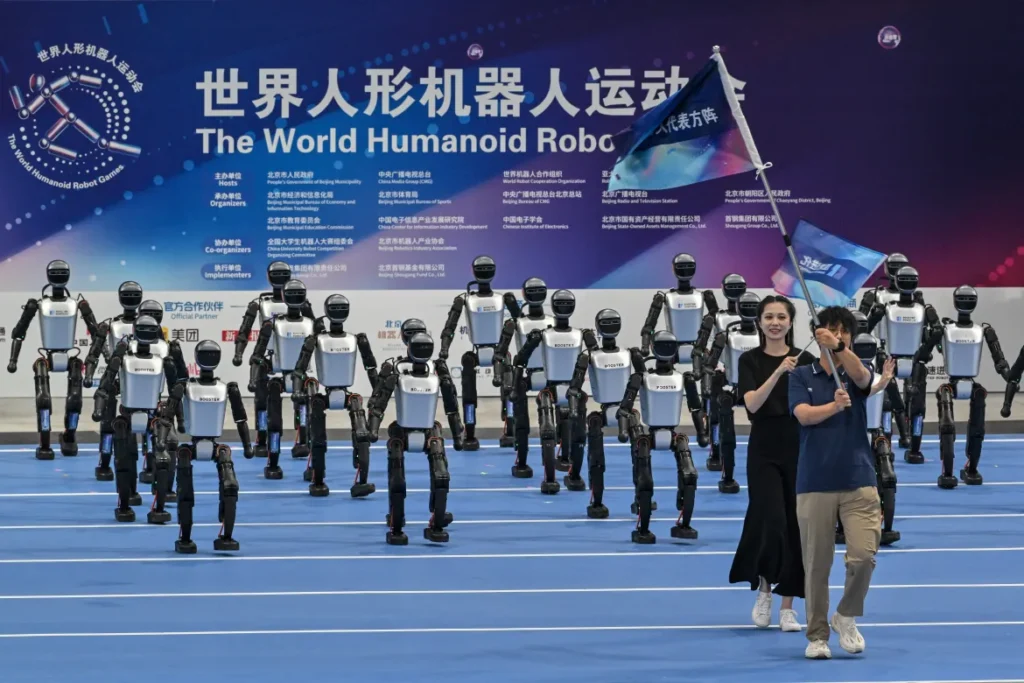
World Humanoid Robot Games 2025 in Beijing showcased over 500 humanoid robots competing in 26 events including sports, cleaning, and medicine sorting, marking a major step in AI and robotics innovation.
Over 500 Humanoid Robots Compete at World Humanoid Robot Games in Beijing – Showcasing Speed, Skill, and Stumbles
A Spectacle of Humanoid Robotics Innovation
Beijing recently hosted the inaugural World Humanoid Robot Games, an Olympics-style competition featuring over 500 humanoid robots from 280 teams across 16 countries. Held at the National Speed Skating Oval—originally built for the 2022 Winter Olympics—the three-day event brought together competitors ranging from universities such as Tsinghua and Peking to global teams from the U.S., Germany, Japan, and even middle schools.
Diverse and Ambitious Events on Display
The competition spanned an impressive array of 26 events, including sporting challenges such as sprinting (1,500 m race), soccer, kickboxing, kung fu, and dance performances, alongside practical tasks like medicine sorting, room cleaning, luggage delivery, and material handling.
Triumphs Amid Technical Glitches
While some robots showcased agility—like the winning Unitree H1 finishing the 1,500-meter dash in around 6 minutes and 30 seconds—most struggled with performance, frequently stumbling, crashing, or falling. One robot even lost its head mid-race, others tangled up during soccer, and many required human assistance to keep going.
Entertainment Meets Engineering Insight
The opening ceremony fused technology and theatrics—robots danced to hip-hop music, played musical instruments, and performed martial arts routines. These entertaining moments underscored that, despite frequent mechanical mishaps, the event provided invaluable real-world data on robot behavior.
Strategic Push Behind the Games
China has invested heavily in humanoid robotics, positioning it as a cornerstone of its broader AI and technological ambitions. The games serve as a testbed for innovation, allowing teams to experiment with novel approaches in high-stakes yet controlled environments—and turning failures into research gold.
B) Why This News Is Important
Highlighting National Technological Aspirations
China’s hosting of the first-ever World Humanoid Robot Games marks a bold assertion of its intention to lead the field of robotics and AI on the global stage. This strategic showcase reflects the importance of robotics in addressing real-world challenges—from demographic shifts to economic competitiveness—in line with national development goals.
Real-World Application and Learning
For government exam aspirants, understanding this event illustrates how technological events influence sectors like defense (robotic security), infrastructure (automation), and civil services (robot-assisted public services). Moreover, analyzing both successes and failures of robots provides insights into problem-solving, R&D strategies, and innovation under pressure.
Bridging Theory and Practice
The event exemplifies how theoretical AI and robotics find practical expression. For example, integrating robot movements into coordinated tasks mirrors issues in logistics and precision operations akin to those in railways, banking automation, and civil administration—areas where aspirants may later influence policymaking or system design.
C) Historical Context
Evolution of Robot Competitions
While robot competitions have existed for years, such as the World Robot Olympiad, they usually involve simple tasks like line-following or maze navigation. The 2025 World Humanoid Robot Games are unique in their exclusive focus on humanoid robots, involving multi-disciplinary, real-world tasks with humanoid form factors.
China’s Strategic Electronics and AI Initiatives
China’s aggressive investment in AI and robotics includes announcements like a 1 trillion-yuan fund to support AI startups and robotics firms. Cities like Beijing and Shanghai have also established substantial dedicated robotics funds.
Robotics in Demographic and Economic Transition
Addressing an aging workforce and a shrinking population, China sees humanoid robots as potential solutions for elder care, factory automation, and service sectors—areas that historically employ large workforces now in short supply.
D) Key Takeaways from World Humanoid Robot Games
| S.No. | Key Takeaway |
|---|---|
| 1 | The first World Humanoid Robot Games took place in Beijing in August 2025, featuring over 500 robots from 280 teams across 16 countries, competing in 26 events. |
| 2 | Events ranged from athletic contests (sprinting, soccer, kickboxing) to practical tasks (cleaning, luggage delivery, medicine sorting). |
| 3 | Despite occasional impressive performances (e.g. Unitree’s H1 robot finishing the 1,500 m in ~6.5 minutes), most robots experienced mechanical failures—falls, crashes, lost parts. |
| 4 | The event blended entertainment and research: robots danced, performed martial arts, and played music, while frequent mishaps provided valuable engineering insights. |
| 5 | Organized amid China’s broader AI strategy, the games reflect strategic investment in robotics for future public services, industry, and demographic support. |
FAQs – Frequently Asked Questions
Q1. What was the significance of the World Humanoid Robot Games 2025?
The event marked the first-ever international humanoid robot Olympics, showcasing global innovation in AI and robotics while testing robots in real-world applications.
Q2. How many robots and teams participated in the event?
Over 500 robots from 280 teams across 16 countries competed in Beijing.
Q3. Which notable university teams took part?
Top institutions like Tsinghua University and Peking University, along with international teams from the U.S., Germany, and Japan, were among the participants.
Q4. What were some unique events included in the competition?
Events ranged from athletics and soccer to martial arts, dance, medicine sorting, cleaning, and luggage delivery.
Q5. Which robot achieved a remarkable feat in the games?
The Unitree H1 humanoid robot completed the 1,500-meter race in around 6 minutes and 30 seconds.
Q6. Why did many robots stumble or fail during the games?
Robots are still in the developmental stage—coordination, balance, and decision-making under dynamic conditions remain major challenges.
Q7. Why is this event important for civil service exam aspirants?
It highlights technological advancements in AI and robotics, which are increasingly relevant in governance, defense, banking, railways, and public service reforms.
Q8. How does this align with China’s policy goals?
China sees humanoid robotics as vital for solving demographic challenges and boosting industrial productivity through automation.
Q9. Did entertainment play a role in the event?
Yes, robots performed dances, martial arts, and even music to engage audiences and demonstrate programming creativity.
Q10. How could such innovations affect future jobs?
While automation could reduce some traditional jobs, it also creates new opportunities in robotics engineering, AI regulation, public service integration, and defense technologies.
Some Important Current Affairs Links

