
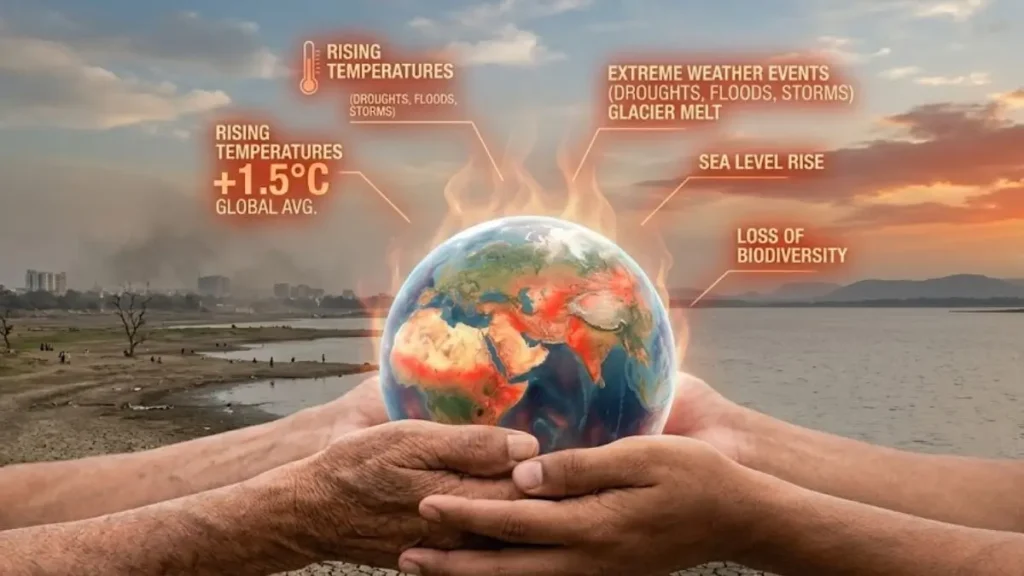
WMO 2026 climate alert warns Earth’s climate is flashing red due to record energy imbalance and greenhouse gas rise. Learn key impacts, historical context, and exam-relevant insights.
WMO Warns Earth’s Climate Is “Flashing Red” in 2026: An Urgent Global Climate Alert
The World Meteorological Organization (WMO), a specialised agency of the United Nations, has issued a stark warning in 2026 that Earth’s climate system is in a state of emergency, with multiple climate indicators turning “flashing red”. According to the latest State of the Global Climate 2025 report, compiled and released by the WMO, the planet’s energy imbalance has reached its highest levels in 65 years — a clear sign of rapidly accelerating global warming driven by human activities.
What Is Earth’s Energy Imbalance?
Energy balance refers to the equilibrium between the energy Earth receives from the sun and the energy it radiates back into space. When greenhouse gases accumulate in the atmosphere — mainly from burning fossil fuels and deforestation — they trap more heat, preventing it from escaping back into space. This causes the Earth to absorb more energy than it releases, leading to a positive energy imbalance. In 2026, this imbalance reached a record high, indicating that excess heat is being stored in the climate system — especially in the oceans — fueling warming at unprecedented rates.
Oceans and the Hidden Heat Crisis
A key highlight of the WMO report is the role of the world’s oceans in absorbing heat. Over 90% of this excess energy is being taken up by the oceans, leading to higher ocean temperatures. This has far‑reaching consequences, from intensifying marine heatwaves to weakening oceanic circulation patterns that regulate global climates. Ocean warming affects marine biodiversity, disrupts fisheries, and contributes to rising sea levels through thermal expansion.
Greenhouse Gases Reach Historic Levels
The report also notes that concentrations of greenhouse gases are at levels unseen in millions of years. Carbon dioxide (CO₂) has reached a concentration not seen in the past 2 million years, while methane and nitrous oxide have hit peaks not experienced in 800,000 years. These potent heat‑trapping gases intensify the greenhouse effect, further driving global warming and contributing to extreme weather patterns such as heatwaves, droughts, and cyclones.
Melting Ice and Rising Seas
The rapid warming of the planet accelerates the melting of glaciers and polar ice sheets in Greenland and Antarctica. This melting contributes significantly to global sea level rise, with observable trends showing an increase in average sea levels. Rising seas pose a major risk to coastal populations, infrastructure, and ecosystems worldwide.
Impact on Human Life and Economy
Climate change is no longer merely an environmental concern — it is a socio‑economic crisis. Extreme heat, floods, and storms worsen public health outcomes, undermining food and water security. According to the report’s analysis, millions of workers are increasingly exposed to dangerous heat conditions, reducing labour productivity and affecting sectors such as agriculture and construction.

Why This News Is Important for Competitive Exams
Key Climate Change Indicator for General Awareness
Understanding the WMO’s climate warning is crucial for competitive exams like UPSC, PSC, SSC, Bank PO, Railways, and Defence because climate change is a frequent topic in General Studies and Environment sections. The WMO’s report provides the latest global data on climate status, which directly relates to questions on environmental issues and sustainable development goals.
Relevance to International Diplomacy and Policy
This news highlights how international institutions like the UN and WMO are monitoring and communicating climate risks. Questions in exams often revolve around the roles of global organisations in tackling climate challenges — including the Paris Agreement, UNFCCC, and efforts to limit temperature rise. Knowledge of how the WMO tracks climate indicators improves candidates’ answers in policy‑related sections.
Interdisciplinary Importance Across Subjects
The concept of energy imbalance and greenhouse gases integrates knowledge from Geography, Science & Technology, and Economics. For instance, how energy imbalance contributes to sea‑level rise connects with physical geography, while rising temperatures impacting agriculture link to economics and disaster management. This multi‑dimensional relevance makes the topic vital for Essay Writing, General Knowledge, and Case Studies in exams.
Historical Context: Climate Monitoring and WMO’s Role
Formation and Mandate of WMO
The World Meteorological Organization was established on 23 March 1950 under the United Nations to coordinate global meteorological and climate activities. Its mandate includes monitoring weather, climate, and water resources and compiling scientific data globally. The WMO’s annual State of the Global Climate reports are authoritative sources for climate trends.
Evolution of Climate Science Reporting
In the past few decades, WMO reports have documented a consistent rise in global temperatures, frequency of extreme weather, and greenhouse gas concentrations. With advances in satellite observations and data modelling, these reports have become more accurate and comprehensive — forming the backbone of climate science assessment and policy frameworks like the IPCC and Paris Climate Agreement.
Global Climate Milestones
Historically, the period from 2015 to 2025 has been documented as the hottest decade on record. This trend reflects an accelerating climate crisis driven by human‑induced emissions. Recognising these patterns helps students understand how present circumstances compare to historical climate baselines — a common question in competitive exams.
Key Takeaways from “WMO Warns Earth’s Climate Is Flashing Red in 2026”
| S. No. | Key Takeaway |
|---|---|
| 1 | Earth’s climate system is in a state of emergency with multiple indicators flashing red due to accelerated warming. |
| 2 | WMO reported that the global energy imbalance has reached a 65‑year high, trapping more heat than ever. |
| 3 | Over 90% of excess heat is absorbed by oceans, leading to ocean warming and ecosystem stress. |
| 4 | Greenhouse gases like CO₂ have reached historic levels, driving continued global warming. |
| 5 | Climate impacts include extreme weather, rising sea levels, threats to health, and socio‑economic disruptions. |
FAQs: Frequently Asked Questions
1. What is the main warning issued by WMO in 2026?
The WMO warned that Earth’s climate is “flashing red,” indicating a global climate emergency due to record-high energy imbalance and increasing greenhouse gas levels.
2. What does Earth’s energy imbalance mean?
It refers to the difference between energy received from the sun and energy radiated back to space. A positive imbalance means more heat is being trapped, causing global warming.
3. How are oceans affected by the current climate crisis?
Over 90% of excess heat is absorbed by oceans, leading to rising sea levels, marine heatwaves, disrupted ocean currents, and threats to marine biodiversity.
4. Which greenhouse gases are at historic levels according to WMO?
Carbon dioxide (CO₂), methane (CH₄), and nitrous oxide (N₂O) have reached concentrations not seen in millions of years, intensifying global warming.
5. How is this news relevant for competitive exams?
It covers key environmental and climate change topics relevant for General Studies, Environment, Geography, and current affairs sections in exams like UPSC, PSC, SSC, Bank PO, Railways, and Defence.
6. Which international agreements are connected to this warning?
The Paris Agreement, UNFCCC initiatives, and Sustainable Development Goals (SDGs) are global frameworks addressing climate change highlighted in WMO’s report.
7. How does climate change impact human life?
It increases extreme weather events, reduces labour productivity due to heat stress, threatens food and water security, and affects public health.
8. What is the historical significance of this report?
This is the first time WMO has highlighted the climate system as “flashing red,” signalling unprecedented warming and environmental risk in modern human history.
Some Important Current Affairs Links

