
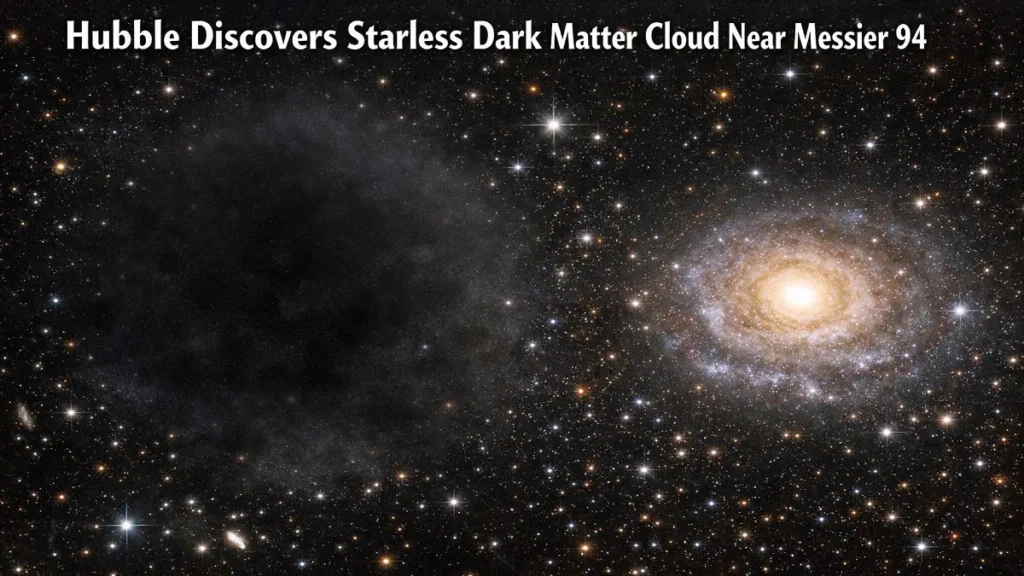
Starless dark matter cloud Cloud‑9 discovered near Messier 94 by Hubble provides unique insights into galaxy formation, dark matter, and early universe structures.
🌌 Hubble Discovers Starless Dark Matter Cloud Near Messier 94 – A Breakthrough in Cosmic Research
In a landmark discovery that is reshaping our understanding of the universe, scientists using NASA’s Hubble Space Telescope have identified a rare cosmic object dominated by dark matter – one that contains no stars at all. This mysterious entity, nicknamed Cloud-9, was discovered close to the spiral galaxy Messier 94 (M94), approximately 14 million light-years away from Earth.
Cloud-9 falls into a special class of astronomical objects known as Reionization-Limited HI Clouds (RELHICs): structures rich in neutral hydrogen gas but devoid of star formation. Scientists believe such objects are relics of the early universe — original building blocks that never evolved into fully formed galaxies.
📍 What is Cloud-9?
Cloud-9 is fundamentally unique:
- It contains massive amounts of neutral hydrogen — nearly one million times the mass of our Sun.
- Its surrounding dark matter halo is extremely heavy, estimated at around five billion solar masses.
- Despite these massive components, Cloud-9 has no stars, distinguishing it clearly from ordinary galaxies.
Scientists first detected this object through radio signals using large radio telescopes like China’s Five-hundred-meter Aperture Spherical Telescope (FAST). Subsequent observations with the Very Large Array (VLA) and Green Bank Telescope (GBT) confirmed the hydrogen gas, but it was only with Hubble’s high-resolution imaging that researchers could definitively confirm its starless nature.
🧠 Why Cloud-9 Matters in Astrophysics
Cloud-9 is not just another celestial body — it’s a cosmic relic that offers direct evidence of theories about how galaxies are born and how dark matter influences this process. For decades, cosmologists have predicted the existence of dark matter halos that collect gas but fail to form stars. Cloud-9 is the first confirmed observation of this predicted population, making it a breakthrough discovery in astrophysics.
Unlike typical galaxies — like our Milky Way with billions of stars — Cloud-9 represents a “failed galaxy,” where conditions necessary for star formation were never met. Such objects act as natural laboratories for studying dark matter — the invisible substance that makes up most of the universe’s mass — without interference from bright stars that normally complicate observations.
🔭 What Makes Cloud-9 Unique?
Cloud-9 helps scientists in multiple ways:
- It reinforces current theories of galaxy formation and evolution.
- It provides a direct observational look into dark matter distribution in a region free of stars.
- It offers clues about the primordial universe, shortly after the Big Bang, when the first cosmic structures began forming.
The discovery of Cloud-9 was published in The Astrophysical Journal Letters and presented at the 247th meeting of the American Astronomical Society, marking it as one of the most significant scientific revelations of the year.

📌 Why This News Is Important for Competitive Exams
⭐ Relevance in Science & Technology Section
This discovery sits at the crossroads of astronomy and physics, making it highly relevant for students preparing for government exams such as UPSC (IAS), PSCs, SSC, banking, and defence services where Science & Technology is a crucial topic. Knowledge about dark matter, galaxy formation, and space exploration missions is often tested in prelims and mains.
⭐ Insight into Dark Matter and Universe Structure
Dark matter is one of the biggest unanswered questions in physics. It does not emit, absorb, or reflect light, so it cannot be observed directly. Discoveries like Cloud-9 give candidates an important real-world example of how scientists detect and infer the presence of dark matter using advanced instruments like the Hubble Space Telescope.
⭐ Validating Theoretical Models
Cloud-9 is the first confirmed example of a class of objects known as RELHICs — predicted by cosmological models explaining why some dark matter halos fail to initiate star formation. This shows how theoretical predictions are confirmed by cutting-edge technology — an important concept in advanced competitive exam syllabi.
⭐ Encourages Awareness of Space Research
Space missions, astronomical observatories, and deep-space research are favorite topics in current affairs and general studies sections. Cloud-9’s discovery by an international collaboration highlights global scientific cooperation, another recurring topic in exam questions.
🕰️ Historical Context: Dark Matter and Galaxy Formation
⭐ Early Dark Matter Theory
The concept of dark matter was first proposed in the early 20th century when astronomers found that visible matter alone could not explain the motion of stars in galaxies. Later research strengthened the idea that most of the universe’s mass is made of invisible dark matter.
⭐ Galaxy Formation Models
Modern cosmology suggests that galaxies form when dark matter halos attract gas. Under the right conditions, this gas cools and condenses to form stars. However, not all halos gather enough gas or meet the conditions for star formation.
⭐ Prediction of RELHICs
Theoretical models predicted the existence of Reionization-Limited HI Clouds (RELHICs) — halos rich in gas and dark matter but lacking stars — as remnants from the early universe. Until now, these were theoretical predictions. Cloud-9’s confirmation marks the first time this prediction has been directly observed.
⭐ Hubble’s Role in Astronomy
Since its launch in 1990, the Hubble Space Telescope has revolutionized our understanding of the cosmos. Its exceptionally clear images and deep-space observations have helped verify multiple scientific theories — and now, it has confirmed a new class of cosmic object.
📋 Key Takeaways from Hubble Discovers Starless Dark Matter Cloud
| S.No. | Key Takeaway |
|---|---|
| 1 | Cloud-9 is a starless dark-matter dominated cloud near galaxy Messier 94. |
| 2 | It was confirmed using NASA’s Hubble Space Telescope. |
| 3 | Cloud-9 is a Reionization-Limited HI Cloud (RELHIC), providing evidence of early cosmic structures. |
| 4 | The discovery supports theories about galaxy formation and dark matter behavior. |
| 5 | The findings were published in The Astrophysical Journal Letters and presented internationally. |
FAQs: Frequently Asked Questions
1. What is Cloud‑9 discovered near Messier 94?
Cloud‑9 is a starless dark matter-dominated cloud, also classified as a Reionization-Limited HI Cloud (RELHIC), discovered close to the spiral galaxy Messier 94, about 14 million light-years from Earth.
2. Which telescope confirmed the starless nature of Cloud‑9?
The Hubble Space Telescope (HST) provided high-resolution images confirming that Cloud‑9 contains no stars.
3. Why is Cloud‑9 important for science and competitive exams?
Cloud‑9 helps scientists study dark matter and galaxy formation, and it serves as a practical example of cosmic structures and theoretical astrophysics topics frequently covered in UPSC, PSC, SSC, banking, and defence exams.
4. What makes Cloud‑9 different from ordinary galaxies?
Unlike galaxies like the Milky Way, Cloud‑9 has massive dark matter and hydrogen gas but no stars, making it a “failed galaxy” and a unique laboratory to study dark matter distribution.
5. What are RELHICs?
Reionization-Limited HI Clouds (RELHICs) are objects rich in neutral hydrogen and dark matter but unable to form stars, predicted by cosmological models as remnants from the early universe.
6. How was Cloud‑9 detected initially?
It was first identified using radio telescopes, including the Five-hundred-meter Aperture Spherical Telescope (FAST), Very Large Array (VLA), and Green Bank Telescope (GBT), before Hubble confirmed its starless nature.
7. Which scientific journal published Cloud‑9’s discovery?
The discovery was published in The Astrophysical Journal Letters and presented at the American Astronomical Society meeting.
8. What can students learn from Cloud‑9’s discovery?
It provides insight into dark matter, galaxy formation, early universe structures, and observational astronomy, all of which are important for science-related competitive exams.
Some Important Current Affairs Links

