
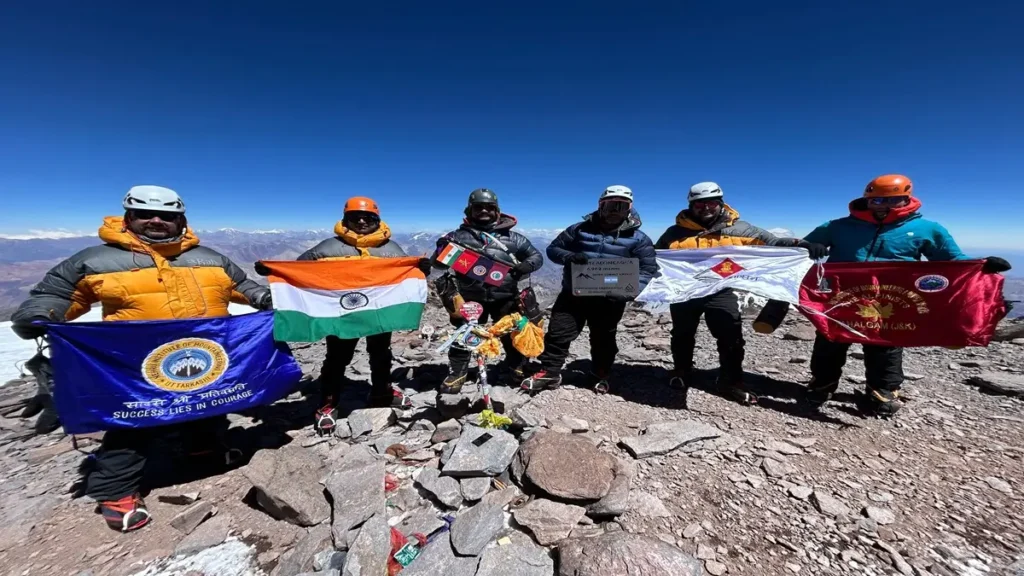
Mount Aconcagua Summit 2026 marks a major achievement as NIM JIM&WS team successfully scales South America’s highest peak. Read key facts, exam relevance, MCQs, and important takeaways for UPSC, PCS, Defence and Banking exams.
Historic Summit: NIM–JIM&WS Team Conquers Mount Aconcagua in Argentina
In a remarkable achievement for Indian adventure sports, a coordinated mountaineering team from the Nehru Institute of Mountaineering (NIM), Uttarkashi, and the Jawahar Institute of Mountaineering & Winter Sports (JIM&WS), Pahalgam, successfully reached the summit of Mount Aconcagua, the highest peak in South America at 6,961 metres (22,838 feet) above sea level.
The expedition, part of India’s growing engagement in global high-altitude mountaineering, reached this historic milestone on 22 February 2026 at around 14:10 hours local time. The achievement signals India’s increasing prowess in extreme adventure and expeditionary missions beyond the Himalayan belt.
Leadership and Team Strength
The challenging expedition was led by Col Hem Chandra Singh, the Principal of both NIM and JIM&WS. The team comprised six highly skilled members with extensive training in mountaineering and survival skills, including:
- Col Hem Chandra Singh (Leader)
- Capt G Santhosh Kumar
- Shri Deep Bahadur Sahi
- Shri Vinod Gusai
- Nb Sub Bhupinder Singh
- Hav Ramesh Kumar
Before commencing their assault on Aconcagua, the climbers first acclimatised by ascending Bonete Peak (5,050 metres), preparing themselves for the harsh conditions that awaited.
Ceremonial Flag-off and Strategic Start
The expedition was ceremonially flagged off on 5 February 2026 by Defence Minister Shri Rajnath Singh from New Delhi, highlighting the strategic importance of such global engagements for Indian adventure teams.
The team arrived in Argentina on 8 February, where they began their strenuous journey upwards. The mission was designed to test extreme endurance, sharpen mountaineering skills, and enhance India’s reputation in world-class mountaineering endeavours.
Conquering Harsh Conditions
Climbing Aconcagua is not just about height but also resilience. The team battled temperatures between −20°C to −30°C, fierce winds, and oxygen scarcity at higher altitudes. These conditions require superb physical fitness and mental strength—traits the Indian team demonstrated with distinction.
Despite these dangers, the team’s discipline, teamwork, and professional training allowed them to stand victorious at the summit, proudly hoisting the Indian flag on one of the toughest mountains outside the Asian continent.
Symbol of India’s Mountaineering Prowess
Mount Aconcagua is the highest peak in South America and the second-highest peak in the world outside Asia, making this accomplishment a moment of immense pride for Indian adventure institutes.
This successful summit reinforces India’s growing stature in global adventure sports, showcases the excellent training standards of its premier mountaineering institutions, and inspires a new generation of adventurers and aspirants preparing for demanding careers across sectors, including defence, adventure tourism, and civil services.
Future Impact and Significance
The knowledge and experience gained from scaling Aconcagua is expected to enhance high-altitude training programs in India, particularly benefiting youth and armed forces personnel aspiring to serve in challenging terrains.
The expedition adds a significant chapter to India’s adventure history while reaffirming the nation’s commitment to pushing boundaries and achieving excellence on the world stage.

Why This News is Important for Competitive Exams
Significance for Government Exam Aspirants
The successful Indian expedition to Mount Aconcagua holds valuable relevance for students preparing for competitive exams such as UPSC (Civil Services), SSC, Banking, Railways, State PCS, Defence, Police Services, and Teaching roles. Current affairs questions often focus on India’s recent achievements pertaining to national pride, international recognitions, and scientific or adventure feats. This mission connects with multiple themes under General Studies and General Knowledge, particularly in areas like international engagement, geographical landmarks, and India’s global achievements.
Educational and Inspirational Importance
Understanding such events enhances a student’s appreciation for India’s growing global presence beyond traditional domains. It offers valuable context for essay writing, interview discussions, and analytical questions related to national achievements, teamwork, leadership, and human endurance.
Historical Context: Mount Aconcagua and India’s Mountaineering Legacy
Mount Aconcagua, located in the Andes mountain range of Argentina, stands at 6,961 metres and is the highest mountain in South America and the second highest outside Asia. Climbing it has long been a goal for world mountaineers who seek to conquer major continental peaks, often as part of the famed “Seven Summits Challenge”.
India’s involvement in high-altitude mountaineering has a rich heritage, with institutions such as the Nehru Institute of Mountaineering (NIM) and Jawahar Institute of Mountaineering & Winter Sports (JIM&WS) playing pivotal roles in training generations of expert climbers. While India’s legendary mountaineers have made history on iconic peaks like Mount Everest, the recent success on Mount Aconcagua signifies the expanding global scope of Indian adventurers.
Key Takeaways from “NIM–JIM&WS Joins Mt Aconcagua Summit”
| S. No. | Key Takeaway |
|---|---|
| 1. | A six-member team from NIM and JIM&WS successfully summited Mount Aconcagua in Argentina on 22 February 2026. |
| 2. | Mount Aconcagua is the highest peak in South America and the second highest outside Asia. |
| 3. | The expedition was flagged off by Defence Minister Rajnath Singh on 5 February 2026. |
| 4. | The team faced extreme weather, including temperatures as low as −30°C. |
| 5. | Success underscores India’s growing stature in international mountaineering and adventure sports. |
Frequently Asked Questions (FAQs)
1. Where is Mount Aconcagua located?
Mount Aconcagua is located in the Andes mountain range in western Argentina. It is the highest peak in South America.
2. What is the height of Mount Aconcagua?
Mount Aconcagua stands at 6,961 meters (22,838 feet) above sea level, making it the highest mountain outside Asia.
3. Which Indian institutions successfully summited Mount Aconcagua in 2026?
The expedition was conducted jointly by the Nehru Institute of Mountaineering (NIM), Uttarkashi, and the Jawahar Institute of Mountaineering & Winter Sports (JIM&WS), Pahalgam.
4. Who led the Indian expedition to Mount Aconcagua?
The team was led by Colonel Hem Chandra Singh, Principal of both NIM and JIM&WS.
5. On which date did the team successfully reach the summit?
The team reached the summit on 22 February 2026.
6. Why is Mount Aconcagua significant in global mountaineering?
Mount Aconcagua is one of the famed “Seven Summits,” representing the highest peak on the South American continent.
7. Which Indian dignitary flagged off the expedition?
The expedition was flagged off by Rajnath Singh, India’s Defence Minister.
8. What temperatures did the team face during the expedition?
The team faced extreme temperatures ranging from -20°C to -30°C along with strong winds and oxygen scarcity.
9. Why is this news important for UPSC and State PCS exams?
Questions related to international geography, India’s global achievements, defence involvement, and mountaineering records are frequently asked in General Studies papers.
10. What is the Seven Summits Challenge?
The Seven Summits Challenge involves climbing the highest peak on each of the seven continents, and Mount Aconcagua represents South America in this list.
Some Important Current Affairs Links

