
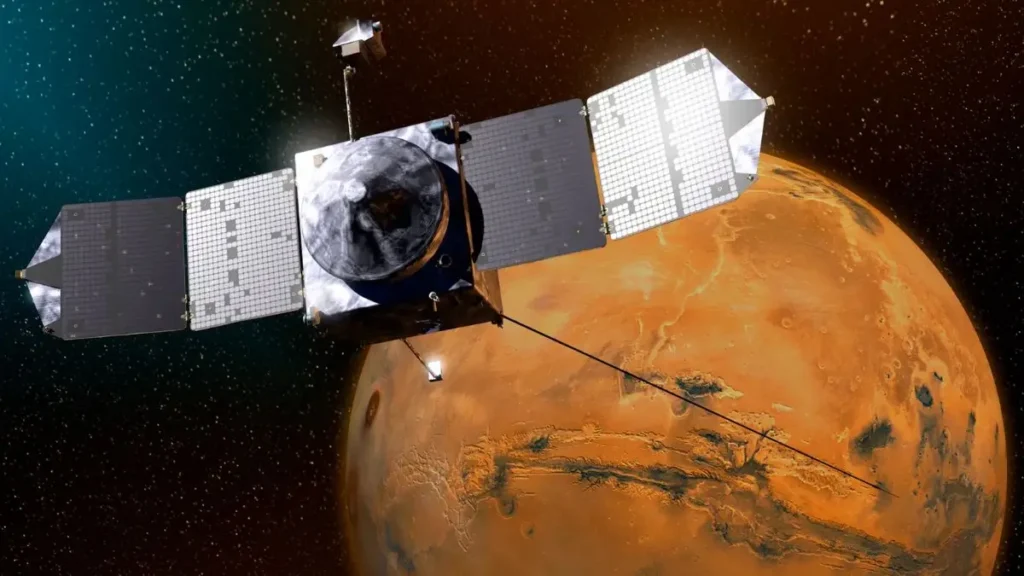
MAVEN mission Mars atmosphere study concludes as NASA officially ends its historic Mars exploration mission after more than a decade. Learn key discoveries, objectives, exam-important facts, timeline, and major contributions to planetary science.
NASA Officially Concludes MAVEN Mission After More Than a Decade of Mars Exploration
Introduction to the MAVEN Mission
The United States space agency, NASA, has officially concluded the MAVEN (Mars Atmosphere and Volatile Evolution) mission after more than eleven years of successful operations around Mars. The mission, launched in November 2013 and inserted into Mars’ orbit in September 2014, was originally designed for a one-year scientific study. However, it exceeded expectations and continued operating for over a decade, becoming one of NASA’s most successful Mars exploration missions.
Why NASA Ended the Mission
NASA announced that contact with the MAVEN spacecraft was permanently lost after December 6, 2025. The spacecraft experienced an unexpected anomaly when it passed behind Mars, resulting in a loss of signal. Despite several months of recovery attempts using NASA’s Deep Space Network and other facilities, engineers were unable to restore communication. A review board later determined that the spacecraft had entered an unrecoverable state, forcing NASA to officially declare the mission complete.
Scientific Objectives of MAVEN
MAVEN was the first mission specifically designed to study the Martian atmosphere and understand how Mars transformed from a potentially habitable planet into the cold and dry world observed today. Scientists sought answers to one of planetary science’s most important questions: What happened to Mars’ atmosphere?
The spacecraft investigated how solar winds stripped away atmospheric particles over billions of years. Through detailed observations of Mars’ upper atmosphere, ionosphere, and interactions with the Sun, MAVEN provided groundbreaking evidence explaining atmospheric loss on the Red Planet.
Major Discoveries Made by MAVEN
During its operational life, MAVEN achieved several remarkable scientific milestones.
Understanding Atmospheric Escape
One of its most significant contributions was demonstrating how solar wind and solar storms gradually eroded Mars’ atmosphere. This discovery helped scientists understand why liquid water disappeared from the planet’s surface.
Discovery of Martian Auroras
The mission recorded the first visible-light observations of auroras on Mars. These observations provided valuable insights into planetary magnetic fields and atmospheric interactions.
Studying Solar Activity
MAVEN observed the impact of solar storms and energetic particles on the Martian environment. The collected data improved scientific understanding of space weather and its effects on planetary atmospheres.
Support for Surface Missions
Beyond scientific observations, MAVEN served as a communication relay for NASA’s Mars rovers, including Curiosity and Perseverance. This role was crucial in transmitting scientific data from the Martian surface back to Earth.
Impact on Future Human Missions to Mars
The information gathered by MAVEN is expected to guide future human exploration efforts. Understanding radiation levels, atmospheric conditions, and solar wind interactions is essential for designing safe missions for astronauts traveling to Mars. NASA officials have emphasized that MAVEN’s scientific legacy will continue influencing planetary exploration and mission planning for many years.
What Happens Next?
Although the spacecraft is no longer operational, it will remain in Mars orbit for an estimated 50 to 100 years. NASA has begun archiving the mission’s vast scientific dataset so researchers worldwide can continue analyzing its findings. Other orbiters, including Mars Reconnaissance Orbiter, Mars Odyssey, and European Space Agency missions, will continue supporting Mars exploration activities.
Conclusion
The conclusion of the MAVEN mission marks the end of a historic chapter in planetary science. By revealing how Mars lost its atmosphere and helping scientists understand the evolution of planetary environments, MAVEN transformed humanity’s knowledge of the Red Planet. Even though the spacecraft has fallen silent, its scientific contributions will continue shaping Mars research and future space exploration missions for decades.

Why This News Is Important
Importance for Space Science
The official conclusion of the MAVEN mission is significant because it marks the end of one of NASA’s most productive Mars exploration programs. The mission generated an enormous amount of data regarding atmospheric evolution, planetary habitability, and solar interactions. These findings have become fundamental references for planetary scientists studying Mars and other celestial bodies.
Relevance for Future Human Exploration
MAVEN’s research provides critical information for future crewed missions to Mars. Understanding atmospheric loss, radiation exposure, and space weather conditions helps engineers develop safer spacecraft and astronaut protection systems. This knowledge is essential as international space agencies prepare for long-term human presence on Mars.
Importance for Competitive Examinations
For UPSC, State PSC, SSC, Banking, Railways, Defence, and Teaching examinations, questions frequently appear regarding major space missions, Mars exploration programs, NASA achievements, and planetary science discoveries. The MAVEN mission represents an important current affairs topic because it combines science, technology, international space research, and planetary exploration. Students should remember the mission’s full form, launch year, objectives, key discoveries, and reasons for mission termination.
Historical Context
Evolution of Mars Exploration
Mars has fascinated scientists for decades due to evidence suggesting that water once existed on its surface. Various missions by NASA, the Soviet Union, and the European Space Agency have attempted to study the planet’s geology, atmosphere, and potential habitability.
NASA’s Mars Program
NASA has conducted several successful Mars missions, including the Mars Pathfinder, Spirit and Opportunity rovers, Curiosity rover, Perseverance rover, Mars Odyssey, and Mars Reconnaissance Orbiter. These missions collectively enhanced understanding of Martian geology and climate.
Launch of MAVEN
MAVEN was launched on November 18, 2013, and entered Mars orbit on September 21, 2014. It became the first dedicated mission to investigate the Martian upper atmosphere and determine how atmospheric escape transformed the planet over billions of years.
Legacy of the Mission
Over more than eleven years, MAVEN completed thousands of orbits and produced groundbreaking discoveries about solar wind interactions, atmospheric escape processes, auroras, and Mars’ climatic evolution. Its success established a foundation for future Mars science missions.
Key Takeaways from This News
| S. No. | Key Takeaway |
|---|---|
| 1 | MAVEN stands for Mars Atmosphere and Volatile Evolution. |
| 2 | The spacecraft was launched on 18 November 2013 and entered Mars orbit on 21 September 2014. |
| 3 | NASA officially ended the mission in June 2026 after losing contact with the spacecraft in December 2025. |
| 4 | MAVEN studied how solar wind stripped away Mars’ atmosphere, helping explain the planet’s transformation from a potentially habitable world to a dry planet. |
| 5 | The mission also served as a communication relay for Curiosity and Perseverance rovers and contributed significantly to future human Mars exploration planning. |
FAQs: NASA Officially Concludes MAVEN Mission After More Than a Decade of Mars Exploration
Q1. What does MAVEN stand for?
MAVEN stands for Mars Atmosphere and Volatile Evolution. It was a NASA mission designed to study the Martian atmosphere and understand how Mars lost much of its atmosphere over time.
Q2. Which organization launched the MAVEN mission?
The MAVEN mission was launched by NASA (National Aeronautics and Space Administration), the space agency of the United States.
Q3. When was the MAVEN spacecraft launched?
The MAVEN spacecraft was launched on November 18, 2013.
Q4. When did MAVEN enter Mars orbit?
MAVEN successfully entered Mars orbit on September 21, 2014.
Q5. What was the primary objective of the MAVEN mission?
The primary objective was to study Mars’ upper atmosphere and determine how atmospheric gases escaped into space over billions of years.
Q6. Why is the MAVEN mission important?
The mission helped scientists understand why Mars transformed from a planet that may have supported liquid water into the cold and dry world seen today.
Q7. When did NASA officially conclude the MAVEN mission?
NASA officially concluded the mission in June 2026 after losing communication with the spacecraft in December 2025.
Q8. What major discovery did MAVEN make?
MAVEN provided evidence that solar wind stripped away much of Mars’ atmosphere, contributing to the loss of surface water.
Q9. Did MAVEN support other Mars missions?
Yes. MAVEN acted as a communication relay for Mars rovers such as Curiosity and Perseverance.
Q10. Why is MAVEN important for competitive examinations?
The mission is important because questions related to space missions, NASA, Mars exploration, atmospheric science, and recent scientific developments frequently appear in UPSC, State PSC, SSC, Banking, Railways, Defence, and Teaching examinations.
Q11. Which planet was studied by the MAVEN mission?
Mars, often referred to as the “Red Planet.”
Q12. What is NASA’s full form?
NASA stands for National Aeronautics and Space Administration.
Q13. Which rover is currently exploring Mars?
NASA’s Perseverance rover is currently conducting scientific research on Mars.
Q14. What is solar wind?
Solar wind is a stream of charged particles continuously emitted by the Sun that can affect planetary atmospheres.
Q15. How long did the MAVEN mission operate?
Although designed for about one year, MAVEN operated successfully for more than eleven years.
Some Important Current Affairs Links

