
Kazakhstan joins Abraham Accords, expanding Israel’s diplomatic framework into Central Asia. Discover the geopolitical significance, U.S. strategy, and exam-relevant insights for current affairs.
Kazakhstan Set to Join the Abraham Accords: A Strategic Shift in Central Asian Diplomacy
Introduction: Kazakhstan’s Breakthrough Move
In a landmark diplomatic announcement, Kazakhstan has indicated its intention to join the Abraham Accords, the U.S.-brokered framework aimed at normalising ties between Israel and Muslim-majority nations. According to statements made by Donald Trump on 6 November 2025, this move marks Kazakhstan as the latest country to sign onto what began in 2020.
What the Abraham Accords Are
The Abraham Accords were initially signed in 2020 under the Trump administration and represented a major departure in Middle East diplomacy: several Arab states formalised relations with Israel after decades of hostilities. The original signatories included the United Arab Emirates, Bahrain, Morocco and Sudan. By joining, Kazakhstan expands this diplomatic architecture beyond the Arab world into Central Asia.
Why Kazakhstan’s Entry Is Significant
Although Kazakhstan already maintains diplomatic and trade ties with Israel, its formal accession to the Abraham Accords carries both symbolic and strategic weight.
From a strategic vantage point, Kazakhstan’s accession:
- Aligns the country with a U.S.-led initiative that emphasises diplomacy, trade, and security coordination.
- Enhances multilateral cooperation among signatory states — including deeper economic, technological and security collaboration, as confirmed by remarks from the U.S. Secretary of State.
- Signals a broader pivot in Central Asia’s diplomacy: Viewed previously as in the sphere of influence of Russia or China, the region now actively engages with U.S. strategic rapprochements.
U.S. Strategy and Regional Impacts
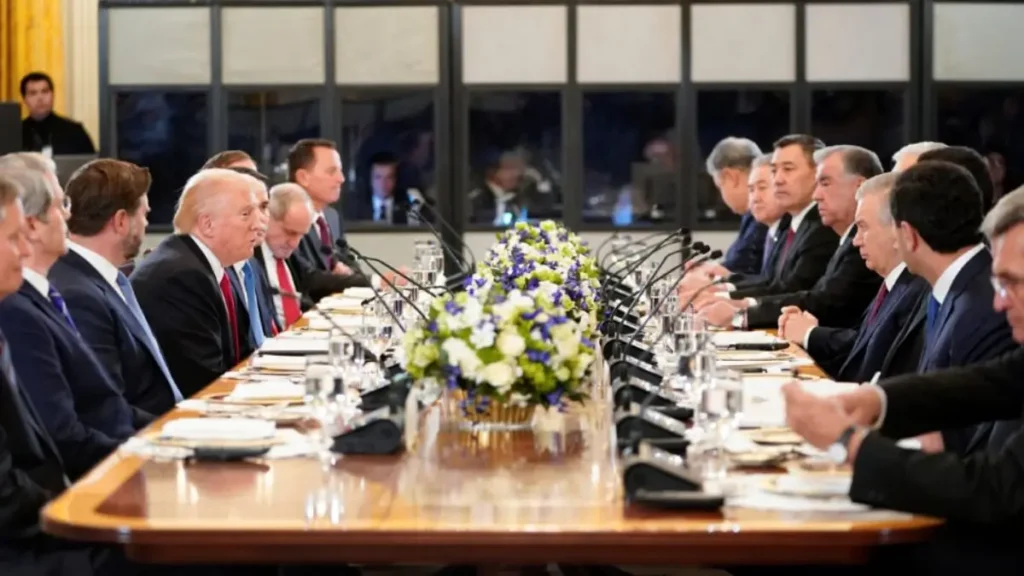
President Trump announced this development following a meeting with the leaders of the “C5+1” grouping — Kazakhstan, Kyrgyzstan, Tajikistan, Turkmenistan and Uzbekistan — at the White House. The push illustrates the U.S.’s renewed focus on Central Asia, where Russia and China have traditionally held more influence.
The expansion of the Abraham Accords to include Kazakhstan could reinvigorate the broader initiative, especially as the U.S. eyes engaging other Muslim-majority nations beyond the original Arab signatories.
Broader Geopolitical Implications
The expansion of the Abraham Accords from the Middle East into Central Asia underscores a shift in Muslim-majority states’ diplomacy with Israel. Shared interests — such as economic development, technology, counter-terrorism and regional stability — are increasingly priorities over older ideological objections centred on the Palestinian question.
However, major players such as Saudi Arabia remain cautious. Riyadh has not yet normalised relations with Israel, citing a need for progress on the Palestinian issue as a pre-condition.

Why This News Is Important
Strengthening Geopolitical Shifts
For students preparing for roles in government, civil services, banking, railways and defence, this development is a key indicator of shifting geopolitics. Kazakhstan’s entry into the Abraham Accords represents a move away from traditional alignments, showing how countries formerly seen as neutral or aligned with other powers now seek new strategic partnerships.
Impact on Security, Economy and Diplomacy
This announcement has implications across multiple domains: diplomacy, security collaborations, economic and technological cooperation. For future civil servants, understanding such developments is essential — as foreign policy changes often ripple into trade policies, regional cooperation frameworks, infrastructure investments and defence strategy.
Relevance to India and the Region
India, being in proximity to Central Asia and maintaining growing ties with Israel, the U.S., and Central Asian states, stands to be impacted by such alignments. It emphasises how regional power-dynamics evolve and how even non-immediate neighbours can become part of larger strategic frameworks. The news thus becomes relevant for state-civil services and central services alike, where knowledge of changing alliances is critical.
Exam-Relevant Focus for Aspirants
In competitive exams like for the Staff Selection Commission (SSC), Union Public Service Commission (UPSC) or banking/railways sectors, current affairs are integrated into the general studies sections. Recognising the significance of Kazakhstan joining the Abraham Accords will help aspirants answer questions not just about the event, but its contextual importance, associated actors and the broader foreign policy implications.
Historical Context
Origins of the Abraham Accords
The Abraham Accords were first introduced in 2020 under the Trump administration, marking a significant shift in Middle East diplomacy. Several Arab states that historically had no formal ties with Israel decided to normalise relations, in part to counter shared concerns — among which were regional security threats, economic development and strategic alignments.
Previous Signatories and Expansion
The initial signatories of the Abraham Accords included the UAE, Bahrain, Morocco and Sudan. Their inclusion represented a move away from decades of conflict and cautious non-engagement with Israel. Since 2020, the Accords have served as a platform for diplomacy, trade, technology partnerships and security ties.
Central Asia’s Geopolitical Landscape
Central Asia historically has been the domain of Russian and Chinese influence, with countries like Kazakhstan balancing between Beijing and Moscow. For Kazakhstan to join an Israel-related diplomatic framework demonstrates a new diversification in its foreign policy. It signals that Central Asian states are looking at broader global partnerships, including with Western-led initiatives.
U.S. Engagement with Central Asia
The U.S. had for years viewed Central Asia as a secondary priority compared to the Middle East or the Indo-Pacific. However, with Russia’s diminished dominance and China’s Belt & Road Initiative presence, the U.S. has renewed engagement efforts. The meeting of the C5+1 group with the U.S. President underscores this shift. Kazakhstan’s joining of the Abraham Accords can be viewed as a manifestation of this broader U.S. strategy.
Key Takeaways from Kazakhstan Joins the Abraham Accords
| S. No | Key Takeaway |
|---|---|
| 1 | Kazakhstan is poised to join the Abraham Accords, expanding the U.S.-brokered framework beyond the Middle East into Central Asia. |
| 2 | The Abraham Accords originally signed in 2020 included the UAE, Bahrain, Morocco and Sudan, aimed at normalising Israel’s relations with Muslim-majority nations. |
| 3 | Kazakhstan’s accession is described as a “natural continuation” of its foreign policy which emphasises dialogue, mutual respect and regional stability. |
| 4 | The move is part of a broader U.S. strategic push into Central Asia, a region traditionally influenced by Russia and China. |
| 5 | Expansion of the Abraham Accords signals changing dynamics in Muslim-majority states’ diplomacy with Israel — moving from ideological to pragmatic cooperation. |
FAQs: Frequently Asked Questions
1. What are the Abraham Accords?
The Abraham Accords are agreements brokered by the U.S. in 2020 to normalise relations between Israel and several Muslim-majority countries including the UAE, Bahrain, Morocco, and Sudan. They focus on diplomacy, trade, technology, and security cooperation.
2. Which countries were the original signatories of the Abraham Accords?
The original signatories were the United Arab Emirates, Bahrain, Morocco, and Sudan.
3. Why is Kazakhstan joining the Abraham Accords significant?
Kazakhstan’s accession extends the Accords into Central Asia, demonstrating a shift in regional diplomacy, strengthening ties with Israel, the U.S., and other member nations, and reducing reliance solely on Russia or China.
4. How does Kazakhstan’s entry affect regional geopolitics?
It signals Central Asia’s growing engagement with Western-led initiatives, promotes multilateral economic and security cooperation, and may influence India’s diplomatic and strategic calculations in the region.
5. How is the U.S. involved in Kazakhstan joining the Accords?
The U.S., through the C5+1 meeting and diplomatic engagement, has encouraged Kazakhstan’s accession to the Abraham Accords as part of its strategy to strengthen influence in Central Asia.
6. What sectors could benefit from Kazakhstan joining the Accords?
Key sectors include trade, technology, security cooperation, energy, and infrastructure development.
7. Which other Central Asian countries are part of the C5+1 group?
The C5+1 group includes Kazakhstan, Kyrgyzstan, Tajikistan, Turkmenistan, and Uzbekistan.
8. What is the connection between the Abraham Accords and the Palestinian issue?
While the Accords focus on Israel’s relations with new partners, some countries like Saudi Arabia continue to link formal normalisation with progress on Palestinian concerns.
Some Important Current Affairs Links

