
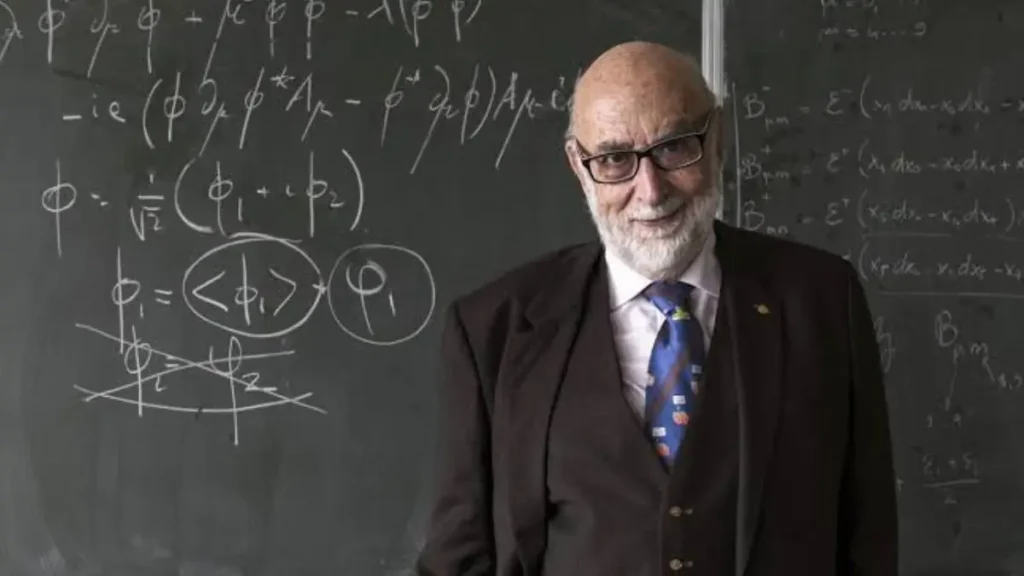
Francois Englert Nobel Prize Physics news update: Learn about the life, achievements, Higgs boson discovery, CERN experiments, and key exam-oriented facts following the death of Nobel-winning physicist François Englert at the age of 93.
A Giant of Modern Physics Leaves Behind an Enduring Legacy
The scientific community is mourning the loss of Belgian theoretical physicist François Englert, who passed away at the age of 93 on June 18, 2026. Englert was one of the most influential physicists of the modern era and is best known for co-developing the theoretical framework that explained how fundamental particles acquire mass—a breakthrough that eventually led to the discovery of the Higgs boson.
His work transformed our understanding of the universe and became one of the cornerstones of the Standard Model of particle physics. The announcement of his death has prompted tributes from scientists, research institutions, and Nobel laureates across the world.
The Discovery That Changed Particle Physics
In 1964, François Englert and fellow physicist Robert Brout proposed a revolutionary mechanism explaining how elementary particles gain mass. Independently, British physicist Peter Higgs arrived at a similar idea. Their theory suggested the existence of an invisible field permeating the universe, now known as the Higgs field. Particles interacting with this field acquire mass.
The theory remained unproven for nearly five decades until scientists at the European Organization for Nuclear Research (CERN) detected evidence of the Higgs boson in 2012 through experiments conducted at the Large Hadron Collider. This discovery confirmed the Brout–Englert–Higgs mechanism and represented one of the greatest achievements in modern science.
Nobel Prize Recognition
For this groundbreaking theoretical contribution, François Englert and Peter Higgs were jointly awarded the 2013 Nobel Prize in Physics. The Nobel Committee recognized their work for explaining the origin of mass in subatomic particles. Robert Brout, who had co-authored the original theory, had passed away in 2011 and therefore was not eligible for the Nobel Prize, which is generally not awarded posthumously.
The Nobel Prize elevated Englert to global prominence and highlighted the importance of theoretical physics in advancing human knowledge.
Early Life and Academic Journey
Born on November 6, 1932, in Etterbeek, Belgium, Englert belonged to a Jewish family of Polish origin. During World War II, he survived Nazi persecution by hiding his Jewish identity and living in various children’s homes and orphanages. These difficult experiences shaped his resilience and determination.
After completing his education, he pursued theoretical physics and became associated with the Université libre de Bruxelles. Throughout his career, he made important contributions not only to particle physics but also to cosmology, quantum field theory, statistical mechanics, and string theory.
Contributions Beyond the Higgs Boson
Although best known for the Higgs mechanism, Englert’s scientific work extended far beyond a single discovery. His research helped deepen scientific understanding of fundamental forces, spontaneous symmetry breaking, and the structure of the universe. He received numerous prestigious honors, including the Wolf Prize in Physics and the J. J. Sakurai Prize before receiving the Nobel Prize.
His influence reached generations of scientists, many of whom built upon his theoretical insights to advance modern particle physics.
Global Tributes Following His Death
Research institutions worldwide have paid tribute to Englert’s remarkable contributions. CERN described him as one of the architects of the Standard Model and acknowledged the lasting impact of his work on contemporary physics. Scientists have emphasized that without his theoretical framework, many of the fundamental discoveries of particle physics would not have been possible.
His death marks the end of an era in physics but his scientific legacy will continue to shape future research into the nature of matter and the universe.

Why This News Is Important
Important for Science and Technology Examinations
The death of François Englert has renewed attention on one of the most important scientific discoveries of the twentieth century—the Higgs mechanism. Questions related to the Higgs boson, Nobel Prize winners, particle physics, and major scientific discoveries frequently appear in competitive examinations such as UPSC, SSC, State PSCs, Banking, Railways, Defence, and teaching recruitment exams.
Relevance to Current Affairs Preparation
Current affairs sections often include notable deaths of Nobel Prize winners, renowned scientists, and influential global personalities. Students preparing for government examinations should remember that François Englert was a Belgian physicist who shared the 2013 Nobel Prize in Physics with Peter Higgs.
Significance of the Higgs Boson Discovery
The discovery of the Higgs boson is considered one of the greatest achievements in modern science. It validated decades of theoretical research and strengthened the Standard Model of particle physics. Understanding this discovery helps aspirants connect scientific developments with broader themes in science and technology.
Frequently Asked Examination Topics
Competitive examinations often ask questions about Nobel Prize winners, CERN, the Large Hadron Collider, and major physics discoveries. The passing of François Englert increases the probability that examiners may include questions related to his life and achievements in upcoming examinations.
Historical Context
The Search for the Origin of Mass
During the early 1960s, physicists struggled to explain why fundamental particles possessed mass while maintaining the mathematical consistency of particle physics theories. Existing models could not adequately answer this question.
The 1964 Breakthrough
In 1964, François Englert and Robert Brout proposed a mechanism through which particles acquire mass by interacting with an omnipresent field. Around the same time, Peter Higgs independently developed a similar concept and explicitly predicted the existence of a new particle that later became known as the Higgs boson.
Experimental Confirmation at CERN
For nearly 50 years, the Higgs boson remained theoretical. In July 2012, scientists working on the ATLAS and CMS experiments at CERN’s Large Hadron Collider announced the discovery of a Higgs-like particle, confirming the theory proposed in 1964.
Nobel Prize and Scientific Recognition
Following the experimental confirmation, François Englert and Peter Higgs received the 2013 Nobel Prize in Physics. Their work is now considered a fundamental component of the Standard Model, the framework that explains the behavior of elementary particles and fundamental forces.
Key Takeaways from François Englert Dies at 93
| S. No. | Key Takeaway |
|---|---|
| 1 | François Englert, Belgian theoretical physicist and Nobel laureate, died on June 18, 2026, at the age of 93. |
| 2 | He co-developed the Brout–Englert–Higgs mechanism explaining how fundamental particles acquire mass. |
| 3 | The theory led to the prediction and eventual discovery of the Higgs boson at CERN in 2012. |
| 4 | Englert shared the 2013 Nobel Prize in Physics with Peter Higgs for this groundbreaking contribution. |
| 5 | His work became a cornerstone of the Standard Model of particle physics and transformed modern scientific understanding of the universe. |
FAQs: François Englert Dies at 93 – Nobel Physicist Behind the Higgs Boson
Q1. Who was François Englert?
Answer: François Englert was a Belgian theoretical physicist who co-developed the Brout–Englert–Higgs mechanism, which explains how elementary particles acquire mass.
Q2. Why is François Englert famous?
Answer: He is famous for his contribution to the theory that led to the discovery of the Higgs boson, one of the most important discoveries in modern particle physics.
Q3. Which Nobel Prize did François Englert receive?
Answer: François Englert shared the 2013 Nobel Prize in Physics with Peter Higgs.
Q4. What is the Higgs boson?
Answer: The Higgs boson is a fundamental particle associated with the Higgs field, which gives mass to elementary particles.
Q5. In which year was the Higgs boson discovered?
Answer: The Higgs boson was experimentally discovered in 2012 at CERN’s Large Hadron Collider (LHC).
Q6. Which organization confirmed the existence of the Higgs boson?
Answer: The discovery was confirmed by CERN (European Organization for Nuclear Research) through experiments at the Large Hadron Collider.
Q7. Who was Robert Brout?
Answer: Robert Brout was a Belgian physicist who collaborated with François Englert on the Higgs mechanism theory in 1964.
Q8. Why did Robert Brout not receive the Nobel Prize?
Answer: Robert Brout passed away in 2011, and Nobel Prizes are generally not awarded posthumously.
Q9. What is the Standard Model of Particle Physics?
Answer: The Standard Model is the scientific theory that explains the fundamental particles of matter and the forces governing their interactions.
Q10. Why is this topic important for competitive exams?
Answer: Questions on Nobel Prize winners, CERN, Higgs boson, particle physics, and important scientific discoveries frequently appear in UPSC, SSC, PSC, Railways, Banking, Defence, and teaching examinations.
Some Important Current Affairs Links

