
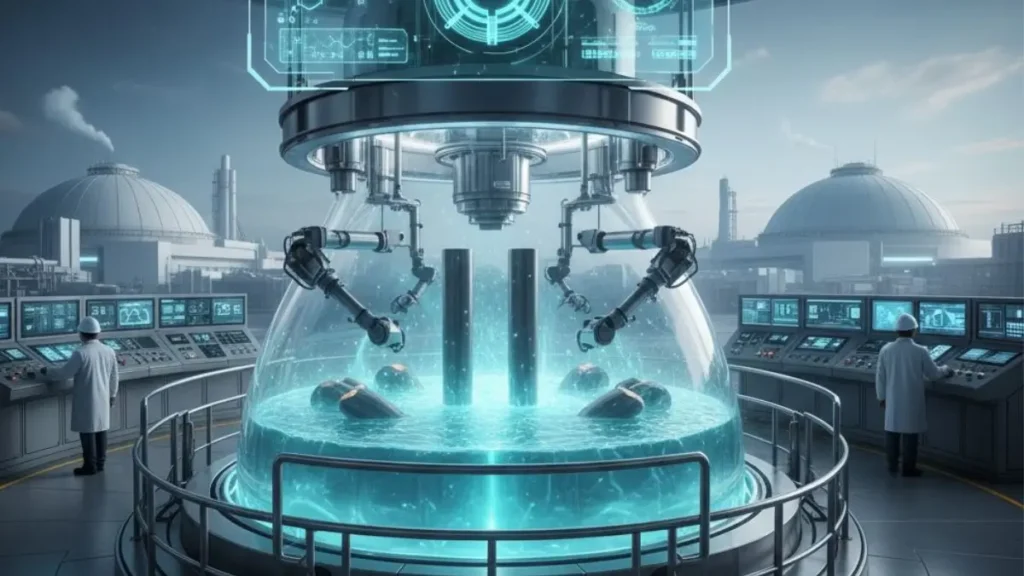
China achieves the world’s first thorium-uranium fuel conversion in a molten salt reactor, marking a major advancement in next-generation nuclear energy and impacting India’s thorium-based energy plans.
China Achieves First-Ever Thorium-Uranium Fuel Conversion in TMSR
Breakthrough in Nuclear Energy
China has made a significant leap in nuclear technology by successfully converting thorium-232 into uranium-233 within a molten salt reactor (MSR). This achievement, announced on 3 November 2025, positions China as the first country to demonstrate the full thorium-to-uranium fuel conversion in a working reactor. The reactor in question, a Thorium Molten Salt Reactor (TMSR), uses molten salt as its coolant medium instead of the more conventional water, enabling a suite of advantages in safety, efficiency and waste reduction.
What is a Thorium Molten Salt Reactor (TMSR)?
A TMSR is an advanced nuclear system designed to utilise thorium as a fertile material rather than relying solely on uranium-235 or plutonium fuels. In this reactor type:
- Molten salt acts as both coolant and fuel-carrier, allowing operation at atmospheric or low pressure instead of high-pressure water systems.
- The use of thorium-232 means that the reactor relies on in-reactor neutron absorption to convert thorium into fissile uranium-233 (U-233).
- The high temperature and passive safety features of the salt system allow improved thermodynamic efficiency and reduced risk of rupture or meltdown compared to traditional water-cooled reactors.
China’s successful demonstration therefore represents a proof-of-concept that the thorium fuel cycle can be executed at reactor scale.
Why Thorium-to-Uranium Fuel Conversion Matters
Converting thorium to uranium in an MSR context matters for several reasons:
- It validates thorium’s viability as a next-generation nuclear fuel, beyond the currently dominant uranium/plutonium cycles.
- It opens up possibilities for cleaner, more sustainable nuclear power: thorium is more abundant in nature than uranium, and the molten salt reactor design offers lower meltdown risk and potentially lower long-lived waste.
- For countries with large thorium reserves but less access to high-grade uranium, this development could shift the global energy balance.
- Because the reactor operation uses molten salts and low pressure, it is better suited to regions where water is scarce, or where infrastructure for high-pressure reactors is challenging.
Implications for China and the World
With this technical milestone, China advances its ambitions in advanced nuclear power and possibly export of next-generation reactor technology. The broader global implications include increasing competition in the advanced reactor domain (including the molten salt and thorium pathways) and potential shifts in nuclear energy strategy for other countries. For instance, the announcement explicitly referenced India’s parallel thorium-fuel-cycle ambitions, noting that India has the world’s largest thorium reserves and has long championed a three-stage nuclear programme culminating in thorium-based reactors. For exam-preparation purposes (teacher, police, banking, railways, defence, civil-services), this news story touches on subjects like international science & technology developments, energy security, strategic resources and nuclear policy.
Challenges Ahead
While the milestone is significant, several challenges remain for thorium-MSR technology to become commercial-scale reality:
- Engineering of full-scale molten salt reactors (MSRs) remains complex and historically less mature than conventional reactors.
- Regulatory, safety and licensing frameworks for novel reactor types are still under development globally.
- The cost-competitiveness of thorium-based systems needs demonstration compared to advanced uranium/plutonium reactors and renewable energy alternatives.
- The supply chain for molten-salt materials, corrosion-resistant components and end-of-life waste handling needs to be fully established.
What It Means for India
Given India’s massive thorium reserves — particularly in monazite sands in Kerala, Odisha, Andhra Pradesh, Tamil Nadu, West Bengal and Jharkhand. — this development in China provides both an impetus and a reminder for India’s own thorium-fuel ambitions. India’s Bhabha Atomic Research Centre (BARC) is developing the Advanced Heavy Water Reactor (AHWR) and an Indian Molten Salt Breeder Reactor (IMSBR) to tap into the thorium fuel cycle. For students preparing for various government exams, understanding this geopolitical-technological dimension is valuable: it covers science & technology current affairs, international energy security, resource strategy and India’s long-term nuclear policy.

Why This News Is Important
Understanding this news is crucial for several reasons relevant to government-exam aspirants:
Firstly, it illustrates a milestone in global science and technology — the conversion of thorium to uranium in a molten salt reactor is a breakthrough that could change how nuclear power is generated. For exams covering science & technology sections, this is a high-value current-affairs item.
Secondly, from a strategic-resources perspective, it touches on thorium and uranium as critical nuclear energy materials. Energy security, resource availability and advanced reactor technologies are increasingly important in defence, civil-services and policy-making contexts. Thirdly, geopolitically, this achievement elevates China’s status in advanced nuclear technologies, affecting the global energy landscape and potentially influencing India’s own programme to exploit its large thorium reserves. Finally, for Indian aspirants, the link between this development and India’s nuclear vision gives direct relevance — knowing how India’s ambitions compare to global developments boosts one’s breadth in current affairs, especially for examinations such as Union Public Service Commission (UPSC), state-PSC, railways and banking sector exams. The inter-linking of technology, international strategy, resources and national policy encapsulated in this news makes it a valuable topic to study and recall.
Historical Context
The concept of using thorium as a nuclear fuel has been under discussion for decades. Thorium-232 itself is not directly fissile — it must absorb neutrons to become uranium-233 (U-233), which then undergoes fission. Historically, the three-stage nuclear power programme of India was built around this idea: stage one using natural uranium in heavy-water reactors, stage two using plutonium in fast reactors and stage three aiming to use thorium. India’s Bhabha Atomic Research Centre (BARC) has promoted the thorium route because India holds about 30–40 % of the world’s known thorium reserves. Meanwhile, molten salt reactor (MSR) technology itself dates back to the 1960s with experiments such as the US Oak Ridge National Laboratory’s MSRE (Molten Salt Reactor Experiment). For many decades, however, commercialisation of MSRs and thorium fuel cycles was held back by technical, regulatory and economic challenges. China’s achievement marks a revival and a concrete expression of the thorium-MSR vision. From an international perspective, nuclear-fuel cycles based on uranium/plutonium have dominated; thorium has been a “promising but un-realised” alternative. The current breakthrough may be a turning point into more active deployment of thorium-MSR systems globally.
Key Takeaways from This News
| S. No | Key Takeaway |
|---|---|
| 1 | China has successfully achieved the first thorium-to-uranium (U-233) fuel conversion inside a molten salt reactor (TMSR). |
| 2 | A Thorium Molten Salt Reactor (TMSR) uses molten salt coolant and thorium-232 as a fertile fuel, offering high safety and efficiency advantages. |
| 3 | The milestone validates the thorium fuel cycle as a viable next-generation nuclear technology, potentially producing less waste and using more abundant fuel. |
| 4 | India has parallel ambitions in the thorium fuel cycle, holding the world’s largest thorium reserves and developing reactors such as the AHWR and IMSBR. |
| 5 | This development has strategic implications for global nuclear energy leadership, resource security and international science & technology competition. |
Frequently Asked Questions (FAQs)
1. What is Thorium and why is it considered important for nuclear energy?
Thorium is a naturally occurring radioactive metal that is more abundant in the Earth’s crust compared to uranium. It is considered important because it can be converted into Uranium-233, a fissile material that can support nuclear fission. Thorium-based reactors promise safer operations, reduced nuclear waste, and greater fuel availability.
2. What is a Thorium Molten Salt Reactor (TMSR)?
A Thorium Molten Salt Reactor is a type of nuclear reactor where molten salt is used both as a coolant and as a fuel carrier. Thorium fuel is dissolved in the molten salt, which operates at high temperatures and low pressure. This offers improved efficiency and enhanced safety, reducing the risk of reactor core meltdown.
3. What did China achieve in this recent discovery?
China successfully demonstrated the conversion of Thorium-232 into Uranium-233 inside a molten salt reactor. This is the world’s first confirmed conversion of thorium fuel to a usable nuclear fuel in a working reactor environment.
4. Why is this achievement significant?
This breakthrough establishes thorium as a viable future nuclear fuel option, which may lead to cleaner, safer, and more efficient nuclear energy systems. It also increases China’s strategic position in advanced nuclear technology globally.
5. How is this development relevant to India?
India holds one of the world’s largest thorium reserves and has long-term plans to use thorium-based reactors (such as the AHWR and IMSBR). China’s achievement acts as both competition and motivation for India to speed up its own thorium fuel cycle programs.
6. What are the advantages of molten salt reactor technology?
- Operates at low pressure, reducing explosion risks
- Higher fuel efficiency
- Ability to burn nuclear waste
- Better thermal efficiency due to high operating temperatures
7. What is Uranium-233 (U-233)?
U-233 is a fissile material produced when thorium absorbs neutrons. It can sustain a nuclear chain reaction, making it suitable for use as nuclear reactor fuel.
Some Important Current Affairs Links

