
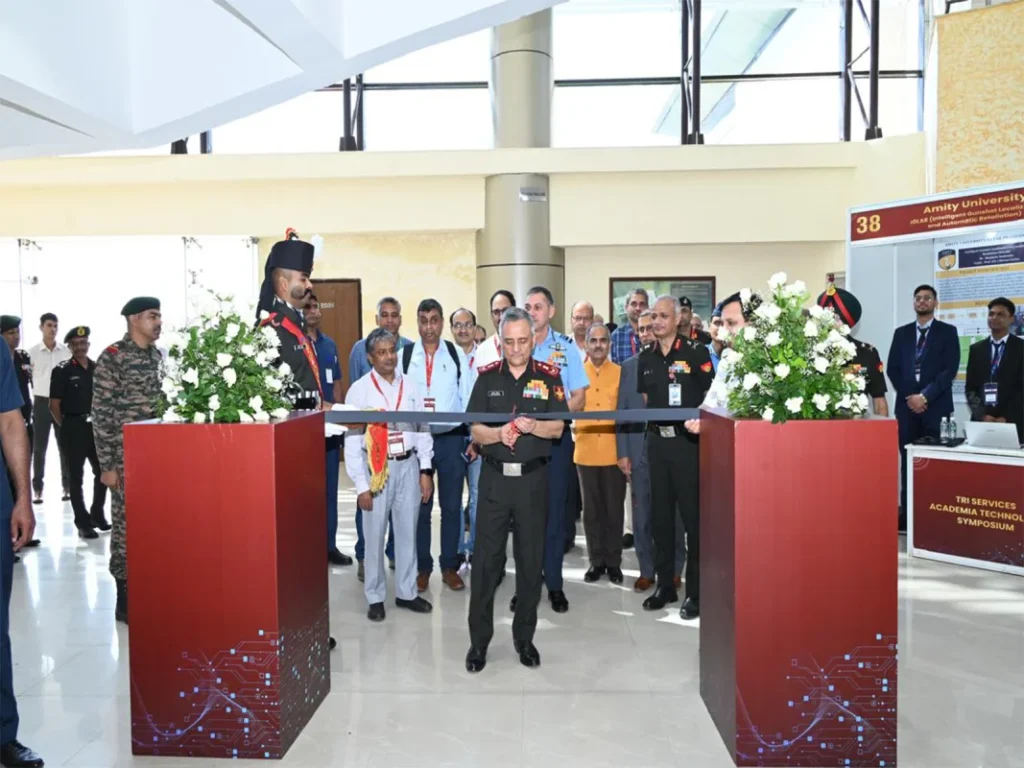
T-SATS 2025 inaugurated by CDS General Anil Chauhan strengthens defence-academia collaboration. Learn about MoUs, projects, and innovative technology showcased for military applications.
CDS Inaugurates First Tri-Services Academia Technology Symposium (T-SATS)
Introduction to T-SATS
On September 22, 2025, the Chief of Defence Staff (CDS), General Anil Chauhan, inaugurated the inaugural edition of the Tri-Services Academia Technology Symposium (T-SATS) at the Manekshaw Centre in New Delhi. This landmark event aims to foster collaboration between India’s Armed Forces and academic institutions to co-develop innovative, indigenous technologies tailored to the nation’s defence needs.
Objectives of T-SATS
The primary objective of T-SATS is to bridge the gap between military requirements and academic research. By integrating the expertise of academia, startups, and industry, the symposium seeks to develop cutting-edge technological solutions that address both traditional and non-traditional security challenges. This initiative aligns with India’s vision to become a global leader in next-generation defence technologies.
Participation and Collaborations
The symposium witnessed participation from directors, department heads, and students from 62 premier institutions, including the Indian Institute of Science (IISc), Indian Institutes of Technology (IITs), Indian Institutes of Information Technology (IIITs), and top private universities. Additionally, Memoranda of Understanding (MoUs) were signed with several academic institutions, such as IIT Madras and Manipal Academy of Higher Education, to formalize collaborations in defence research and development.
Technology Exhibition and R&D Initiatives
A key highlight of the symposium was the Technology Exhibition, showcasing 43 innovative projects from academic institutions. These projects were evaluated by subject matter experts from the three Services for their potential military applications. Promising projects will be considered for joint research and development efforts and potential funding support.
Structured Interactions and Strategic Guidance
The symposium also featured 108 structured one-on-one meetings between academic innovators and service representatives. These closed-door sessions provided a platform for pitching research and development proposals, receiving strategic guidance, and shaping ideas into military-use cases. This collaborative approach ensures that innovative ideas are effectively translated into practical defence solutions.
Why This News Is Important
Enhancing Defence Innovation
The establishment of T-SATS marks a significant step towards enhancing innovation in India’s defence sector. By leveraging the expertise of academic institutions and industry, the symposium aims to develop indigenous technologies that meet the evolving needs of the Armed Forces.
Promoting Self-Reliance in Defence
This initiative aligns with the government’s ‘Atmanirbhar Bharat’ (Self-Reliant India) campaign, emphasizing the importance of self-reliance in defence manufacturing. By fostering collaborations between academia and the military, India aims to reduce dependence on foreign defence technologies and promote indigenous development.
Strategic Defence Planning
The symposium provides a platform for strategic discussions on the future of warfare, including the integration of emerging technologies such as artificial intelligence, cyber capabilities, and unmanned systems. These discussions are crucial for formulating defence doctrines that address contemporary security challenges.
Historical Context
Evolution of Defence Collaboration
The concept of integrating academia with the Armed Forces is not new. Historically, institutions like the National Defence Academy have played a pivotal role in training officers from all three services together, fostering a spirit of jointness. The creation of the Chief of Defence Staff (CDS) position in 2020 further emphasized the need for integrated defence strategies and collaboration across services.
Advancements in Defence Technology
Over the years, India has made significant strides in developing indigenous defence technologies, including advancements in missile systems, naval platforms, and communication networks. Initiatives like T-SATS aim to accelerate this progress by facilitating direct collaboration between researchers and defence personnel.
Key Takeaways from T-SATS Inauguration
| S.No | Key Takeaway |
|---|---|
| 1 | Inauguration of T-SATS: The first Tri-Services Academia Technology Symposium was inaugurated by CDS General Anil Chauhan at the Manekshaw Centre, New Delhi. |
| 2 | Participation of 62 Institutions: Directors, department heads, and students from 62 premier institutions, including IISc, IITs, IIITs, and private universities, participated in the symposium. |
| 3 | Technology Exhibition: 43 innovative projects from academic institutions were showcased, evaluated for potential military applications. |
| 4 | Structured Interactions: 108 one-on-one meetings between academic innovators and service representatives facilitated the pitching of R&D proposals. |
| 5 | MoUs Signed: Memoranda of Understanding were signed with several academic institutions to formalize collaborations in defence R&D. |
FAQs: Frequently Asked Questions
1. What is T-SATS?
T-SATS stands for Tri-Services Academia Technology Symposium, a platform inaugurated by CDS General Anil Chauhan to promote collaboration between the Indian Armed Forces and academic institutions for defence technology development.
2. When and where was T-SATS inaugurated?
T-SATS was inaugurated on September 22, 2025, at the Manekshaw Centre in New Delhi.
3. Who inaugurated the first T-SATS?
The symposium was inaugurated by Chief of Defence Staff (CDS) General Anil Chauhan.
4. Which academic institutions participated in T-SATS?
62 premier institutions, including IISc, IITs, IIITs, and private universities, participated in T-SATS.
5. What was the main purpose of T-SATS?
The main purpose was to bridge the gap between military requirements and academic research, develop indigenous defence technologies, and promote innovation aligned with ‘Atmanirbhar Bharat’.
6. How many innovative projects were showcased?
43 innovative projects from academic institutions were showcased and evaluated for potential military applications.
7. What is the significance of the MoUs signed during T-SATS?
MoUs formalize collaborations in research and development, allowing academia and the Armed Forces to work jointly on defence technology projects.
8. How did T-SATS facilitate interaction between academia and the Armed Forces?
T-SATS conducted 108 structured one-on-one meetings, enabling innovators to pitch proposals, receive feedback, and convert ideas into practical defence solutions.
9. How does T-SATS contribute to self-reliance in defence?
By encouraging indigenous technology development, T-SATS reduces reliance on foreign technologies and supports the government’s ‘Atmanirbhar Bharat’ initiative.
10. What emerging technologies were highlighted at T-SATS?
Technologies like artificial intelligence, cyber capabilities, unmanned systems, and defence communication networks were emphasized for future military applications.
Some Important Current Affairs Links

