
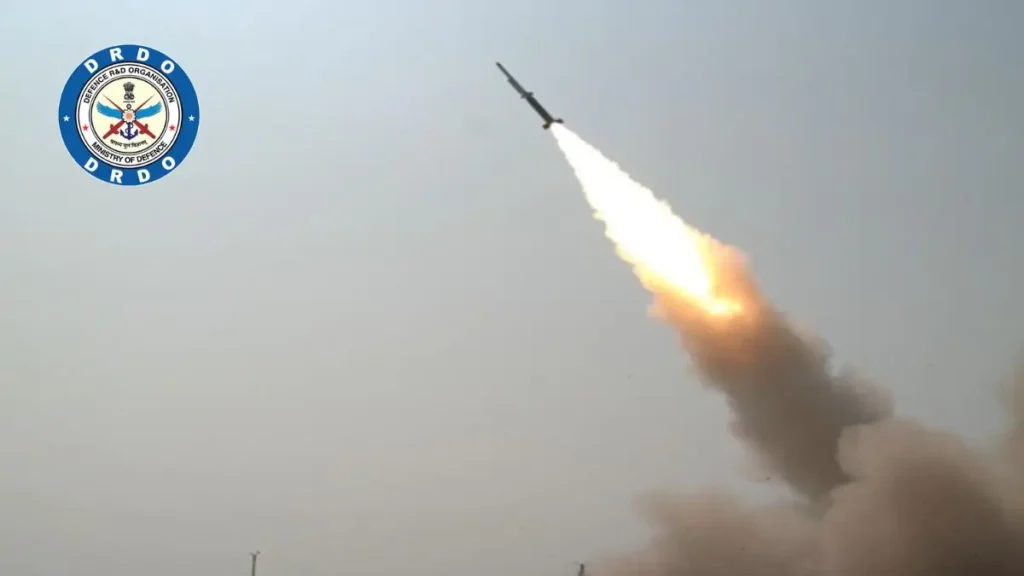
Solid Fuel Ducted Ramjet technology DRDO successfully tested in 2026. Discover India’s missile propulsion breakthrough, enhanced air-to-air missile range, and strategic defence advancements.
🚀 DRDO Successfully Demonstrates Solid Fuel Ducted Ramjet Technology: A Breakthrough in India’s Missile Propulsion
Introduction: A Major Leap in Defence Technology
On 3 February 2026, the Defence Research and Development Organisation (DRDO) achieved a major technological milestone by successfully demonstrating the Solid Fuel Ducted Ramjet (SFDR) propulsion system. The test was conducted from the Integrated Test Range (ITR), Chandipur, off the coast of Odisha. This success places India in an exclusive group of nations possessing advanced ramjet propulsion technology, crucial for long‑range air‑to‑air missiles and future aerial combat superiority.
What Is Solid Fuel Ducted Ramjet (SFDR) Technology?
Solid Fuel Ducted Ramjet (SFDR) is an advanced propulsion technology used in modern long‑range missiles. Unlike conventional solid rocket motors that burn fuel for a short duration before burning out, SFDR uses atmospheric oxygen to sustain combustion of solid fuel during flight. This provides higher cruising speed, extended range and enhanced manoeuvrability—key attributes needed in modern aerial warfare.
How SFDR Works
- The missile is initially accelerated using a ground‑based booster to reach the desired speed (Mach number).
- Once at speed, the ramjet sustainer motor takes over, using atmospheric oxygen for combustion.
- Continuous thrust allows the missile to maintain supersonic speeds over long distances.
The integration of advanced components like nozzle‑less boosters, fuel flow controllers, and air‑intake systems ensures optimal performance throughout the flight.
Details of the Successful Test
During the SFDR test:
- All critical subsystems, including nozzle‑less boosters, the ramjet motor, and fuel flow controller, operated precisely as planned.
- The system performance was validated using sophisticated tracking instruments deployed along the Bay of Bengal coast, confirming data accuracy and functionality.
- Senior scientists from top DRDO laboratories monitored the test, showcasing India’s strong R&D ecosystem.
Strategic Significance for India
This demonstration is a game‑changer for India’s defence capability:
- It advances indigenous technology development, reducing dependence on foreign systems.
- It enhances the Indian Air Force’s combat edge by enabling missiles to engage adversaries at long ranges with better accuracy and endurance.
- It reflects India’s commitment to Atmanirbhar Bharat in defence manufacturing.
Future Prospects
The successful SFDR demonstration paves the way for next‑generation missiles like Astra Mark‑3 or other advanced air‑to‑air systems that will strengthen India’s deterrence and security posture in the region.

📌 Why This News Is Important
Enhancing Defence Capabilities
The successful SFDR demonstration marks a strategic breakthrough for India’s defence technology landscape. Air‑to‑air missiles powered by SFDR propulsion can cruise at supersonic speeds while maintaining efficient fuel consumption over long distances. This is vital for the Indian Air Force (IAF) because it enhances the ability to intercept aerial threats far beyond current ranges offered by conventional missile systems.
Boosting Indigenous Technology
This milestone reinforces India’s commitment to advancing homegrown defence technologies, aligning with the government’s Atmanirbhar Bharat initiative. The achievement also showcases DRDO’s capability to integrate multiple complex subsystems—such as nozzle‑less boosters and advanced combustion controllers—into a cohesive missile propulsion system.
Global Strategic Positioning
By mastering SFDR technology, India now joins a select group of countries that possess cutting‑edge ramjet propulsion systems. This positions India favorably in defence collaborations and elevates its role in global military technology conversations, particularly relevant for tests and evaluations in future defence partnerships.
🕰 Historical Context: Evolution of SFDR and Missile Technology in India
India’s journey in advanced propulsion technology spans several decades. Early efforts focused on conventional solid rocket motors and liquid propulsion systems. The concept of the Ramjet was first tested by DRDO in previous decades, with flight experiments and subsystem validations conducted periodically.
From Foundation to Innovation
- Pre‑2020: DRDO worked on initial ramjet components and ground tests to validate basic combustion principles.
- 2021–2023: Successive tests improved subsystem reliability and materials engineering for high‑temperature combustion.
- 2026: The latest demonstration confirmed the integrated performance of SFDR technology under flight conditions, representing a culmination of years of research and experiments.
This progression reflects India’s steady focus on acquiring propulsion technologies that fuel beyond‑visual‑range (BVR) missile capabilities—key for modern aerial engagements.
📊 Key Takeaways from DRDO’s SFDR Technology Demonstration
| S. No. | Key Takeaway |
|---|---|
| 1 | DRDO successfully demonstrated Solid Fuel Ducted Ramjet (SFDR) technology on February 3, 2026. |
| 2 | The test was conducted from the Integrated Test Range (ITR), Chandipur, Odisha. |
| 3 | SFDR enables sustained combustion using atmospheric oxygen, improving range and manoeuvrability. |
| 4 | The achievement places India among an elite group of nations with advanced missile propulsion technology. |
| 5 | This milestone supports indigenous defence advancements and strengthens India’s combat capabilities. |
FAQs: Frequently Asked Questions
1. What is Solid Fuel Ducted Ramjet (SFDR) technology?
SFDR is an advanced missile propulsion system that uses solid fuel along with atmospheric oxygen for sustained combustion, enabling missiles to travel longer distances at high supersonic speeds with better maneuverability.
2. When and where did DRDO successfully test SFDR technology?
DRDO successfully demonstrated SFDR technology on 3 February 2026 from the Integrated Test Range (ITR), Chandipur, Odisha.
3. Why is SFDR technology important for India?
SFDR enhances the range, speed, and maneuverability of air-to-air missiles, strengthens India’s indigenous defence capabilities, reduces reliance on foreign technologies, and positions India among nations with advanced missile propulsion systems.
4. Which missiles in India are expected to benefit from SFDR?
Next-generation missiles like Astra Mark-3 and other long-range air-to-air missiles are expected to use SFDR propulsion for extended range and enhanced combat performance.
5. How does SFDR work compared to conventional rocket motors?
Unlike conventional solid rocket motors that burn fuel for a limited duration, SFDR uses atmospheric oxygen for sustained combustion, providing continuous thrust over longer distances.
6. Which organization developed SFDR technology in India?
The Defence Research and Development Organisation (DRDO) developed and successfully demonstrated the SFDR system.
7. What is the strategic significance of SFDR for India?
SFDR strengthens India’s air defence capability, enables interception of distant threats, and enhances global strategic positioning in defence technology.
Some Important Current Affairs Links

