
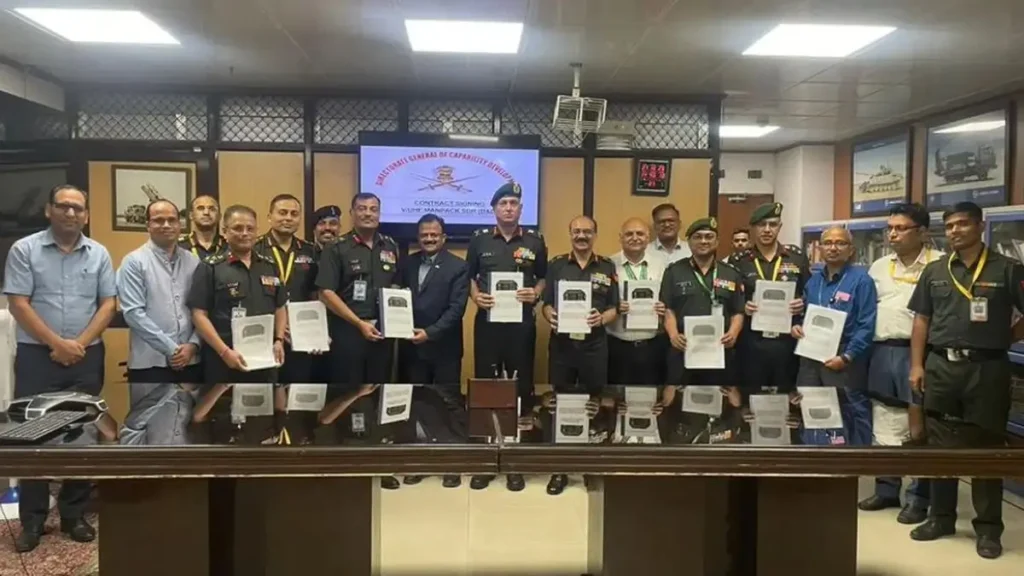
Indian Army Indigenous Software Defined Radios by DRDO and BEL under IRSA v1.0 mark a major step in Make in India defence communication systems, enhancing secure battlefield networks and national self-reliance.
“Indian Army to Procure First Indigenous Software-Defined Radios”
In a major stride towards modernising battlefield communications and bolstering self-reliance in defence technology, the Indian Army has signed a contract to procure its first indigenously developed Software-Defined Radios (SDRs). These SDRs, developed by Defence Research and Development Organisation (DRDO) and set for manufacture by Bharat Electronics Limited (BEL), are designed to operate according to the national specification Indian Radio Software Architecture (IRSA) v1.0, marking a critical advancement in India’s defence electronics capability.
What are Software-Defined Radios?
Unlike traditional radio systems that rely heavily on fixed hardware components such as mixers, filters and modulators, SDRs shift many of those functions into software modules. This offers significant advantages: the ability to switch waveforms or communication protocols via software updates, interoperability across platforms, and greater adaptability in fluid battlefield environments. The particular SDRs being procured by the army come equipped with high data-rates and Mobile Ad hoc Network (MANET) capabilities, enabling units to form networked communication links even under dynamic, mobile conditions.
Understanding the IRSA Standard
The IRSA initiative—launched by DRDO in collaboration with the Integrated Defence Staff (IDS) and the tri-services—defines a national specification for SDR platforms in India. Under IRSA version 1.0, standardised interfaces, APIs (Application Programming Interfaces), execution environments and waveform portability mechanisms are laid out—meaning a waveform developed for one radio could run on another IRSA-compliant platform.
Strategic Significance for Defence
From the defence perspective, the procurement underscores three key goals: bolstering secure, network-centric communications across Indian Army units; reducing dependence on foreign imports for critical electronics; and establishing future-ready platforms that simplify upgrades and certification. The standardisation via IRSA helps avoid a fragmented ecosystem of incompatible radios, enabling better lifecycle management, commonality and potential exports.
Industrial & Ecosystem Impact
On the industrial front, awarding the contract to BEL signals confidence in indigenous manufacturing strength. Implementation of IRSA-based SDRs is set to create a wider technology ecosystem—bringing together DRDO, DPSUs (Defence Public Sector Undertakings), private industry and academia. If Indian manufacturers successfully produce IRSA-compliant equipment, there is potential to export to friendly nations, thereby enhancing the defence industrial base.
What This Means for Government-Exam Aspirants
For students preparing for teaching roles, police, banking, railways, defence or civil services like the Union Public Service Commission (UPSC), this news sits at the intersection of defence technology, ‘Make in India’ policy and national security. Understanding such developments helps with the modern defence equipment, indigenisation, technology standards and ecosystem questions in general studies papers. The date of the contract (October 2025) and the partners involved (DRDO, BEL) are key facts to note.

Why This News Is Important
Strengthening Secure Battlefield Communications
In modern warfare, communication networks are as important as weapons themselves. The procurement of indigenously developed SDRs means the Indian Army will have advanced, flexible, secure communication platforms customised for dynamic operations. This elevates India’s defence readiness by enabling units to communicate efficiently in mobile and contested environments.
Boosting Indigenous Defence Manufacture
This announcement supports the government’s broader push for self-reliance in defence manufacturing. By contracting BEL with DRDO’s technology and using the IRSA standard, the initiative aligns with “Make in India” goals, reduces dependence on imports and sets the stage for export potential. Aspirants should note links between national policy and defence procurement.
Standardisation and Future-Proofing
The introduction of the IRSA standard is a strategic move to avoid fragmentation in equipment, enabling waveform portability and interoperability across platforms. For exam applicants, this illustrates how technology standards matter in national security, defence industry policy and procurement strategy.
Relevance for Various Exams
For candidates preparing for banking, teaching, railways, police or civil services, this development intersects with topics like Government of India initiatives, defence production, technology in national security and current affairs. Knowing such stories improves general knowledge and analytical ability in objective and descriptive sections.
Historical Context
The shift towards Software-Defined Radios is part of a global trend in defence communications. Traditional radio systems, fixed in hardware, have long been vulnerable to obsolescence and limitations in flexible waveform usage. Recognising this, many militaries worldwide have moved to SDRs that can adapt to different frequencies, waveforms and network types.
In India, the Defence Research and Development Organisation (DRDO) launched the IRSA initiative (Indian Radio Software Architecture) in collaboration with the tri-services and Integrated Defence Staff to create a home-grown standard that would reduce dependency on foreign technologies and ensure interoperability among Indian platforms. The version 1.0 specification for IRSA lays down common interfaces and execution environments, enabling waveform portability and easier certification. The contract awarded to BEL marks the first large-scale field procurement of SDRs under this standard. Previously, India relied significantly on imported communication equipment, making this shift a key milestone in the journey towards defence indigenisation.
Key Takeaways from “Indian Army to Procure First Indigenous Software-Defined Radios”
| S. No | Key Takeaway |
|---|---|
| 1 | The Indian Army has signed a contract in October 2025 for its first indigenously developed Software-Defined Radios (SDRs). |
| 2 | The SDRs are developed by DRDO and will be manufactured by BEL under the national standard IRSA Version 1.0. |
| 3 | The IRSA standard defines national interfaces, APIs and waveform portability mechanisms for SDR platforms. |
| 4 | The new radios support high data-rates and Mobile Ad hoc Network (MANET) capabilities, enabling dynamic, network-centric battlefield comms. |
| 5 | The initiative aligns with self-reliance in defence manufacturing, industrial ecosystem development and future export possibilities. |
Frequently Asked Questions (FAQs)
1. What are Software-Defined Radios (SDRs)?
Software-Defined Radios are advanced communication systems where traditional hardware-based radio functions—such as modulation, demodulation, and signal processing—are executed through software. This makes them more flexible and upgradable compared to traditional radios.
2. Who developed the indigenous SDRs for the Indian Army?
The Defence Research and Development Organisation (DRDO) developed the technology, and Bharat Electronics Limited (BEL) is the manufacturer responsible for large-scale production.
3. What is IRSA Version 1.0?
IRSA stands for Indian Radio Software Architecture, a national standard for SDR platforms developed jointly by DRDO and the Integrated Defence Staff (IDS). It defines interfaces, APIs and waveform portability guidelines for interoperability across different radios.
4. How do SDRs enhance battlefield communication?
SDRs allow quick adaptation to multiple frequencies and waveforms, support Mobile Ad hoc Networks (MANET), and ensure secure, high-data-rate communication links even in mobile or contested environments.
5. How does this procurement support the ‘Make in India’ initiative?
By adopting an indigenous communication technology and awarding production to a domestic defence PSU, the procurement strengthens India’s self-reliance in critical defence technologies, aligning directly with the Atmanirbhar Bharat Abhiyan.
6. Which government organisation will manufacture the SDRs?
Bharat Electronics Limited (BEL) will handle manufacturing under DRDO’s technology transfer and guidance.
7. What is the main advantage of using IRSA-compliant SDRs?
IRSA ensures standardisation, interoperability and future upgradability—meaning a single waveform can run across multiple devices developed by different vendors.
8. Why is this development significant for exam aspirants?
It combines concepts from defence, science and technology, public sector enterprise contribution and national policy—topics frequently covered in UPSC, SSC, CDS, NDA, and State PCS exams.
9. When was the contract signed for the procurement?
The Indian Army signed the contract in October 2025, marking the first formal step in large-scale deployment of indigenous SDRs.
10. What future prospects does this project open for India’s defence industry?
The initiative is expected to spur a wider ecosystem involving DRDO, DPSUs, private companies and academia—paving the way for exports and innovation in communication technologies.
Some Important Current Affairs Links

