
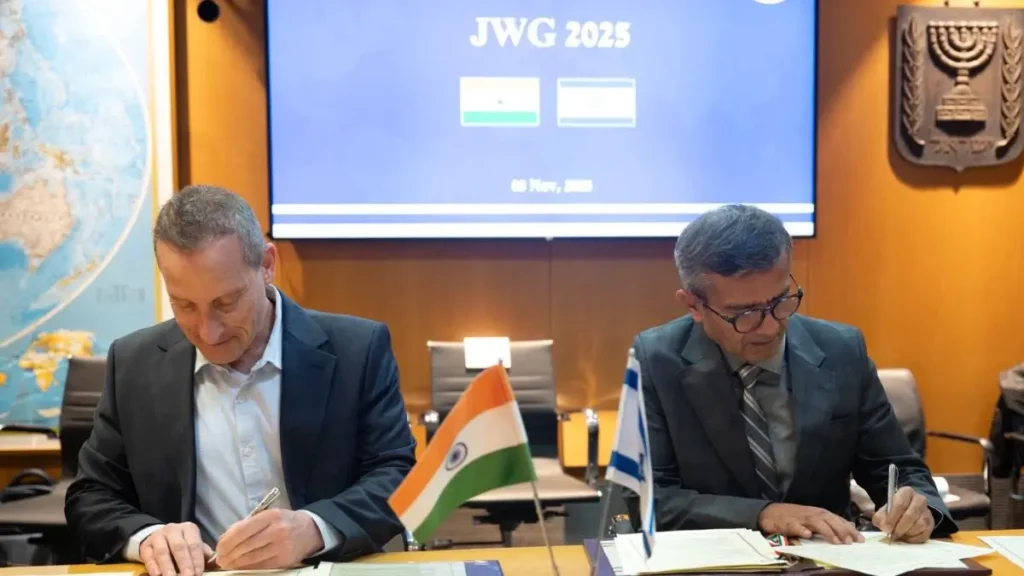
India Israel defence partnership strengthens as both nations sign a strategic MoU to enhance co-development, technology sharing, and Make in India defence manufacturing capabilities.
India-Israel MoU Marks New Chapter in Defence Ties
Enhanced Defence Partnership Between India and Israel
At the 17th meeting of the Joint Working Group (JWG) on Defence Cooperation held in Tel Aviv, the governments of India and Israel signed a Memorandum of Understanding (MoU) to further deepen their defence cooperation. This MoU is structured to set a unified vision and policy direction for long-term collaboration in areas including co-production of defence equipment, technology exchange and joint capability building.
Broad Scope of Cooperation
The MoU emphasises several key strategic focus areas:
- Defence industrial cooperation through co-development and co-production of equipment.
- Exchange of advanced defence technologies and innovation.
- Joint development of operational capabilities and mutual support for emerging threats.
- Enhanced collaboration to counter terrorism and asymmetric threats – acknowledging the shared threat perceptions of both nations.
This indicates a shift from simpler buyer-seller dynamics toward a more equal, strategic industrial partnership.
Leadership and Strategic Significance
The meeting was co-chaired by India’s Defence Secretary Rajesh Kumar Singh and Israel’s Major General Amir Baram, signalling high-level commitment. On the sidelines, India’s Defence Secretary also met Israel’s Defence Minister Israel Katz and briefed him on the outcomes of the JWG meeting.The timing and nature of this MoU align with India’s broader aim of achieving self-reliance in defence production, while Israel strengthens its strategic alliances in the Indian Ocean region.
Impacts and Forward Outlook
With this MoU in place, India and Israel are better positioned to co-develop defence platforms, share cutting-edge technologies (such as unmanned systems, surveillance tools, missile systems) and strengthen joint readiness for evolving threats. It paves the way for future joint manufacturing, possibly enabling Indian industry to manufacture advanced systems with Israeli collaboration. The deeper defence tie also has diplomatic and strategic ripple effects — signalling to regional and global actors that India and Israel view each other as enduring security partners. For students preparing for competitive exams in sectors like defence, civil services, railways and banking (especially in the general awareness section), this development is key to understanding India’s evolving defence diplomacy and manufacturing strategy.

Why This News is Important
Strategic Importance
This MoU reflects India’s transition from being primarily a purchaser of defence equipment to becoming a partner in co-development and production. It demonstrates India’s evolving defence diplomacy, where it is building long-term strategic relationships rather than transactional ones. For exams, understanding how India manages its defence relationships—for example with Israel—is essential in topics covering international relations, defence policies and India’s strategic autonomy.
Relevance to India’s Defence Manufacturing and “Make in India” Initiative
India’s push for self-reliance in defence, embodied in the Make in India programme and the Atmanirbhar Bharat Abhiyan, is reinforced by this MoU. Collaboration with Israel—known for its advanced defence technology—helps India upgrade its technological base, enhance indigenous manufacturing and reduce dependence on imports. For aspirants in exams like banking and railways, where awareness of national policy frameworks is tested, this connection adds depth to understanding how India aligns its strategic defence goals with industrial policy.
Diplomacy and Regional Security Implications
India-Israel defence ties have larger regional implications. Both countries face threats such as terrorism and unconventional warfare; by cooperating, they enhance their strategic posture. For civil service exams such as the Union Public Service Commission (UPSC) and state PSCs, this development is a case study in bilateral diplomacy, defence partnerships, and geo-strategic linkages across the Middle East and South Asia. Understanding such links helps examine India’s role in regional security architecture and its alignment with global powers.
Historical Context
India and Israel have had a growing defence relationship over the past decades. Since the establishment of diplomatic ties in 1992, Israel has emerged as a major supplier of defence equipment to India—ranging from drones, surveillance systems, missile technologies to cybersecurity solutions. The bilateral defence cooperation has been marked by multiple agreements and joint ventures.
The Joint Working Group (JWG) on Defence Cooperation between India and Israel has met regularly; the 17th meeting now marks a milestone by shifting from routine discussions to a formal MoU emphasising structured long-term cooperation. This shift aligns with India’s transformation in defence policy: moving from “import-heavy” to “design-and-manufacture”. It also comes at a time when India is diversifying its strategic partnerships—alongside the US, France, Russia, and the Middle East—to secure technology and production capabilities.
In parallel, Israel has sought to widen its defence export footprint and deepen ties with major strategic partners. The convergence of India’s “Make in India” defence push and Israel’s advanced technology makes this MoU a logical next step. For aspirants studying defence, strategic affairs or international relations, it provides an example of modern bilateral defence diplomacy and industrial strategy.
Key Takeaways from India-Israel Defence MoU
| S. No. | Key Takeaway |
|---|---|
| 1 | India and Israel signed an MoU at the 17th JWG meeting in Tel Aviv to deepen their defence cooperation. |
| 2 | The agreement focuses on co-development and co-production of defence equipment and sharing advanced technologies. |
| 3 | It emphasises counter-terrorism collaboration, joint operational capabilities and mutual support against shared threats. |
| 4 | The move aligns with India’s self-reliance in defence manufacturing and the “Make in India” initiative. |
| 5 | This MoU signifies a strategic shift in India-Israel ties from buyer-seller to long-term strategic partner in defence industry. |
Frequently Asked Questions (FAQs)
1. What is the purpose of the recent India-Israel MoU in defence cooperation?
The MoU is intended to deepen defence collaboration between India and Israel by promoting co-development, co-production of defence equipment, technology sharing, and strengthening joint operational capabilities.
2. Which meeting led to the signing of the MoU between India and Israel?
The MoU was signed during the 17th Joint Working Group (JWG) meeting on Defence Cooperation held in Tel Aviv.
3. How does this MoU support the ‘Make in India’ and ‘Atmanirbhar Bharat’ initiatives?
The MoU promotes indigenous defence manufacturing in India through shared technologies and joint production, reducing India’s dependence on defence imports.
4. Who co-chaired the India-Israel JWG meeting?
The meeting was co-chaired by Rajesh Kumar Singh, India’s Defence Secretary, and Major General Amir Baram from Israel.
5. Which sectors are expected to benefit the most from this defence partnership?
Sectors such as missile technology, unmanned aerial systems, surveillance systems, counter-terrorism capabilities, and defence start-up innovation ecosystems will benefit significantly.
6. Why is Israel considered an important defence partner for India?
Israel is one of the world’s leading innovators in defence technologies and has been a reliable supplier and collaborator in areas like drones, radar systems, and missile defence systems.
7. What global significance does this MoU carry?
It reinforces India’s strategic positioning in West Asia and indicates strengthened bilateral ties in the context of shared security concerns like terrorism.
Some Important Current Affairs Links

