
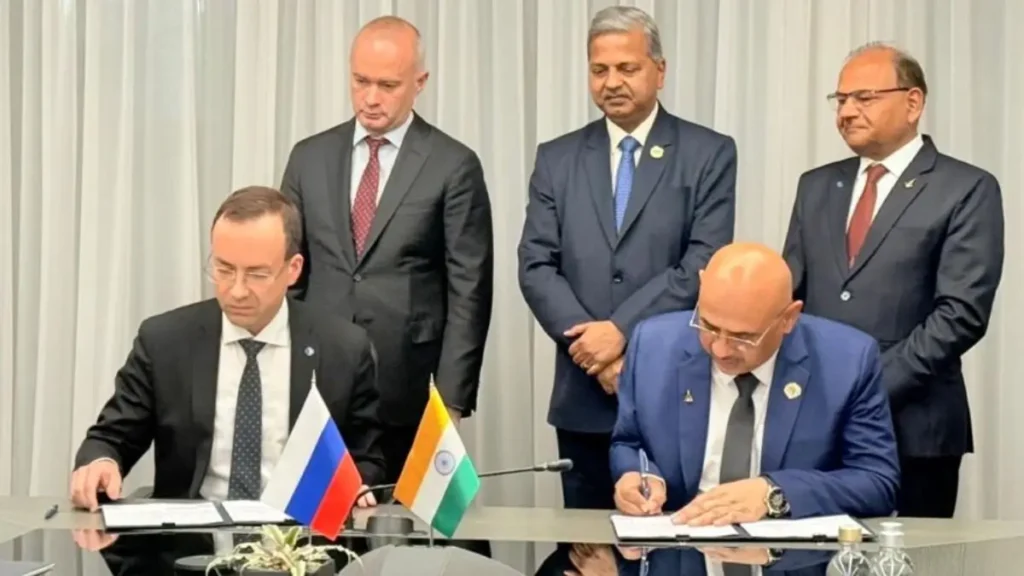
HAL SJ-100 aircraft manufacturing India: Hindustan Aeronautics Limited (HAL) signs MoU with Russia’s UAC to manufacture SJ-100 passenger aircraft in India under Make in India and UDAN schemes, marking a major milestone in civil aviation self-reliance.
“India’s HAL to Manufacture Russian SJ-100 Passenger Aircraft in India”
Partnership for Manufacture of SJ-100
On 27 October 2025, Hindustan Aeronautics Limited (HAL) signed a Memorandum of Understanding (MoU) with Russia’s United Aircraft Corporation (UAC) to produce the civilian commuter aircraft SJ‑100 (also known as the Sukhoi Superjet 100) in India.Under the agreement, HAL will have the rights to manufacture the aircraft for domestic customers in India, thereby marking the first time a complete passenger aircraft will be produced in India.
Features of the SJ-100
The SJ-100 is a twin-engine narrow-body regional aircraft designed to carry around 100 passengers and operate on short-haul routes. According to reports, more than 200 units of the SJ-100 have already been produced and are in operation with over 16 airlines globally. The aircraft is designed for a flight range of approximately 3,530 km, with operational capability across extreme climate zones (temperatures from –55°C to +45°C).
Implications for Indian Aviation and “Make in India”
The HAL-UAC partnership is described by HAL as a game-changer for short-haul connectivity under the UDAN scheme (Ude Desh ka Aam Naagrik) initiative, which aims to extend air travel to tier-II and tier-III cities in India.The agreement aligns with India’s push for self-reliance (“Atmanirbhar Bharat”) in civil aviation and is expected to create direct and indirect jobs in the aviation manufacturing sector. HAL stated that this project will represent the first time a full passenger aircraft will be made in India, the last such production having ended with the Avro HS‑748 in 1988.
Market Potential and Strategic Significance
HAL estimates that over the next decade the Indian aviation sector will require over 200 narrow-body jets for regional connectivity and an additional 350 aircraft to serve nearby international tourist destinations in the Indian Ocean region. The deal also reflects deepening aerospace cooperation between India and Russia, spanning beyond defence into the civil aviation realm.
Challenges and Outlook
While the MoU marks a significant milestone, actual production will require setting up supply chains, manufacturing infrastructure, regulatory clearances, and specialized workforce training. India must also ensure high standards of quality and certification for the SJ-100 to meet both domestic and potentially export market norms. The success of this project will depend on timely implementation, cost-competitiveness, and integration into India’s regional connectivity ecosystem.

Why This News Is Important
Strategic Milestone in Indian Aerospace
This agreement is a landmark moment for India’s civil aviation industry, as it marks the first time a full passenger aircraft will be manufactured domestically. Up until now, India has primarily procured aircraft produced abroad or engaged in licensed production of components; full aircraft manufacture had not been achieved since the Avro HS-748 ended production in 1988. The move signals India’s ambition to become a manufacturing hub for aerospace in alignment with the “Atmanirbhar Bharat” initiative.
Boost for Regional Connectivity and ‘Make in India’
The domestic production of the SJ-100 blends well with the UDAN regional connectivity mission, which aims to bring air travel to underserved regions. By having aircraft manufactured locally, India can potentially reduce costs, increase maintenance efficiency, create jobs, strengthen indigenous capabilities, and improve access to air travel in smaller cities and remote locations. It therefore impacts not just the aviation sector, but also economic development, employment, and infrastructure growth—key aspects for government exams focusing on current affairs in economy, infrastructure and policy.
Geopolitical and Industrial Implications
Beyond aviation, the MoU underscores growing India-Russia collaboration in aerospace, diversifying India’s partnerships beyond traditional defence procurements. For aspirants of civil services, banking, railways or defence exams, this news exemplifies how industrial policy, manufacturing strategy, and international collaboration converge. It shows government efforts to support strategic sectors, build indigenous capacity, and integrate regional connectivity projects with broader economic goals.
Historical Context
Previous Aircraft Production in India
India’s last major production of a full passenger aircraft was with the Avro HS-748, produced by HAL from 1961 to 1988. After the avro programme ended, India did not manufacture full passenger jets domestically; rather, it focused on licensed production of aircraft components, defence aircraft, and imports of commercial aircraft.
Make in India and Aviation Industry Policy
The Government of India, particularly through the “Make in India” campaign and later “Atmanirbhar Bharat” initiative, has sought to enhance domestic manufacturing capabilities across sectors including aerospace. India has identified regional connectivity, aviation infrastructure and manufacturing as priorities. The UDAN scheme (launched in 2016) aims to promote regional air connectivity to unserved and underserved airports.
India-Russia Aerospace Collaboration
India and Russia have a long history of aerospace cooperation, primarily in defence: e.g., co-production of fighter aircraft, helicopters, and other platforms. The SJ-100 MoU now expands this cooperation into civil aviation manufacturing. This represents a shift in India’s strategy toward integrating civil aerospace manufacturing domestically and gaining technology partnerships that support both strategic independence and industrial growth.
Key Takeaways from “India to Produce SJ-100 Passenger Aircraft in India”
| S. No. | Key Takeaway |
|---|---|
| 1 | HAL has signed a MoU with Russia’s UAC for manufacturing the SJ-100 civil commuter aircraft in India. |
| 2 | The SJ-100 is a twin-engine narrow-body aircraft designed for short-haul operations (~3,530 km range) and around 100-seat capacity. |
| 3 | This will be the first time a complete passenger aircraft is produced in India since the Avro HS-748 production ended in 1988. |
| 4 | The production supports the UDAN scheme for regional air connectivity and aligns with India’s “Atmanirbhar Bharat” policy in civil aviation. |
| 5 | Over the next 10 years, India may need over 200 narrow-body jets for regional connectivity; this domestic manufacture could help meet that demand and boost jobs and manufacturing in aviation. |
Frequently Asked Questions (FAQs)
1. What is the SJ-100 aircraft?
The SJ-100, also known as the Sukhoi Superjet 100, is a twin-engine regional passenger aircraft developed by Russia’s United Aircraft Corporation (UAC). It can carry around 100 passengers and is designed for short- to medium-range routes.
2. Which Indian company has signed an MoU with Russia to manufacture the SJ-100 in India?
Hindustan Aeronautics Limited (HAL) has signed a Memorandum of Understanding (MoU) with Russia’s United Aircraft Corporation (UAC) for manufacturing the SJ-100 aircraft in India.
3. Why is this agreement significant for India?
This marks the first time a complete passenger aircraft will be manufactured in India, strengthening the “Make in India” and “Atmanirbhar Bharat” initiatives. It’s also expected to boost regional air connectivity under the UDAN scheme.
4. What was the last passenger aircraft produced in India before the SJ-100 project?
The last passenger aircraft produced in India was the Avro HS-748, which was manufactured by HAL until 1988.
5. How does the SJ-100 project align with the UDAN scheme?
The SJ-100’s short-range operational design supports regional routes, complementing the UDAN (Ude Desh ka Aam Naagrik) scheme that aims to make air travel accessible to smaller towns and cities.
6. How many narrow-body aircraft is India expected to need in the next decade?
India’s aviation sector is projected to need over 200 narrow-body jets for regional connectivity and around 350 additional aircraft for nearby international routes.
7. What are the potential benefits of this project for the Indian economy?
The project is expected to create thousands of jobs, enhance technical expertise, boost local manufacturing, and reduce reliance on imported aircraft, thus contributing to GDP growth.
8. What are the challenges India might face in this project?
Challenges include setting up advanced manufacturing facilities, ensuring global certification standards, supply chain management, and timely production rollout.
9. How does this agreement enhance India–Russia relations?
The HAL–UAC collaboration extends the traditionally strong defence partnership between India and Russia into the civil aviation domain, indicating a diversified strategic relationship.
10. When is the production of SJ-100 expected to begin in India?
While specific timelines have not been announced, the initial phases involve technology transfer, workforce training, and setting up production infrastructure before assembly begins in India.
Some Important Current Affairs Links

