
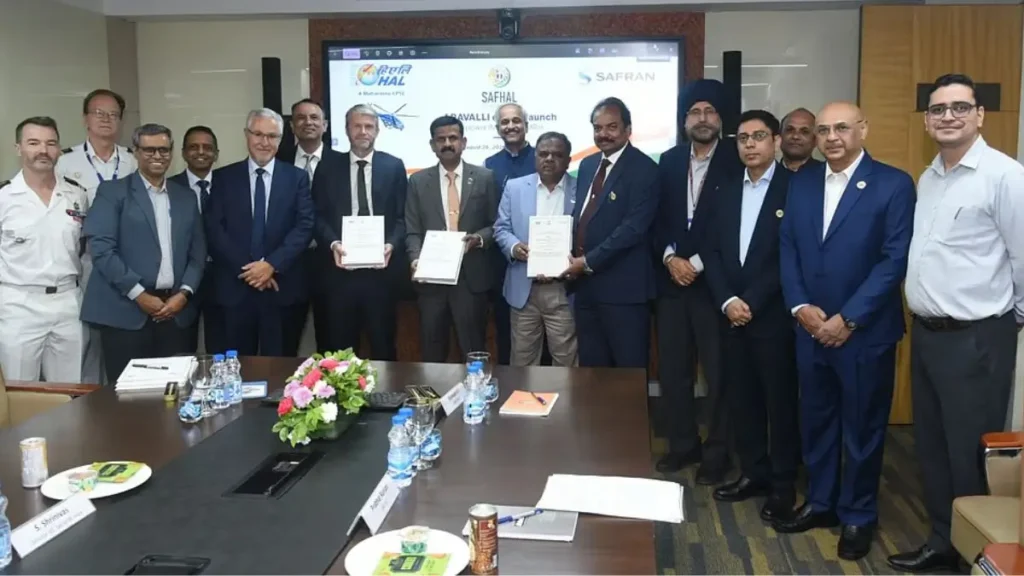
Aravalli helicopter engine deal: HAL and Safran have signed an agreement to develop a new engine for India’s future IMRH and DBMRH helicopter programmes.
India Takes a Major Step Towards Indigenous Helicopter Engine Development
Hindustan Aeronautics Limited (HAL) and Safran Helicopter Engines have signed a final agreement to jointly develop and manufacture the Aravalli helicopter engine, marking an important development for India’s defence and aerospace sector. The new-generation engine is expected to support India’s future military helicopter programmes and strengthen the country’s long-term capabilities in aero-engine technology.
The agreement is being implemented through SAFHAL Helicopter Engines Private Limited, a joint venture between HAL and Safran Helicopter Engines. The joint venture has been established for the design, development, certification, production, sales and life-cycle support of helicopter engines. The Aravalli engine programme represents a significant move towards building domestic capabilities in one of the most complex areas of aerospace technology.
Aravalli Engine to Power Future Indian Helicopters
The Aravalli engine is planned to power India’s proposed 13-tonne Indian Multi-Role Helicopter (IMRH) and its naval version, the Deck-Based Multi-Role Helicopter (DBMRH). These helicopter programmes are intended to meet future operational requirements of the Indian Armed Forces across land-based and maritime environments.
The development of a high-power engine is particularly significant because helicopter engines are critical strategic components that determine the aircraft’s performance, operational range, payload capability and reliability. Through the new programme, India aims to improve its technological capability in helicopter propulsion and reduce dependence on external sources for future defence requirements.
HAL and Safran Partnership Gains Strategic Importance
HAL is India’s leading aerospace and defence public sector undertaking and has been associated with the development and production of several aircraft and helicopters. Safran Helicopter Engines, meanwhile, brings extensive global expertise in helicopter propulsion systems. The partnership combines India’s manufacturing and aerospace experience with Safran’s engine technology and international expertise.
The collaboration between the two companies has been developing over several years. HAL and Safran had earlier agreed to establish a joint venture for the development of helicopter engines, particularly for future Indian helicopter programmes. The creation of SAFHAL Helicopter Engines Private Limited provided an institutional framework for cooperation in engine design, development, manufacturing and support.
Boost to Aatmanirbharta in Defence Manufacturing
The Aravalli helicopter engine programme is closely connected with India’s broader objective of achieving greater self-reliance in defence production. Indigenous development of critical defence technologies is important because aero-engines are among the most technologically demanding systems in the aerospace sector.
By developing advanced propulsion capabilities within India, the country can strengthen its domestic defence-industrial ecosystem. Such programmes can also create opportunities for Indian industries, suppliers, research institutions and skilled professionals to participate in the aerospace manufacturing chain.
The initiative may also contribute to the development of long-term technological expertise in areas such as engine design, testing, certification, manufacturing and maintenance.
Strategic Significance for India’s Armed Forces
Future multi-role helicopters will be important for a variety of military operations, including troop movement, logistics, disaster response and other specialised missions. The IMRH and DBMRH programmes are expected to support the requirements of India’s armed forces, including operations in diverse geographical and maritime conditions.
A domestically developed high-power helicopter engine can provide greater strategic flexibility for future aircraft programmes. It can also support the development of a stronger indigenous ecosystem for maintenance, repair and life-cycle support.
For government exam aspirants, the development is important from the perspective of defence technology, Aatmanirbhar Bharat, Make in India, defence manufacturing and India-France strategic cooperation.
Important Organisations and Exam Facts
HAL is a Maharatna Public Sector Undertaking under the Ministry of Defence. It plays a major role in the design, development, manufacture and maintenance of aerospace and defence platforms in India.
Safran Helicopter Engines is the helicopter propulsion business associated with the French aerospace and defence group Safran. The HAL-Safran collaboration demonstrates how international partnerships can support the development of advanced technologies while expanding domestic manufacturing capabilities.
The key projects associated with the new engine include the Indian Multi-Role Helicopter (IMRH) and the Deck-Based Multi-Role Helicopter (DBMRH). Aspirants preparing for UPSC, State PSC, defence examinations, banking examinations and other government recruitment tests should remember these names, as they may appear in questions related to current affairs and defence technology.
Why this News is Important
Strengthening Indigenous Defence Technology
The agreement between HAL and Safran is important because it focuses on the development of advanced helicopter engine technology, an area that requires significant technological expertise. Aero-engines are among the most complex components of military aviation, and developing domestic capability in this sector can strengthen India’s technological independence.
The Aravalli engine programme is therefore more than a manufacturing project. It represents an effort to build expertise in the complete ecosystem of helicopter engine development, including design, certification, production and life-cycle support.
Supporting the Aatmanirbhar Bharat Vision
India has been increasing its focus on indigenous defence manufacturing through initiatives such as Aatmanirbhar Bharat and Make in India. The development of critical technologies within the country can reduce external dependence and support the growth of domestic defence industries.
The programme is particularly relevant because propulsion technology is a strategically important part of aerospace development. A stronger domestic capability in helicopter engines can support future military and civil aerospace projects.
Importance for Future Military Modernisation
The proposed IMRH and DBMRH are expected to meet future requirements of India’s armed forces. A modern high-power engine can support the operational capability of these platforms across land and maritime environments.
The development is also important for the Indian Navy because the DBMRH is designed as a naval variant. This gives the project significance for India’s broader defence modernisation and maritime security requirements.
Significance for Competitive Examinations
For competitive examinations, this development is relevant under Defence Current Affairs, Science and Technology, International Relations and Government Initiatives. Students should remember the organisations involved, the name of the engine, the joint venture, and the helicopter platforms associated with the programme.
The news also provides an example of how international technological collaboration can support India’s domestic defence capabilities while contributing to long-term self-reliance.
Historical Context: Background of HAL-Safran Helicopter Engine Collaboration
Earlier Agreement Between HAL and Safran
HAL and Safran Helicopter Engines signed an agreement in 2022 to create a joint venture for developing helicopter engines. The collaboration was intended to support future Indian Defence helicopter programmes, including the 13-tonne Indian Multi-Role Helicopter.
This earlier agreement laid the foundation for deeper cooperation in engine design, development, manufacturing and support. The partnership reflected India’s growing emphasis on developing advanced aerospace technologies through a combination of domestic capability and international collaboration.
Formation of SAFHAL Helicopter Engines
The joint venture, SAFHAL Helicopter Engines Private Limited, was incorporated in 2023. According to HAL’s joint venture information, the company was established for the design, development, certification, production, sale and life-cycle support of helicopter engines.
HAL holds a majority stake of 50.5%, while Safran Helicopter Engines holds 50% in the joint venture structure listed by HAL. The creation of the company provided a dedicated platform for developing engines for future helicopter programmes.
HAL’s Long Experience in Aero-Engine Development
HAL has a long history in aero-engine production and maintenance. Its Engine Division in Bengaluru was established in 1956, and the division has worked with international aerospace companies in the production, maintenance and overhaul of various aero-engines.
Over the decades, HAL has also expanded its involvement in the manufacturing and maintenance of engines and aerospace components. The Aravalli engine programme therefore builds upon an existing foundation of aerospace manufacturing and international technology collaboration.
Evolution of India’s Indigenous Defence Manufacturing
India’s defence manufacturing strategy has increasingly focused on reducing dependence on imports and developing domestic capabilities in strategically important technologies. Indigenous aircraft, helicopters, missiles, naval systems and other defence platforms have received increasing policy attention.
The HAL-Safran Aravalli engine programme should be viewed in this broader context of strengthening India’s domestic aerospace ecosystem and developing greater technological capability in critical defence sectors.
Key Takeaways from Aravalli Helicopter Engine Deal
| S. No. | Key Takeaway |
|---|---|
| 1 | HAL and Safran Helicopter Engines have finalized an agreement to jointly develop and manufacture the Aravalli helicopter engine. |
| 2 | The programme is being undertaken through the HAL-Safran joint venture, SAFHAL Helicopter Engines Private Limited. |
| 3 | The Aravalli engine is intended to power the proposed 13-tonne Indian Multi-Role Helicopter (IMRH). |
| 4 | The engine will also support the naval Deck-Based Multi-Role Helicopter (DBMRH). |
| 5 | The project is important for Aatmanirbhar Bharat, indigenous defence manufacturing and the development of domestic aerospace propulsion capability. |
FAQs
1. What is the Aravalli helicopter engine?
The Aravalli helicopter engine is a new-generation engine being jointly developed by Hindustan Aeronautics Limited (HAL) and Safran Helicopter Engines for India’s future helicopter programmes.
2. Which companies have signed the agreement for the Aravalli engine?
Hindustan Aeronautics Limited (HAL) and Safran Helicopter Engines have signed the agreement for the joint development and manufacturing of the Aravalli helicopter engine.
3. What is SAFHAL Helicopter Engines Private Limited?
SAFHAL Helicopter Engines Private Limited is the joint venture between HAL and Safran Helicopter Engines established for the design, development, certification, production, sales and life-cycle support of helicopter engines.
4. Which helicopter will be powered by the Aravalli engine?
The Aravalli engine is being developed for India’s proposed Indian Multi-Role Helicopter (IMRH), a future multi-role military helicopter programme.
5. What is the weight category of the IMRH?
The proposed Indian Multi-Role Helicopter (IMRH) is a 13-tonne class helicopter.
6. What is DBMRH?
DBMRH stands for Deck-Based Multi-Role Helicopter. It is the naval version associated with India’s future multi-role helicopter programme.
7. Why is the Aravalli engine important for India?
The project is important because it aims to strengthen India’s domestic capability in helicopter engine technology, which is one of the most technologically complex areas of aerospace engineering.
8. How is the project linked to Aatmanirbhar Bharat?
The programme supports the Aatmanirbhar Bharat vision by promoting indigenous development, manufacturing and technological capability in the defence and aerospace sector.
9. Which country is Safran associated with?
Safran is a major aerospace and defence company associated with France.
10. Under which ministry does HAL function?
HAL functions under the Ministry of Defence, Government of India.
Some Important Current Affairs Links

