
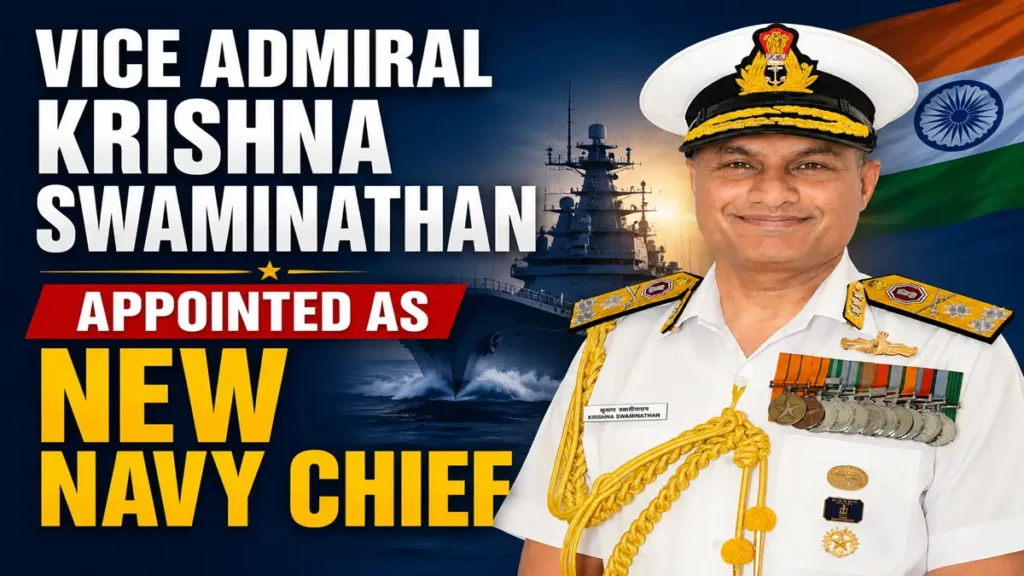
Vice Admiral Krishna Swaminathan appointment as new Indian Navy Chief 2026 highlights India’s maritime security strategy, naval modernization, Western Naval Command leadership, and defence current affairs important for UPSC, SSC, Banking, Railways, NDA, CDS, and State PSC exams.
Vice Admiral Krishna Swaminathan Appointed as New Navy Chief
Leadership Change in the Indian Navy
The Government of India has appointed Vice Admiral Krishna Swaminathan as the next Chief of the Naval Staff (CNS). He will succeed Admiral Dinesh Kumar Tripathi, who is scheduled to retire on May 31, 2026. The appointment marks an important leadership transition in the Indian Navy at a time when India is strengthening its maritime security and naval preparedness in the Indian Ocean Region.
Distinguished Naval Career
Vice Admiral Krishna Swaminathan was commissioned into the Indian Navy on July 1, 1987. He is a specialist in Communication and Electronic Warfare and has nearly four decades of service experience. During his long naval career, he has handled operational, administrative, and strategic responsibilities in different capacities.
He is an alumnus of prestigious defence institutions such as the National Defence Academy, Joint Services Command and Staff College in the United Kingdom, College of Naval Warfare in Karanja, and the United States Naval War College in Rhode Island. His training and international exposure are considered important for India’s evolving maritime strategy.
Major Commands and Responsibilities
Before being appointed Navy Chief, Vice Admiral Swaminathan served as the Flag Officer Commanding-in-Chief of the Western Naval Command, one of the Indian Navy’s most strategically significant commands. He assumed this responsibility in July 2025.
He has commanded several important naval platforms, including missile vessels, missile corvettes, guided missile destroyers, and the aircraft carrier INS Vikramaditya. These command assignments gave him extensive operational experience in maritime warfare and naval operations.
Vice Admiral Swaminathan has also served as Vice Chief of the Naval Staff and Chief of Personnel in the Indian Navy. His experience in human resource management and operational planning is expected to help the Navy modernize its capabilities and improve combat readiness.
Awards and Achievements
For his distinguished service to the nation, Vice Admiral Swaminathan has received several prestigious military honours, including the Param Vishisht Seva Medal (PVSM), Ati Vishisht Seva Medal (AVSM), and Vishisht Seva Medal (VSM). These awards are given for exceptional service in the armed forces.
Importance for India’s Maritime Security
India’s maritime interests are expanding rapidly because of growing trade routes, regional security concerns, and increasing Chinese naval presence in the Indian Ocean Region. The appointment of an experienced officer like Vice Admiral Swaminathan is seen as important for strengthening India’s naval strategy and ensuring operational preparedness.
The Indian Navy is currently focusing on indigenisation, modernization of warships, submarine capability enhancement, and maritime surveillance. Under the new leadership, these strategic priorities are expected to continue with greater emphasis on self-reliance and technological advancement.

Why This News is Important
Important for Defence and Security Exams
The appointment of a new Navy Chief is highly relevant for candidates preparing for defence-related competitive examinations such as NDA, CDS, AFCAT, CAPF, and civil services examinations. Questions related to important military appointments are frequently asked in current affairs sections.
Significance in India’s Maritime Strategy
India’s strategic focus on the Indian Ocean Region has increased in recent years due to rising geopolitical tensions and maritime competition. The Navy Chief plays a major role in planning naval operations, strengthening maritime diplomacy, and ensuring coastal security. Therefore, leadership changes in the Navy are important from both strategic and examination perspectives.
Focus on Modernization and Indigenisation
The Indian Navy is working on several modernization projects, including indigenous aircraft carriers, submarines, anti-submarine warfare systems, and unmanned technologies. A capable and experienced Navy Chief is essential for implementing these initiatives effectively. Students preparing for government examinations should understand the importance of India’s naval modernization efforts and their role in national security.
Frequently Asked Topic in Current Affairs
Appointments of chiefs of the Army, Navy, Air Force, and Chief of Defence Staff are common topics in banking, railways, SSC, teaching, police, and UPSC examinations. Candidates should remember the names, positions, and responsibilities associated with these appointments.
Historical Context
Evolution of the Indian Navy
The Indian Navy traces its origins to the Royal Indian Navy during British rule. After independence in 1947, it evolved into a modern maritime force responsible for safeguarding India’s coastal boundaries and maritime interests.
Over the decades, the Indian Navy has played a major role in wars, humanitarian operations, anti-piracy missions, and disaster relief activities. India’s naval capabilities have significantly expanded with the induction of aircraft carriers, submarines, destroyers, and indigenous warships.
Importance of the Chief of Naval Staff
The Chief of Naval Staff is the highest-ranking officer in the Indian Navy and is responsible for operational command, modernization planning, and strategic decision-making. The Navy Chief also advises the Government of India on maritime defence matters and national security issues.
Previous Navy Chiefs have played major roles in expanding India’s blue-water naval capability and strengthening India’s position in the Indo-Pacific region.
India’s Growing Maritime Focus
India’s maritime focus has increased due to strategic developments in the Indo-Pacific and growing Chinese naval activity in the Indian Ocean. The Indian Navy has been strengthening partnerships with countries such as the United States, Japan, Australia, and France under various maritime cooperation initiatives.
The appointment of Vice Admiral Krishna Swaminathan comes at a crucial time when India is emphasizing maritime security, naval modernization, and self-reliance in defence production.
Key Takeaways from This News
| S.No. | Key Takeaway |
|---|---|
| 1 | Vice Admiral Krishna Swaminathan has been appointed as the new Chief of the Naval Staff of India. |
| 2 | He will succeed Admiral Dinesh Kumar Tripathi, who retires on May 31, 2026. |
| 3 | He is a specialist in Communication and Electronic Warfare and was commissioned into the Indian Navy in 1987. |
| 4 | He previously served as the Flag Officer Commanding-in-Chief of the Western Naval Command. |
| 5 | His appointment is important for India’s maritime security and naval modernization efforts. |
FAQs Related to Vice Admiral Krishna Swaminathan Appointment
1. Who has been appointed as the new Chief of the Naval Staff of India?
Vice Admiral Krishna Swaminathan has been appointed as the new Chief of the Naval Staff (CNS) of the Indian Navy.
2. Whom will Vice Admiral Krishna Swaminathan succeed?
He will succeed Admiral Dinesh Kumar Tripathi as the Navy Chief.
3. When was Vice Admiral Krishna Swaminathan commissioned into the Indian Navy?
He was commissioned into the Indian Navy on July 1, 1987.
4. What is the specialty of Vice Admiral Krishna Swaminathan?
He is a specialist in Communication and Electronic Warfare.
5. Which important command did Vice Admiral Swaminathan head before this appointment?
Before becoming the Navy Chief, he served as the Flag Officer Commanding-in-Chief of the Western Naval Command.
6. What is the role of the Chief of Naval Staff?
The Chief of Naval Staff is the highest-ranking officer in the Indian Navy and is responsible for operational command, modernization, maritime strategy, and naval preparedness.
7. Which awards have been conferred upon Vice Admiral Krishna Swaminathan?
He has received the Param Vishisht Seva Medal (PVSM), Ati Vishisht Seva Medal (AVSM), and Vishisht Seva Medal (VSM).
8. Why is this appointment important for India?
The appointment is important because India is focusing on maritime security, naval modernization, and strengthening its presence in the Indo-Pacific region.
9. Which region is strategically important for the Indian Navy?
The Indian Ocean Region (IOR) is strategically very important for India’s maritime security and trade routes.
10. For which competitive exams is this news important?
This news is important for UPSC, SSC, Banking, Railways, Defence exams (NDA, CDS, AFCAT), State PSCs, Police, and teaching examinations.
Some Important Current Affairs Links

