
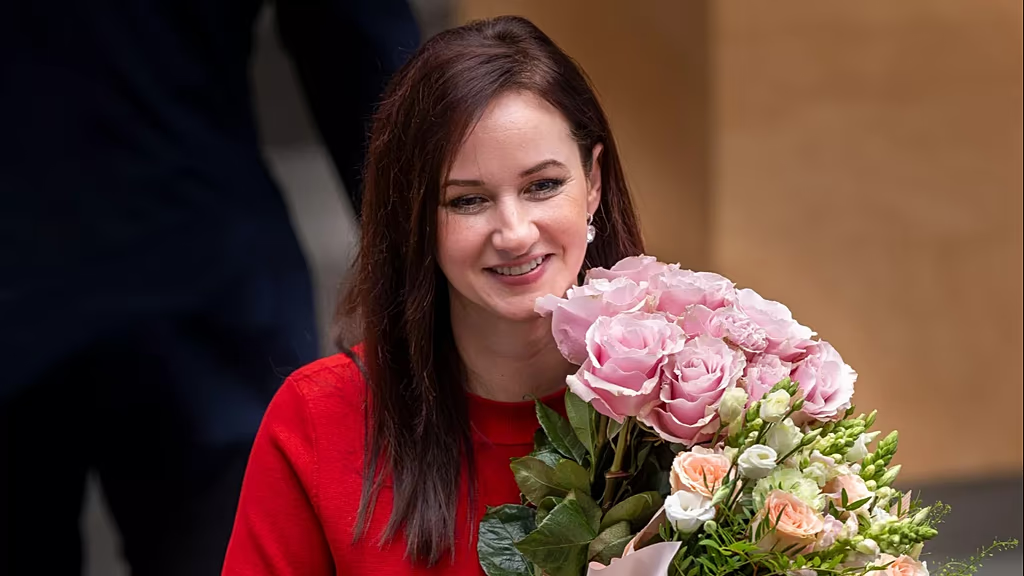
Inga Ruginienė appointed Lithuania Prime Minister 2025 after Gintautas Paluckas resignation. Know key facts, challenges, coalition, and foreign policy updates.
Inga Ruginienė Appointed as Lithuania’s New Prime Minister
On August 26, 2025, Inga Ruginienė was elected as Lithuania’s new Prime Minister by the Seimas (Lithuanian Parliament), following the resignation of her predecessor, Gintautas Paluckas, amid corruption investigations. Ruginienė, a former labor union leader and relative newcomer to politics, secured 78 votes in favor and 35 against, with 14 abstentions. Her appointment marks a significant shift in Lithuania’s political landscape.
Background and Political Journey
Born on May 24, 1981, in Trakai, Lithuania, Ruginienė graduated from Vilnius University in 2005. She began her career as a public health specialist and later served as the Vilnius region director for the company “S Stata.” In 2018, she became the chairwoman of the Lithuanian Trade Union Confederation, a position she held until 2024. In the 2024 parliamentary elections, Ruginienė joined the Social Democratic Party of Lithuania (LSDP) and was elected to the Seimas. She subsequently served as the Minister of Social Security and Labour under Prime Minister Gintautas Paluckas.
Resignation of Gintautas Paluckas
In July 2025, Gintautas Paluckas resigned as Prime Minister following media investigations into his business dealings, which led to corruption inquiries by law enforcement agencies. The resignation prompted the LSDP to nominate Ruginienė as their candidate for Prime Minister. President Gitanas Nausėda endorsed her nomination, praising her as a “constructive negotiator who seeks compromise.”
Coalition Government and Policy Directions
Following her election, Ruginienė formed a new center-left coalition with two junior partners, securing a solid majority in the 141-seat Seimas. She has pledged to restore government stability and uphold voter trust. Foreign policy is expected to remain unchanged, with continued strong support for Ukraine amid Russian aggression. Lithuania, an EU and NATO member, remains strategically significant on the alliance’s eastern flank.
Challenges Ahead
Despite the parliamentary approval, Ruginienė faces challenges in maintaining political stability. Protests have erupted against the new government, with organizers accusing it of including politicians who oppose sanctions against Russia and Belarus, as well as anti-vaccine campaigners. Ruginienė’s ability to navigate these challenges will be crucial for the success of her administration.
Why This News Is Important
Political Stability in Lithuania
The appointment of Inga Ruginienė as Prime Minister is a significant development in Lithuania’s political landscape. Her election aims to restore stability following the resignation of her predecessor amid corruption investigations. This transition reflects the country’s commitment to democratic processes and governance.
Implications for EU and NATO Relations
As a member of both the European Union and NATO, Lithuania’s foreign policy plays a pivotal role in regional security. Ruginienė’s administration is expected to continue supporting Ukraine in its conflict with Russia, aligning with EU and NATO positions. This continuity ensures Lithuania’s active participation in international diplomatic efforts.
Economic and Social Policy Directions
Ruginienė’s background in labor unions and social affairs positions her to address economic and social issues effectively. Her focus on restoring government stability and upholding voter trust suggests a commitment to policies that promote social welfare and economic equity.
Challenges to Democratic Institutions
The protests against the new government highlight challenges to democratic institutions and public trust. Addressing these concerns will be essential for Ruginienė’s administration to maintain legitimacy and public support.
Regional Security Concerns
Lithuania’s strategic location on the eastern flank of NATO makes its security policies critical to regional stability. Ruginienė’s administration’s approach to defense and foreign relations will influence the broader security dynamics in Eastern Europe.
Historical Context
Lithuania, a Baltic state, regained its independence from the Soviet Union in 1990. Since then, it has been a member of various international organizations, including the European Union and NATO. The country has faced numerous challenges, including economic transitions and security concerns due to its proximity to Russia. The resignation of Prime Minister Gintautas Paluckas in 2025 marked a significant moment in Lithuanian politics, leading to the appointment of Inga Ruginienė as the new head of government.
Key Takeaways from “Inga Ruginienė Appointed as Lithuania’s New Prime Minister”
| S.No | Key Takeaway |
|---|---|
| 1 | Inga Ruginienė was elected as Lithuania’s Prime Minister on August 26, 2025. |
| 2 | She secured 78 votes in favor and 35 against in the Seimas. |
| 3 | Ruginienė has pledged to restore government stability and uphold voter trust. |
| 4 | She formed a new center-left coalition with two junior partners. |
| 5 | Protests have erupted against the new government, citing concerns over its composition. |
FAQs: Frequently Asked Questions
1. Who is Inga Ruginienė?
Inga Ruginienė is a Lithuanian politician and former labor union leader who was appointed as Lithuania’s Prime Minister on August 26, 2025.
2. When was Inga Ruginienė elected as Prime Minister?
She was elected on August 26, 2025, by the Seimas, Lithuania’s parliament.
3. Why did the previous Prime Minister Gintautas Paluckas resign?
Gintautas Paluckas resigned amid corruption investigations following media reports regarding his business dealings.
4. Which party does Inga Ruginienė belong to?
She is a member of the Social Democratic Party of Lithuania (LSDP).
5. What are the main challenges facing Ruginienė’s government?
Her government faces protests and public criticism, mainly regarding coalition partners opposed to sanctions against Russia and Belarus, and other controversial policies.
6. How is Lithuania’s foreign policy expected to change under Ruginienė?
Lithuania is expected to continue its strong support for Ukraine in the ongoing conflict with Russia and maintain alignment with EU and NATO positions.
7. What is the significance of her appointment for students preparing for exams?
This news highlights recent European political developments, democratic governance, foreign policy, and leadership transitions, all of which are relevant for general knowledge and current affairs sections in government exams.
Some Important Current Affairs Links

